

More news on this day
Rapidly shifting battle lines in the 2026 Iran war have cascaded into the skies, forcing Gulf airlines to slash schedules, reroute long-haul traffic and quietly rewrite the rules of their lucrative loyalty programmes.
Get the latest news straight to your inbox!
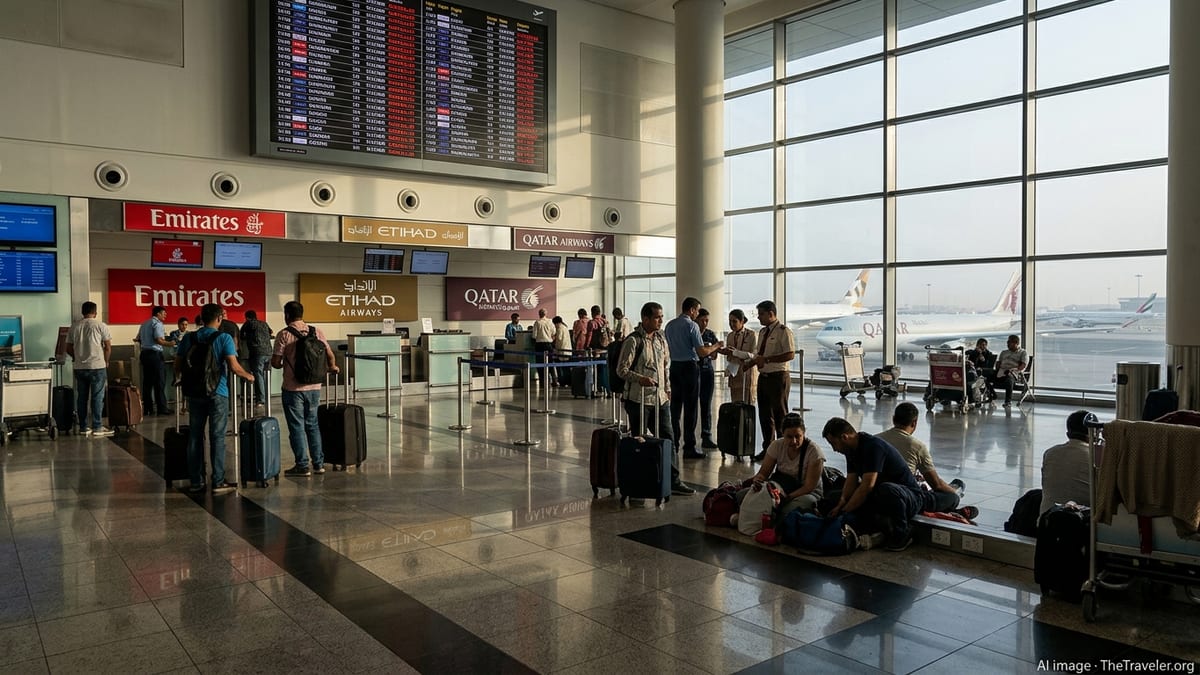
Airspace Closures Turn Gulf Hubs into Bottlenecks
The coordinated strikes involving Iran, the United States and Israel that began on 28 February 2026 triggered sweeping airspace closures from Iraq and Iran to Qatar, Bahrain and the United Arab Emirates. Publicly available data on flight paths and traffic flows indicates that some of the world’s busiest corridors between Europe, Asia and Africa have been forced to skirt the region, adding hours to journeys and pushing up fuel costs.
Analyses of the conflict’s economic impact suggest that airspace restrictions and damage to infrastructure have removed a significant share of global capacity almost overnight, with multiple Gulf airports handling a sizeable portion of worldwide connecting traffic either closed or operating on a heavily curtailed basis. Reports describe widespread diversions, mass cancellations and large numbers of passengers stranded at or en route to Dubai, Abu Dhabi and Doha.
Specialist aviation trackers and travel advisories describe a patchwork of operations. Emirates and Etihad have restored limited networks from Dubai and Abu Dhabi to dozens of destinations, often prioritising point to point traffic and tightly controlled connections, while Qatar Airways remains largely confined to repatriation flights from select European cities. Regional gateways such as Muscat in Oman have emerged as alternative staging posts for airlines trying to bypass the most volatile airspace.
For travellers, the practical effect is that the traditional Gulf super-connector model has been interrupted. It has become harder to rely on a single, seamless stop in Dubai, Abu Dhabi or Doha on routes between Australia, South Asia and Europe, and many journeys now involve unfamiliar hubs, longer routings and tighter rebooking windows.
Loyalty Programmes Move from Status Chase to Damage Control
As aircraft are grounded and schedules torn up, Gulf carriers are using their loyalty schemes as a frontline tool for customer retention. Public communications from frequent flyer teams and customer emails shared online indicate that Etihad Guest has reduced the number of Tier Miles or Tier Segments required to attain or renew status by roughly a quarter, signalling an acknowledgement that normal flying patterns have become impossible for many members.
Travel points analysts also note that Emirates Skywards has recently pushed through a restructuring of partner award charts, moving to a distance based model for many external airlines. Early independent analysis points to materially lower mileage prices on a range of short haul and regional partner flights, turning the programme into a more attractive option for members looking to stitch together complex reroutes that avoid sensitive airspace.
At the same time, longer term shifts predating the current war are colliding with the crisis. Emirates has already tightened access to its most coveted First Class awards by limiting many of them to elite Skywards members, and major bank transfer partners have reduced transfer ratios into Skywards. Observers argue that these changes now sit uncomfortably alongside appeals for passenger loyalty during a period of heavy disruption.
For Qatar Airways Privilege Club members, generous status matches and transfer bonuses in recent years are now being tested against an almost fully suspended network. Travel blogs and loyalty forums describe a growing disconnect between elite benefits on paper and the practical reality of using those perks when the underlying flights are not operating at scale.
Waivers, Refunds and Award Tickets Under Extraordinary Strain
With war officially excluded as a covered reason in many travel insurance policies, much of the financial burden from disrupted trips has shifted to airline waiver policies and loyalty programme rules. Publicly available fare notices and waiver bulletins from Gulf carriers outline rolling change fee waivers, extended rebooking periods and, in some cases, options to convert cancelled itineraries into open tickets valid well into late 2026.
For cash tickets, this usually means that passengers can move their journeys to later dates or different destinations on the same airline without paying change fees, although fare differences often still apply. Where flights are fully cancelled, airlines are generally offering full refunds back to the original form of payment, but processing times can be lengthy given the scale of disruption.
Award tickets are proving more complicated. Reports from frequent flyer communities indicate that miles from cancelled redemptions are typically being returned to accounts, yet the real difficulty lies in finding replacement seats at similar mileage levels on alternative routings. Because many Gulf carriers prioritise their own loyalty members over partners for scarce premium cabin award space, travellers holding partner-issued award tickets to or via the region are frequently being referred back to the original issuing programme for help.
Observers also point out that airlines are becoming more cautious about opening up new award inventory while schedules remain fluid. This has led to a surge in last minute searches and a premium on flexibility, as travellers willing to depart from or arrive in secondary cities, or to mix cabins, sometimes have better chances of salvaging a disrupted trip using miles.
How Travellers Can Reassess Strategy in the Gulf Loyalty Wars
For years, Gulf airline loyalty programmes have been built on the promise of reliable one stop access between almost any two points on the globe, with aspirational premium cabins as the marquee reward. The Iran war has exposed how quickly that value proposition can change when the geographic heart of these networks becomes a conflict zone.
Travel rewards specialists increasingly recommend that flyers diversify across multiple programmes rather than anchoring all of their plans to a single Gulf carrier. Flexible bank points that can be transferred to several alliances, combined with at least one backup programme in each major region, can make it easier to pivot when a particular hub or carrier becomes inaccessible for reasons beyond the airline’s control.
At the elite status level, the temporary easing of qualification thresholds at some Gulf airlines is creating opportunities for travellers who still need to fly through the region and are willing to consolidate trips during the crisis. However, many experienced flyers caution that status decisions should be based on concrete benefits that can be used in the next 12 to 18 months, not only on emotional loyalty to a brand whose network map is currently in flux.
For leisure travellers, the most pragmatic approach may involve focusing less on maximising miles and more on securing the most straightforward and resilient itinerary. That can mean opting for longer nonstops on non Gulf carriers, accepting a less glamorous onboard product, or using miles for hotels and ground transport instead of insisting on premium cabin flights through an active conflict zone.
What to Watch Next in the Region’s Loyalty Landscape
The trajectory of Gulf airline loyalty programmes over the coming months will largely depend on the conflict’s duration and the pace at which airspace and airport operations normalise. Industry analysts are monitoring upcoming schedule filings and seasonal timetables for signs that airlines expect a return to prewar routing patterns, as well as any additional adjustments to earning rates, elite thresholds or partner award pricing.
Credit card partnerships are another critical variable. Transfer ratios, sign up bonuses and co branded card perks can be adjusted relatively quickly, and there is precedent for banks to recalibrate exposure to a particular airline when network reliability deteriorates. Any fresh devaluations or incentive offers tied to Gulf carrier cards will offer clues about how both airlines and financial institutions are assessing long term risk in the region.
On the passenger side, sentiment expressed in public forums shows a mix of frustration at perceived inflexibility during cancellations and a pragmatic belief that price and convenience will eventually win out once the conflict subsides. Many frequent travellers state that they are already exploring status matches with non Gulf carriers while keeping a close eye on whether Emirates, Etihad and Qatar use this crisis to rebuild trust through more transparent and traveller friendly loyalty policies.
Until airspace stabilises, loyalty in the Gulf will be defined less by aspirational redemptions and more by how programmes handle reroutes, refunds and elite treatment in a time of exceptional stress. For travellers, staying informed about policy updates and being willing to shift allegiance may prove as valuable as any mileage balance.