

More news on this day
Thousands of passengers across the Middle East and Europe remain stranded as sweeping airspace restrictions and security disruptions in the Gulf region trigger the cancellation of at least 241 flights and delays to more than 130 services, affecting routes through the United Arab Emirates, Oman, Bahrain, Qatar, Kuwait and beyond.
Get the latest news straight to your inbox!
Regional Airspace Closures Ripple Across Major Hubs
Publicly available data from aviation trackers and government notices show that a series of airspace closures and operating restrictions across the Gulf has sharply curtailed commercial traffic since late February 2026. The United Arab Emirates, Bahrain, Qatar and Kuwait have all imposed varying levels of limits on overflights and arrivals, while Oman and Saudi Arabia have been handling diversions and additional traffic on alternative corridors.
These restrictions follow escalated regional tensions and missile and drone strikes that have targeted infrastructure in and around key aviation hubs. Airports serving Dubai and Abu Dhabi in the UAE and Doha in Qatar have been operating on reduced schedules, with a focus on repatriation, cargo and emergency movements rather than regular commercial frequencies. Industry analyses indicate that the cumulative effect has been thousands of cancellations across the wider Middle East, with at least 241 flights scrubbed and 138 delayed in the current wave alone.
Because of limited airspace corridors and the need to keep aircraft and crew within defined safety perimeters, many international services that would typically use the Gulf as a transit point have either been suspended or rerouted further south over the Arabian Sea and Red Sea. This has added significant time to journeys connecting Europe, Asia and Africa, and has created bottlenecks at alternative hubs where capacity is already stretched.
Operational bulletins from several airlines describe a constantly shifting picture in which flight permissions can change with little notice. Schedules that appear active one day can be pulled back the next, leaving passengers with confirmed tickets suddenly grounded and scrambling for alternatives.
Gulf Air, Emirates and Flydubai Face Severe Disruption
The largest impacts are evident among carriers whose business models rely heavily on dense connecting traffic through the Gulf. Published updates and airline communications show that Bahrain-based Gulf Air has been among the hardest hit, with its operations repeatedly curtailed by airspace constraints around its home hub. The airline has cancelled large portions of its schedule, leaving many passengers to seek alternative routings through Saudi Arabian airports or to postpone travel altogether.
Dubai-based Emirates and Flydubai have also experienced sweeping disruption. After damage and security incidents around Dubai International Airport, Emirates initially suspended many services before gradually introducing a skeleton schedule of repatriation and limited commercial flights. Flydubai, which serves a mix of regional and medium-haul destinations, has similarly trimmed frequencies and prioritised routes considered essential for returning residents and facilitating onward connections.
These reductions have hit popular corridors especially hard, including services between the Gulf and European cities such as Paris, Amsterdam and Athens, as well as busy regional links to Riyadh and Jeddah in Saudi Arabia. In several cases, passengers report that multiple rebooked flights were subsequently cancelled, fuelling uncertainty and lengthening time spent in transit zones or temporary accommodation near airports.
Operational data suggests that while some Emirates and Flydubai routes are now running on reduced timetables, overall seat capacity through Dubai and other Gulf hubs remains far below normal March levels. The result is a shortage of available seats even when flights are operating, driving up load factors on the few services that do depart.
European Carriers Cut Back on Gulf and Middle East Links
The disruption is not limited to Gulf-based airlines. European carriers including Air France and KLM have revised their schedules on routes touching the Middle East, in some cases suspending flights altogether for defined periods. Public timetables and airline advisories indicate that services connecting Paris and Amsterdam with Doha, Dubai, Riyadh and Jeddah have been among those affected.
For some routes, aircraft that would normally overfly Gulf airspace have been rerouted via southern detours, adding flight time and increasing fuel burn. On other routes, airlines have opted to cancel outright, citing airspace uncertainty and evolving risk assessments. These changes have contributed to the tally of at least 241 cancellations and 138 delays related to the current disruption pattern.
Passengers travelling from European gateways to destinations further east, including South and Southeast Asia, have been particularly affected when their itineraries relied on Gulf transits. With hubs in the UAE and Qatar operating on limited schedules and Bahrain heavily impacted, travellers have been pushed toward alternative connection points in Turkey, Egypt and southern Europe, where available capacity is also finite.
Airports such as Paris Charles de Gaulle and Athens International have reported knock-on delays as they accommodate late-arriving and rescheduled aircraft, as well as clusters of stranded passengers attempting to rebook onto indirect routings that bypass the Gulf entirely.
Riyadh, Doha, Jeddah, Paris and Athens See Stranded Crowds
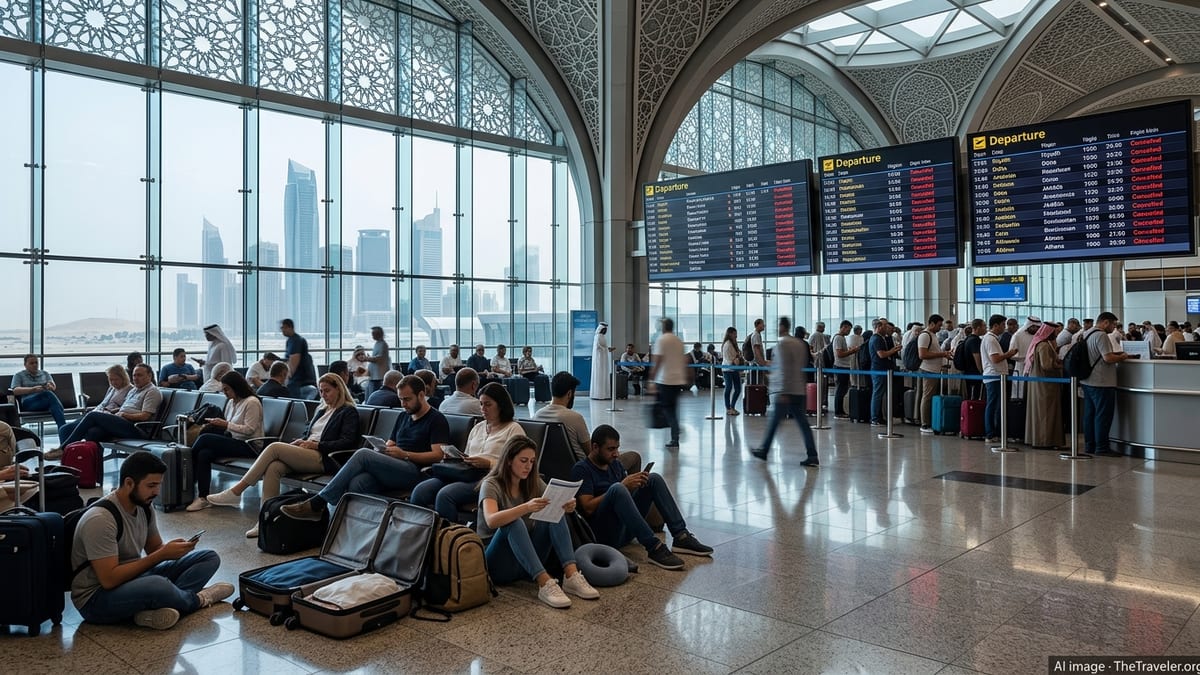
At ground level, images and accounts from Riyadh, Doha, Jeddah, Paris and Athens describe crowded terminals, long queues at airline counters and information boards dominated by red cancellation markers. Publicly shared photographs from Hamad International Airport in Doha and Dubai International Airport depict passengers resting on benches and floors while awaiting clarity on outbound flights.
In Saudi Arabia, Riyadh and Jeddah have become key pressure points in the regional network. With some carriers rerouting via Saudi hubs to avoid more heavily restricted airspace, passenger volumes have risen even as available flights remain constrained. This has led to reports of long waiting times for rebooking and limited hotel availability close to airports.
In Europe, Paris and Athens have served as both gateways and holding points for travellers whose onward Gulf-bound or Gulf-transiting flights were cancelled. Some have opted to remain in Europe while they wait for more stable conditions in the Middle East, while others are piecing together complex multi-leg itineraries that may involve surface travel and multiple airline changes.
Travel advisories from governments and consumer organisations are urging passengers to verify flight status repeatedly on the day of travel and to build in significant extra time for connections, particularly if itineraries still involve overflying or transiting the affected Gulf states.
Uncertain Outlook as Airlines Gradually Adjust Schedules
Despite the scale of the disruption, there are signs that airlines and aviation authorities are beginning to adjust to a prolonged period of constrained operations. Schedules published for late March 2026 show some carriers tentatively adding back a limited number of flights to and from Doha and Dubai, often labelled as interim or emergency timetables.
Qatar Airways and other Gulf carriers are starting to advertise restricted networks that prioritise key regional capitals and major long-haul destinations such as Paris and Athens, while maintaining tight limits on overall frequencies. These partial resumptions are heavily dependent on continued access to defined safe corridors and could be scaled back again if the security assessment deteriorates.
For now, publicly available industry forecasts suggest that travellers should expect ongoing volatility in the region’s air services, with the potential for additional cancellations and delays at short notice. Airlines continue to encourage passengers to accept travel vouchers, flexible rebooking options or rerouting via alternative hubs when direct Gulf connections are not feasible.
With thousands of people still working to reach home or onward destinations, the disruption has underlined how central Gulf hubs have become to global travel flows. Until airspace restrictions ease more substantially across the UAE, Oman, Bahrain, Qatar, Kuwait and neighbouring states, the network impact is likely to remain visible from Riyadh and Jeddah to Paris, Amsterdam and Athens.