

More news on this day
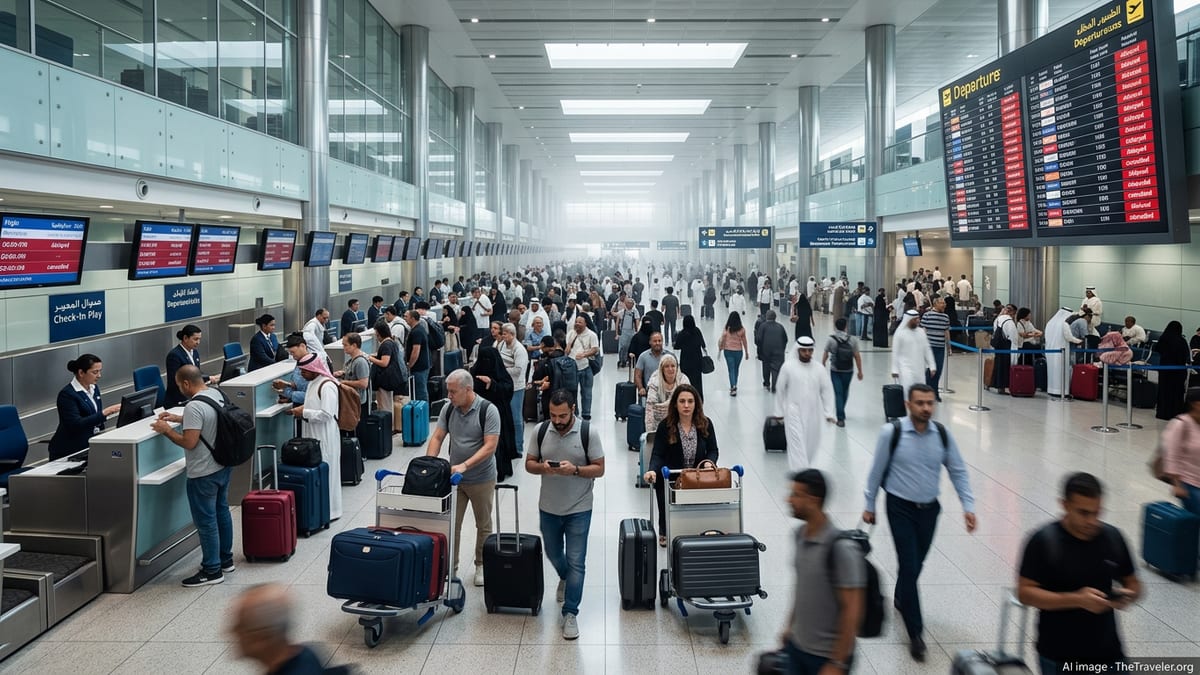
Major air hubs across the Gulf struggled to restore normal operations on March 8 as rolling airspace closures, conflict-related security concerns and damaged airport infrastructure triggered widespread delays, cancellations and last-minute rerouting for hundreds of thousands of passengers.
Rolling Airspace Closures Keep Key Hubs Under Strain
By March 8, much of the Gulf’s skies remained a patchwork of closures, partial reopenings and tightly controlled corridors following more than a week of conflict-driven missile and drone activity across the region. Authorities in several states continued to treat their airspace as an active security zone, authorizing only limited movements and reserving the right to shut routes with little notice.
Bahrain’s airspace remained among the most restricted. With Bahrain International Airport still closed and its airspace shut, national carrier Gulf Air’s scheduled passenger operations were effectively grounded, forcing mass rebookings and leaving many travelers reliant on regional detours through Saudi Arabia or the United Arab Emirates where possible. Travel agents in the region reported customers repeatedly re-ticketed as tentative routings collapsed when new security notices were issued.
The disruptions were not confined to airports directly hit or threatened in the latest strikes. Carriers that depend on Gulf airspace for east–west connections, including major European and Asian airlines, continued to avoid large swaths of the region, adding hours to flight times or canceling services outright where detours were impractical. The result was a global knock-on effect, with delays rippling through networks far beyond the Middle East.
Even in countries where restrictions were easing, authorities warned that operations would remain fragile as long as the broader regional conflict continued, keeping air traffic managers on high alert and leaving schedules subject to rapid revision.
Passengers Face Cancellations, Long Delays and Patchwork Evacuation Options
For passengers, the March 8 picture was one of uncertainty and improvisation. Stranded travelers across the Gulf reported overnight stays in transit hotels, lengthy queues at service desks and rapidly shifting information about when and how they could leave. In some cases, travelers saw multiple onward connections canceled in succession as airspace restrictions were extended or reimposed.
With Bahrain out of action and Qatar and parts of the United Arab Emirates only cautiously reopening corridors, some foreign governments and airlines prioritized evacuation-style services. Limited repatriation and relief flights operated from hubs such as Doha and select Emirati airports, aimed at clearing backlogs of transit passengers who had been stuck for days. Seats on those flights were in high demand, with priority often given to citizens traveling on government-coordinated manifests.
Alternative routings through Saudi Arabia and Oman provided a partial release valve, particularly for South and Southeast Asian travelers trying to reach home. However, those options remained constrained by crew duty limits, aircraft positioning issues and the risk that new security advisories could suddenly close a corridor. Travel agencies reported that some passengers elected to travel overland within the Gulf to reach an airport still operating a limited schedule, only to encounter fresh cancellations on arrival.
Industry analysts warned that even passengers far from the region should expect continuing disruption, particularly on itineraries that normally connect through Dubai, Abu Dhabi or Doha. Missed connections, rolling delays and aircraft out of position in global fleets have combined to strain airlines’ ability to recover their schedules quickly.
Airlines Balance Safety, Schedules and Soaring Operational Costs
Airlines operating in and around the Gulf spent March 8 juggling safety imperatives with mounting commercial pressures. Many carriers continued to maintain suspensions on routes that crossed contested or recently targeted airspace, rerouting flights around the Arabian Peninsula at substantial additional fuel and crew cost.
Gulf-based carriers that typically dominate long-haul transit traffic adopted a patchwork approach, resuming select services where authorities had certified corridors as safe while keeping other links suspended. Some airlines announced that they were operating a fraction of their usual daily departures, focusing on key trunk routes to Europe, South Asia and major regional capitals. Others extended blanket cancellations on flights to cities most affected by airspace closures, including Bahrain and certain Gulf gateways that remain offline or heavily constrained.
Financial analysts have highlighted the growing bill from these disruptions, pointing to longer routings, unscheduled technical stops, hotel accommodation for stranded passengers and aircraft parked idle at closed airports. For regional carriers such as Gulf Air, the closure of their home hub has meant a near-total loss of scheduled revenue, even as fixed costs continue to accumulate.
Global airlines, meanwhile, have had to reassess their exposure to Gulf transit markets. Some have temporarily pulled capacity from the region altogether, while others are experimenting with new routings that bypass traditional Gulf hubs in favor of alternative connection points in Europe or South Asia until conditions stabilize.
Authorities Urge Caution as Security Situation Remains Volatile
Aviation and government officials across the region and beyond used March 8 to reiterate safety advisories and urge travelers to remain flexible. Civil aviation authorities in several countries maintained notices warning airlines to avoid specific flight levels and corridors near active conflict zones, citing the residual risk from missiles, drones and military activity.
Travel advisories from North American, European and Asian governments continued to recommend that citizens reconsider nonessential travel to parts of the Middle East, and to depart affected countries while commercial options remain available. Officials cautioned that airspace restrictions could harden again with little or no lead time if the security situation deteriorates, potentially trapping travelers who delay their departure.
Regulators and aviation safety agencies are also closely monitoring traffic levels around key choke points such as the Strait of Hormuz and airways over the northern Gulf, where commercial routes can intersect with military operations. Temporary reroutings and altitude restrictions have been introduced to reduce the risk of misidentification or inadvertent exposure to air defense systems.
In statements on March 8, aviation authorities emphasized that any incremental reopening of airspace would proceed in phases and in lockstep with security assessments, rather than according to commercial pressures. They encouraged airlines to maintain contingency plans and to ensure that passengers are informed of schedule changes as early as possible.
What Travelers Can Expect in the Coming Days
Travel experts and airline executives cautioned that the disruptions seen on March 8 are unlikely to disappear quickly, even if the immediate security situation improves. Clearing the backlog of stranded passengers will take days at a minimum, and possibly longer if fresh closures or attacks occur. Aircraft and crew remain scattered across atypical locations, complicating efforts to return fleets to normal rotation.
Passengers booked to travel through the Gulf in the short term were advised to monitor their reservations closely, maintain up-to-date contact details with airlines and consider flexible alternatives, including rerouting through different regions or postponing nonessential trips. Many carriers in and outside the Middle East have relaxed change and refund policies for itineraries touching the affected airspace during this period.
Industry observers expect airlines to refine their schedules repeatedly over the next week as they gain clearer visibility on airspace availability and demand patterns. Some carriers are likely to prioritize larger wide-body aircraft on trunk routes to move as many stranded passengers as possible, even if that means temporarily reducing frequency.
Until regional skies are fully reopened and military tensions ease, travelers and airlines alike face a period of heightened unpredictability. March 8 underscored how quickly Gulf airspace disruptions can reverberate through global aviation, turning one of the world’s most important transit regions into a bottleneck that affects journeys on nearly every continent.