

More news on this day
Qatar has tightened airspace controls and kept most commercial flights grounded, aligning with the United Arab Emirates, Saudi Arabia, Egypt, and Jordan as the expanding US–Israel–Iran conflict forces an unprecedented reset of aviation routes across the Middle East.
Get the latest news straight to your inbox!
Coordinated Airspace Restrictions Redraw the Gulf’s Skies
Publicly available aviation advisories show that since late February 2026, Bahrain, Iran, Iraq, Israel, Jordan, Qatar, Saudi Arabia, and the United Arab Emirates have all imposed sweeping limits on overflights or outright closures of key flight information regions. Jordanian and Saudi airspace have reopened only in a limited fashion, while Qatar and several Gulf neighbors continue to operate under heavy constraints. Notices to air missions describe a high-risk environment spanning much of the Gulf and Levant, forcing airlines and cargo operators to rethink standard routings almost overnight.
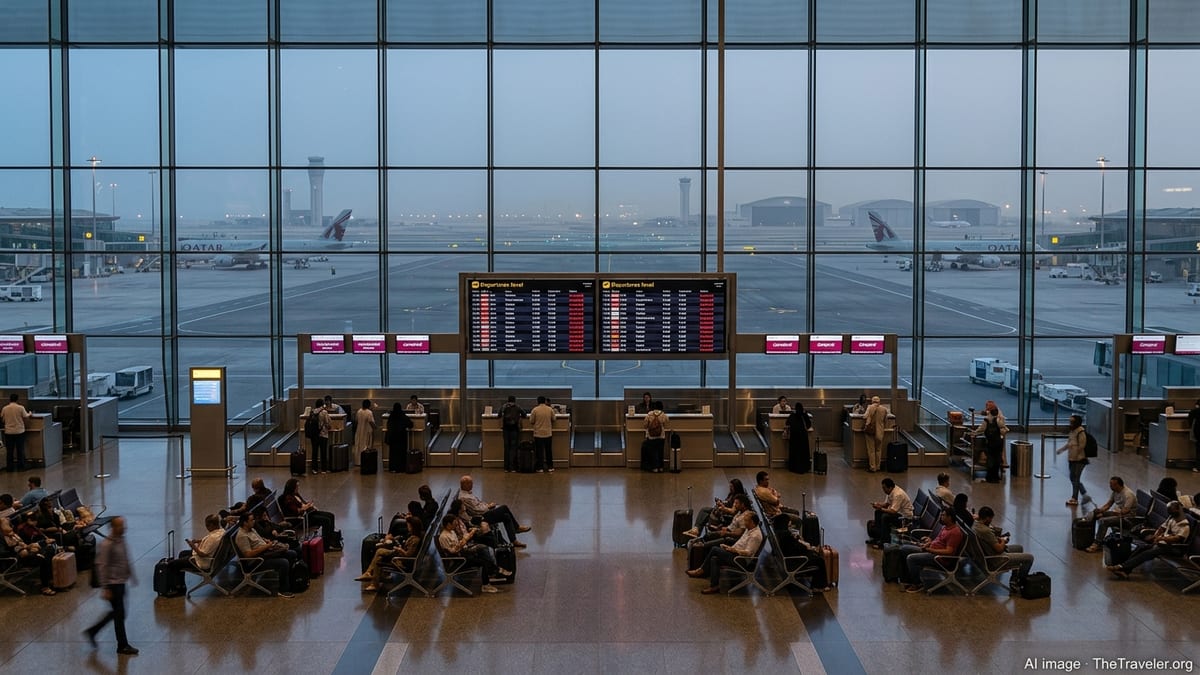
According to industry bulletins, Qatar closed its airspace on February 28 following the outbreak of large-scale hostilities between the United States, Israel, and Iran. Hamad International Airport, a major global hub, has since handled only a trickle of services, mostly cargo and tightly controlled evacuations. The Qatar Civil Aviation Authority signaled a cautious easing on March 7 by allowing restricted emergency air navigation, but normal passenger operations remain largely suspended.
Neighboring states have taken parallel steps. The United Arab Emirates temporarily shut its airspace in mid-March after reporting incoming missile and drone threats linked to Iranian strikes, while Saudi Arabia and Jordan have maintained what regional logistics updates describe as “open but limited” conditions. Egypt, though geographically one step removed from the main conflict zones, has seen knock-on disruptions as flights are rerouted through its airspace to bypass the Gulf and northern Middle East.
Travel data and port advisories indicate that, taken together, these restrictions amount to the most extensive peacetime clampdown on Middle East skies in decades. Airlines that once depended on dense Gulf and Levant corridors are now contending with fragmented, shifting access and a highly volatile security backdrop.
Airlines Slash Capacity as Hubs Struggle to Stay Connected
The immediate consequence for carriers has been a dramatic cull in scheduled services. Gulf-based airlines that built their business models on seamless connectivity between Europe, Asia, and Africa via hubs like Doha and Dubai are operating at a fraction of their usual capacity. Economic analysis published in recent days estimates that overall airline activity in the United Arab Emirates has dropped to around half of pre-conflict levels, while flights linked to Qatar have fallen to barely more than a tenth.
Operational updates from travel management companies and cargo specialists describe a patchwork of responses. Emirates and Etihad have repeatedly suspended and then cautiously restarted limited services from Dubai and Abu Dhabi as airspace status changes, while retaining bans on routes that cross directly over high-risk sectors. Qatar Airways has maintained a more conservative posture, having announced a full halt to scheduled commercial departures when Qatari airspace first closed and only gradually adding a small number of cargo and repositioning flights.
For travelers, the effect is chaos. Online discussion forums are filled with accounts of last-minute cancellations, extended layovers, and passengers forced to rebook via alternative hubs in Europe, Turkey, or South Asia at considerable extra cost. Some carriers, particularly in Europe and Asia, have simply scrubbed services to Qatar and parts of the Gulf through at least mid-March, citing ongoing uncertainty around routing and insurance coverage.
The disruption has also rippled into major international events and tourism flows. Recent sporting fixtures planned for Bahrain and Saudi Arabia have been postponed or relocated after organizers cited security concerns and the inability to guarantee reliable air links. Hotel and tourism operators across the region report a sharp wave of cancellations as prospective visitors abandon or postpone trips rather than navigate a rapidly changing flight landscape.
Rerouted Corridors Shift Pressure to Egypt and Alternative Hubs
With key Gulf and Levant air corridors constrained, airlines have scrambled to establish longer, safer routings around the Persian Gulf and conflict-affected portions of the Middle East. Flight-tracking data and traveler reports indicate that many long-haul services that would normally pass over Iraq, Iran, or the Gulf are now diverting via Egypt, the Red Sea, or more southerly tracks over the Arabian Sea.
Egypt, whose airspace and airports remain formally open, has become an increasingly important pivot point. Carriers are using Cairo and other Egyptian air traffic corridors to bridge Europe and Asia without entering the most heavily restricted zones. This has increased congestion over North Africa and the eastern Mediterranean, prompting carriers to pad schedules with additional buffer time to account for longer routings and potential holding patterns.
Beyond Egypt, secondary hubs in Turkey, Cyprus, and parts of South Asia have seen an uptick in connecting traffic as airlines reconfigure networks. Some passengers previously bound for Doha or Dubai have been rebooked to itineraries that now stitch together multiple segments through Istanbul, Muscat, or European capitals. Travel advisors recommend that passengers build extra time into connections and remain flexible on routing, as seat availability fluctuates and airlines frequently adjust flight plans in response to new risk assessments.
Despite these mitigation efforts, the geographic reality of the crisis means there are no simple workarounds. The airspace affected spans a central corridor linking three continents, so reroutes often add several hours of flying time and substantial fuel costs. This in turn feeds into higher fares and a more fragile global schedule, with missed connections more likely and recovery from disruptions slower than usual.
Economic Shockwaves Hit Gulf Tourism and Trade
The aviation turmoil is feeding into broader economic concerns for Qatar and its neighbors. Recent economic projections circulating in financial media point to deep potential contractions in Gulf gross domestic product if airspace restrictions and security threats persist. Analysts highlight Qatar and Kuwait as particularly exposed, with forecasts suggesting double-digit GDP declines in a worst-case scenario for 2026, while the United Arab Emirates and Saudi Arabia also face significant slowdowns.
For Qatar, the combination of airspace controls, targeted strikes, and production interruptions at key industrial sites has created a powerful shock. With Hamad International Airport functioning well below capacity and many international visitors unable or unwilling to travel, sectors such as business travel, high-end tourism, and conferences have been hit hard. Published reports describe airlines in Qatar operating at only a small share of typical flight volumes, with priority given to essential cargo and limited repatriation or evacuation services.
Across the wider Gulf, reduced connectivity is undermining the role of regional hubs as global crossroads. Hotels in Dubai, Doha, and Riyadh that normally depend on high transit traffic are experiencing abrupt dips in occupancy. Duty-free and airport retail revenues have fallen sharply, and service industries linked to aviation, from ground handling firms to limousine operators, are facing sudden revenue shortfalls.
Trade flows are also under strain. Shipping companies already grappling with threats in and around the Strait of Hormuz now must contend with curtailed air freight options. Logistics advisories suggest that many shippers have shifted urgent cargo away from the Gulf entirely, routing through Europe, East Africa, or South Asia instead. This diversion adds cost and time, complicating supply chains for sectors ranging from pharmaceuticals to high-value electronics.
Uncertain Timeline Leaves Travelers and Industry in Limbo
Despite scattered signs of partial reopening, the timeline for a full restoration of normal air services remains unclear. Security assessments continue to describe elevated risks of missile and drone activity over parts of the Gulf and Levant, and new hostilities or retaliatory strikes could trigger fresh rounds of closures with little warning. Civil aviation authorities in several states, including Qatar, have framed current relaxations as temporary and strictly controlled, emphasizing that standard commercial activity is not yet possible.
For airlines, this ambiguity makes long-term planning difficult. Carriers must decide week by week how many flights to operate, where to position aircraft and crew, and which routes can be insured at commercially acceptable terms. Many have opted to publish leaner schedules through at least late March while retaining the option to add ad hoc services if conditions improve.
Travel experts advise anyone planning to transit through Qatar, the United Arab Emirates, Saudi Arabia, Egypt, or Jordan in the coming weeks to monitor airline communications closely and consider flexible tickets or alternative routings. Passengers with essential travel are being encouraged to reconfirm flights repeatedly in the days leading up to departure, as last-minute cancellations remain common when risk levels change.
Until a durable ceasefire or diplomatic breakthrough eases tensions between the United States, Israel, Iran, and their regional partners, the Middle East’s position at the heart of global aviation will remain compromised. For now, Qatar’s alignment with neighboring states in tightening skies underscores how deeply this conflict has reached into the core infrastructure of international travel.