

More news on this day
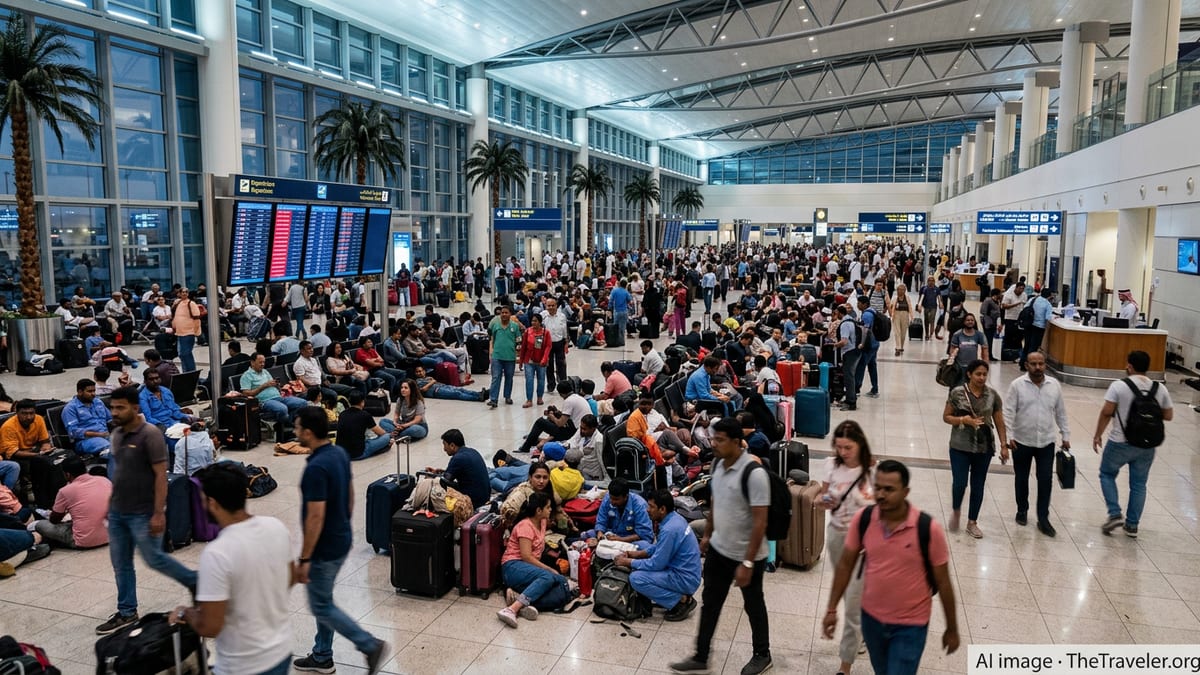
Rapidly expanding airspace closures across the Gulf have triggered one of the most severe aviation shutdowns since the pandemic, stalling tourism flows and leaving large numbers of migrant workers stranded from South Asia to Europe as airlines struggle to navigate a patchwork of restrictions and damaged hubs.
Get the latest news straight to your inbox!
Regional Conflict Freezes Critical Gulf Aviation Corridors
Since late February 2026, a widening arc of conflict involving Iran, the United States, Israel and Gulf states has reshaped the airspace map of the Middle East. Commercial routes that typically funnel long haul traffic through hubs such as Dubai, Doha, Abu Dhabi, Kuwait City and Manama have been severely curtailed or shut altogether as authorities impose emergency flight restrictions for safety reasons. Publicly available aviation and security assessments describe a near continuous band of disrupted airspace stretching from Iran and Iraq across parts of the Gulf to Israel, forcing thousands of daily flights to divert or cancel.
Data compiled by aviation analysts and reported in multiple outlets indicates that closures in the United Arab Emirates, Qatar, Kuwait, Bahrain and neighboring states are contributing to more than 4,000 daily flight cancellations linked to the 2026 Iran war. Major airports including Dubai International and Abu Dhabi have sustained damage from strikes, while Hamad International in Doha has been constrained first by full airspace closure, then by a limited, tightly controlled reopening for emergency and repatriation movements only. In Bahrain, the suspension of operations at Bahrain International has effectively grounded the national carrier Gulf Air, which relies on the airport as its sole hub.
Carriers based outside the region have responded by pulling back capacity or suspending Gulf-bound operations altogether. Coverage in European and Asian media notes that airlines such as British Airways, Air India and others have halted flights into key Gulf and Levant destinations or rerouted a handful of services via longer tracks skirting closed sectors over the southern Red Sea and parts of Oman. These changes have sharply increased flight times and fuel burn on Europe to Asia routes that previously relied on efficient Gulf connections.
The result is a cascading disruption that reaches far beyond the immediate conflict zone. Flight tracking data and airline notices show waves of cancellations and diversions at airports as far apart as London, Frankfurt, Johannesburg, Singapore and Melbourne, where departures to Gulf hubs have been grounded or turned back en route when overflight permissions changed with little warning.
Migrant Workers Bear the Brunt of Stranded Travel
Among those hardest hit by the Gulf airspace closures are migrant workers who depend on regular links between South Asia, Africa and the Middle East for their livelihoods. Reporting from South Asian and Middle Eastern outlets describes terminals in cities such as Dhaka, Kathmandu and Kochi crowded with laborers whose transit flights through Dubai, Doha or Abu Dhabi have vanished from departure boards. Many had borrowed heavily to secure jobs in construction, domestic work or service industries across the Gulf and now face weeks of uncertainty in limbo.
One Bangladeshi travel publication notes that thousands of passengers, including large numbers of Bangladeshi migrants heading to Gulf destinations, have been stranded at Dhaka’s airport as flights to Doha, Dubai and Abu Dhabi were cut or repeatedly rescheduled. Similar scenes are described at Nepal’s Tribhuvan International Airport, where images and television footage show Nepalese workers clustered around information screens after regional airspace closures disrupted flights to the Middle East. Local coverage in Spain also highlights several hundred Andalusian residents stuck abroad because connecting flights over the Persian Gulf can no longer operate as planned.
In the Gulf itself, migrant-heavy communities are facing particular strain. Publicly available reports from the United Arab Emirates describe thousands of passengers grounded across Dubai and other cities toward the end of February after the sudden closure of airspace in Iran, Iraq, Qatar, Bahrain and the UAE. While some travelers on short visits have been offered hotel stays and flexible rebooking, migrant workers with limited savings and expiring visas confront a more precarious situation, relying on ad hoc extensions, fee waivers or charity to cover extended stays.
Repatriation efforts have started to ease the backlog, but they remain patchy and uneven. Limited evacuation and special charter services have been organized by some governments and airlines, while Qatar Airways and other carriers have announced small numbers of priority flights to European capitals for stranded passengers. Even so, media coverage from South Asia and Europe suggests that large numbers of migrants remain stuck without clear timelines for onward travel, amplifying the social and economic toll in both host and origin countries.
Tourism Collapse Ripples Through Destinations Worldwide
The same closures choking migrant corridors are also precipitating a sharp collapse in tourism flows linked to Gulf transit hubs. Before the crisis, airports such as Dubai International, Hamad International and Abu Dhabi acted as pivotal connectors for global leisure travel, funnelling tourists between Europe, Africa, Asia and Australasia. With flights suspended or sharply reduced, destinations that depend on Gulf carriers for visitor access are seeing abrupt drops in arrivals and spending.
Travel industry coverage describes how European beach destinations, Indian Ocean resorts and Southeast Asian islands are feeling the impact of lost Gulf connectivity. Tour operators who relied on high frequency services via Dubai or Doha to sell multi-stop itineraries now face large volumes of cancellations and refund requests. In Spain, regional media report that package holidaymakers returning from Asia and Africa have found themselves stranded mid-journey, unable to complete itineraries routed through the Persian Gulf, while hotels at home brace for fewer inbound visitors from the Middle East.
Inbound tourism to the Gulf is also suffering. Dubai, Abu Dhabi and Doha have, in recent years, positioned themselves as stopover and city-break destinations, attracting millions of transit passengers to extend their journeys with short stays. With a high proportion of flights grounded and travel advisories in key source markets discouraging non essential trips to or through the region, that flow has slowed to a trickle. Retail, hospitality and events sectors that depend heavily on transit-driven tourism are reporting what business analysts describe as the most significant disruption since the height of the pandemic.
For destinations further afield, the disappearance of Gulf links is compounding existing pressures from other airspace constraints. Routes that were already avoiding parts of Ukraine and Russia now have to factor in detours around the Gulf, pushing some long haul services beyond commercially viable flight times. Analysts warn that even once limited traffic resumes, higher fares driven by fuel-intensive routings could dampen international leisure demand for months to come.
Airlines, Governments and Travellers Struggle to Adapt
Airlines operating in and around the Gulf are engaged in a complex realignment to cope with the closure of core corridors and hubs. Coverage in specialist aviation outlets details how carriers have suspended dozens of routes, repositioned aircraft to alternative airports and sought new overflight permissions to preserve at least a skeleton network. Some regional airlines, including Gulf Air, have effectively halted all scheduled services after their main bases became unusable, while others such as Emirates and Etihad are gradually restoring reduced operations when limited airspace windows open.
Governments are responding with a mix of emergency regulations, traveler assistance programs and evolving travel advisories. Several European authorities have issued guidance urging citizens to defer non essential travel to or through the Gulf, while consular services prioritize support for those caught in transit. In South Asia, officials are coordinating with airlines to add extra services on safer routes, but capacity constraints mean demand continues to outstrip supply. Policy analysts note that the crisis is testing previously built evacuation and contingency frameworks that were expanded during the pandemic and earlier airline collapses.
For individual travelers, the situation has become a lesson in the fragility of global connectivity. Consumer organizations and travel risk consultancies are advising passengers to avoid itineraries that rely on tightly timed connections through volatile regions, to monitor airline apps closely, and to consider flexible tickets that allow routing changes without heavy penalties. Some travel insurers have begun updating policy language to clarify coverage around war related disruptions, which can leave tourists and migrant workers exposed if they are not aware of exclusions.
The industry itself is beginning to reassess risk models that long treated the Gulf as a stable crossroads. Commentaries in aviation journals point out that the current closures follow earlier large scale airspace disruptions over Ukraine, parts of the eastern Mediterranean and the Red Sea, suggesting that geopolitical instability could become a recurring operational constraint for global airlines rather than an occasional shock.
Uncertain Timeline for Recovery Raises Long-Term Concerns
While limited repatriation flights and partial reopenings are slowly chipping away at the backlog of stranded passengers, there is no clear timetable for a full restoration of Gulf airspace access. Security briefings and economic analyses agree that aviation recovery is likely to be partial and uneven, with some corridors reopening more quickly than others depending on risk assessments and the pace of any ceasefire or de escalation efforts in the region.
The prolonged uncertainty is fueling wider concerns about the resilience of the global travel system. Tourism boards, airlines and airport operators are revising forecasts for 2026 and beyond, with some warning of a material downgrade in expected passenger volumes and tourism revenues if Gulf hubs remain constrained for an extended period. Longer routes, higher insurance and security costs, and reduced aircraft utilization all threaten to squeeze margins at a time when the industry is still rebuilding from the pandemic era downturn.
For migrants and lower income travelers, the long term implications may be particularly stark. If airlines permanently reduce capacity on routes linking South Asia, Africa and the Middle East, ticket prices could rise and seasonal or temporary work abroad could become harder to access. Development economists caution that such shifts risk undermining remittance flows that are vital to household incomes and local economies in several labor sending countries.
What remains clear is that the Gulf airspace closures have moved beyond a short term emergency to become a structural shock to aviation and tourism. Until air corridors reopen reliably and travelers regain confidence in the stability of key hubs, the ripple effects of grounded aircraft, empty hotel rooms and stranded migrant workers are likely to persist across multiple regions and travel seasons.