

More news on this day
Coordinated strikes by the United States and Israel on Iranian targets have set off a chain reaction of missile fire, airspace shutdowns and airport disruptions across the Gulf, leaving would‑be visitors to Dubai, Doha and Tel Aviv facing rapidly shifting risks and widespread travel chaos.
Get the latest news straight to your inbox!
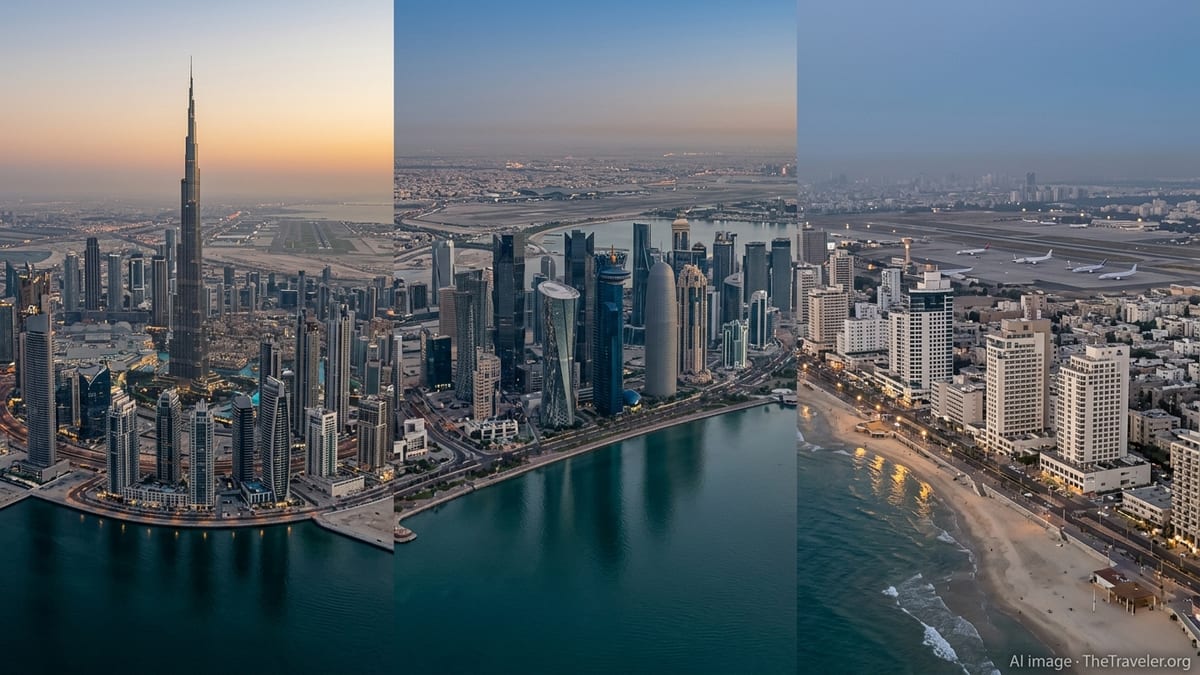
How the Strikes Triggered Gulf Airspace Shutdowns
According to publicly available reporting, the current wave of disruption began on 28 February 2026, when the United States and Israel launched coordinated attacks on Iranian government and military facilities. In response, Iran fired missiles and drones toward Israel and United States assets across the wider region, including in the United Arab Emirates, Qatar, Kuwait, Bahrain and Saudi Arabia. Regional governments responded by closing all or parts of their airspace, effectively throttling civilian aviation over some of the world’s busiest corridors.
Airspace closures were reported over Iran, Iraq, Israel, Syria, Kuwait, Qatar, Bahrain and the UAE, along with periods of suspension or severe restriction over key hubs in Dubai, Abu Dhabi and Doha. Commercial flight-tracking data and multiple travel advisories show civilian aircraft avoiding Iranian airspace almost entirely, with long-haul services between Europe and Asia forced into longer, more southerly or northerly routings.
As the conflict intensified into March 2026, published analyses of the economic impact of the war described more than 4,000 daily flight cancellations across the wider region. The closures stranded large numbers of passengers and forced airlines to cut or suspend services on many Middle East routes, including links to Tel Aviv and the main Gulf transfer points.
In parallel, Israel imposed tight restrictions on its own airspace following Iranian missile barrages, disrupting operations at Ben Gurion Airport near Tel Aviv for several days at a time. While some services have periodically resumed, schedules remain volatile and subject to abrupt suspension when security conditions deteriorate.
Dubai: Global Hub Under Strain
Dubai International Airport, normally the world’s busiest hub for international passengers, has been at the center of the turbulence. Publicly available information from aviation incident summaries and regional media coverage indicates that the airport sustained at least limited damage from strikes linked to the widening conflict, prompting temporary shutdowns of terminals and a high volume of flight cancellations.
Reports from travel risk consultancies and industry bulletins describe periods when Dubai was forced to suspend most departures and arrivals, with some accounts indicating cancellations affecting a majority of scheduled flights on peak days. Airlines based in the Gulf, as well as European and Asian carriers, have repeatedly rerouted or grounded services rather than transit airspace viewed as at risk from missile or drone activity.
For leisure travelers and transit passengers, the immediate impact has been uncertainty rather than a complete collapse in connectivity. Some flights continue to operate when airspace is open, but they are vulnerable to last-minute schedule changes. Travelers connecting through Dubai have faced missed onward legs, extended layovers and unexpected diversions to alternative hubs, adding both cost and stress to journeys that would usually be routine.
Tourism bodies that had counted on Dubai’s role as a safe, reliable gateway for the wider region now confront a more fragile landscape. Analysts cited in recent economic assessments warn that if interruptions persist, hotel occupancy, retail spending and major events business in Dubai could see the sharpest downturn since the pandemic era, even if core infrastructure remains largely intact.
Doha: Strategic Hub Facing Prolonged Disruptions
Doha’s Hamad International Airport, another key stopover point for Europe–Asia traffic, has also been significantly affected by the airspace closures. According to published coverage summarizing Qatari aviation notices, Qatar closed its airspace on 28 February 2026 as the first round of strikes unfolded. Flight cancellations mounted quickly, with many long-haul services diverted away from Doha or suspended entirely.
Subsequent statements from Qatar’s civil aviation authorities, as reported in local and international media, described a partial reopening of air navigation under restricted capacity in early March. Operations have focused on limited evacuation, repatriation and cargo flights, while most regular commercial passenger services remain either suspended or heavily reduced.
Those patterns have immediate consequences for tourism. Doha’s hotels, museums and event venues had been positioning the city as both a short-break destination and a convenient stopover. With the airport operating below normal capacity and international arrivals curtailed, occupancy levels are under pressure and forward bookings are being re-evaluated by both leisure and business travelers.
Travel industry analyses suggest that if the conflict and airspace constraints continue, Qatar’s tourism strategy, built around high-profile sporting events and cultural attractions, could face a difficult period. Potential visitors may delay trips or opt for alternative transit points that can offer more predictable schedules, even if journey times are longer.
Tel Aviv: Heightened Security and Volatile Access
In Israel, the tourism outlook hinges on both physical access and perceptions of security. According to open reporting on the conflict, Iran has launched multiple waves of missile and drone strikes at Israeli territory since late February 2026, prompting air raid alerts and the activation of missile defense systems over several cities, including the Tel Aviv area.
In the early days of the clashes, Israel temporarily closed its airspace, bringing departures and arrivals to a halt at Ben Gurion Airport. Subsequent phases have seen a pattern of reopening and renewed restriction as new barrages are detected. Many international airlines have suspended flights to Tel Aviv altogether, citing operational uncertainty and the need to keep crews and aircraft clear of potential danger zones.
For travelers, that translates into a highly unstable environment. Even when flights are technically available, itineraries can be disrupted with little notice if security conditions shift. Travel advisories from governments and private risk firms have repeatedly raised their alert levels for Israel, highlighting the prospect of sudden closures of airports and land crossings as the situation evolves.
Beyond flight operations, the atmosphere in and around Tel Aviv is shaped by visible security measures, from increased military presence to tighter checks at hotels and attractions. While some visitors may still proceed with essential trips, particularly for family or business reasons, discretionary leisure tourism is expected to fall sharply while the risk of further large-scale attacks remains elevated.
What Travelers Need to Know Right Now
Publicly available travel advisories and risk assessments emphasize that the situation across Dubai, Doha and Tel Aviv is dynamic, with conditions capable of changing within hours. Airspace closures are often announced with little advance warning, and partial reopenings may be limited to specific corridors or types of flights, such as cargo or evacuation services.
For travelers considering trips in the near term, the most immediate risks are operational rather than directly physical. These include extended delays, last-minute cancellations, complex reroutings and unexpected overnight stays if transit hubs suddenly curtail operations. Because Gulf and Israeli airports function as major connecting points for long-haul travel, disruptions can cascade into missed connections far from the Middle East itself.
Insurance and booking flexibility have become critical tools. Policy documents and airline waivers published since the escalation indicate that some carriers are offering rebooking without penalty or refunds on affected routes, while many insurers are reassessing coverage for travel to or through active conflict zones. Travelers are being advised by public sources to examine the fine print on war and disruption exclusions before committing to new bookings.
Longer term, analysts cited in economic and tourism studies warn that a sustained conflict could reshape regional travel patterns. If the perception of the Gulf as a safe, stable gateway is dented, airlines and passengers may gradually favor alternative hubs, and the recovery of visitor numbers to Dubai, Doha and Tel Aviv could lag well behind other destinations even after hostilities subside.