

More news on this day
Gulf aviation’s most powerful carriers are battling an extraordinary operational shock as widespread Middle East airspace closures choke off Qatar’s tourism lifeline, strand hundreds of thousands of travelers and drain demand from hotels across Saudi Arabia and Bahrain.
Get the latest news straight to your inbox!
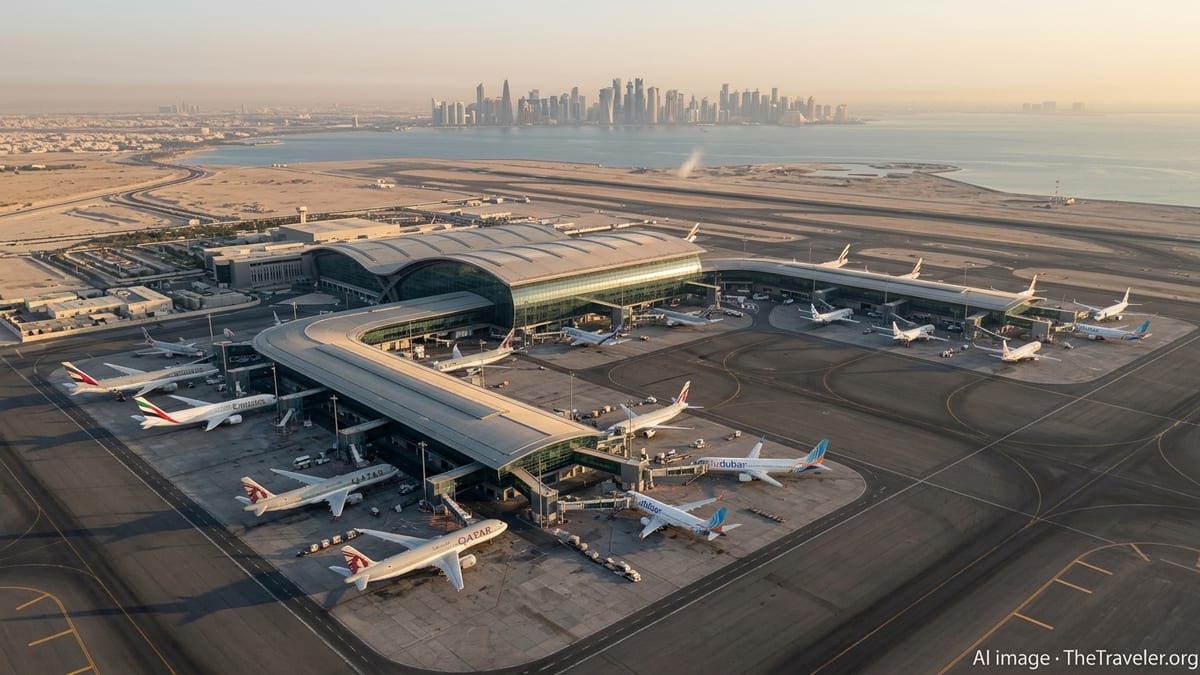
Airspace Closures Turn Gulf Super-Connectors Into Grounded Giants
In late February and early March 2026, a rapid escalation of conflict involving Iran triggered sweeping airspace restrictions across the Gulf, transforming some of the world’s busiest transit hubs into near standstill zones. Publicly available flight-tracking data and aviation analytics show that closures or severe limits were imposed over Qatar, the United Arab Emirates, Bahrain, Iraq, Iran and Israel, effectively severing key east–west corridors that normally funnel traffic through Doha, Dubai and Abu Dhabi.
According to published coverage from global newswires and specialist aviation outlets, the immediate result was the cancellation of more than a thousand flights in a matter of days, with disruptions radiating out to Europe, South Asia, East Asia and Africa. Qatar Airways, Emirates, Etihad Airways and Flydubai, which collectively move tens of millions of passengers a year through Gulf hubs, have been forced into a patchwork of suspensions, diversions and limited relaunches as governments adjust airspace notices.
While Emirates and Etihad have begun restoring a portion of their long-haul operations via longer polar or southern routings, industry briefings indicate that Qatar Airways faces a more severe structural constraint. With Qatari airspace itself restricted and neighboring flight information regions constrained, the Doha carrier has had fewer viable alternatives, leading to prolonged groundings and a cascade of cancellations across its global network.
For Flydubai, whose business model is built on dense short-haul connectivity around the Gulf, the effective disappearance of nearby airspace has struck at the core of its route map. Travel and logistics advisories describe large parts of the low-cost carrier’s network as temporarily offline or operating on sharply reduced schedules, with knock-on effects for secondary cities that rely on Dubai as a primary international gateway.
Qatar’s Tourism Engine Stalls as Transit Flows Collapse
Qatar’s tourism and visitor economy, which has been aggressively cultivated since the 2022 FIFA World Cup through major events, new hotel openings and cruise infrastructure, is acutely exposed to any interruption in aviation flows. Industry modeling referenced in recent commentary suggests that prolonged closures and capacity cuts could translate into cumulative losses on the order of tens of billions of US dollars in foregone tourism receipts, convention business and associated spending, pushing the sector’s medium-term revenue gap toward the 56 billion dollar mark if current conditions persist.
Public data from global tourism bodies and Gulf-focused economic consultancies highlight how dependent Qatar’s visitor strategy has become on Qatar Airways’ hub-and-spoke network. A large share of arrivals combine stopovers in Doha with onward journeys between Europe, Asia and Africa, while major sports tournaments, business conferences and cultural festivals rely on seamless global air links. With that connectivity fractured, hotel pipelines, entertainment districts and retail developments face abrupt drops in occupancy and footfall.
Market analysts note that the disruption hits just as Qatar was attempting to pivot from event-driven surges to steadier year-round tourism. Cruise calls, meetings and incentive trips, and high-spend stopover programs have all been thrown into uncertainty as travel planners reevaluate itineraries and risk management policies. The longer airspace restrictions linger, the more likely it becomes that some of this demand is permanently re-routed through rival hubs once stability returns.
Travel trade reports also point to secondary impacts on employment and small businesses. Destination management companies, tour operators, restaurant groups and transport providers that scaled up for sustained growth now confront cancellations, refund requests and idle capacity. Many are leaning on short-term relief measures and renegotiated contracts while watching airspace updates for any sign of a durable reopening.
Riyadh and Bahrain Hotels Grapple With Sudden Occupancy Shock
The turbulence is not confined to Qatar. Preliminary data shared within the hospitality industry for early March 2026 indicates that hotels in key Gulf cities, including Riyadh and Bahrain’s capital Manama, have registered a sharp slip in occupancy as airspace closures and traveler warnings take hold. Research circulated by hotel benchmarking firms and regional consultancy notes points to declines of 35 to 60 percent in some properties across affected markets, a stark reversal from the high-load conditions seen in 2025.
In Bahrain, which has positioned itself as a boutique hub for conferences, weekend leisure breaks and Formula 1-driven tourism, the closure of its airspace and disruption to Gulf Air’s operations has translated directly into empty rooms and postponed events. Analysts describe a freeze in new group bookings and a wave of deferrals for meetings and incentives that had been targeting the spring and early summer calendar.
Saudi Arabia’s emerging tourism centers around Riyadh and its megaprojects are also feeling the strain. While domestic demand offers some cushion, international arrivals linked to the wider Gulf aviation system have slowed noticeably. Publicly available industry commentary suggests that some upscale hotels which had counted on strong feeder traffic via Gulf super-connectors are now revising revenue forecasts and offering aggressive rate promotions to stimulate local and regional demand.
Hotel operators in both markets are focusing on business continuity, reworking staffing rosters, and accelerating guest safety and crisis communication protocols. Some groups are leveraging sister properties in less affected destinations such as Oman and Cyprus to accommodate relocated events and long-stay guests who prefer to wait out the uncertainty outside immediate conflict-adjacent zones.
Global Travel and Cargo Networks Strain Under Gulf Shockwaves
The Gulf airspace crunch is reverberating far beyond the region, underlining the central role of Qatar Airways, Emirates, Etihad and Flydubai in global mobility and trade. Travel industry briefings estimate that Gulf carriers collectively support a substantial share of worldwide long-haul connectivity between Europe, Asia, Africa and Oceania, as well as a significant portion of global air cargo capacity through their passenger bellies and dedicated freighters.
With that capacity suddenly curtailed, logistics advisories describe a scramble to reroute high-value freight via alternative hubs in Turkey, Central Asia and southern corridors over the Arabian Sea. Extended flight times of two to six hours on some diverted routes are inflating fuel costs, complicating crew scheduling and tightening aircraft availability, with ripple effects for shippers dependent on just-in-time supply chains.
For passengers, the disruption has translated into cascading delays, missed connections and mass rebooking exercises across continents. Consumer-facing travel guidance urges ticket holders to monitor airline apps closely, accept flexible rerouting where possible and prepare for extended layovers or last-minute changes. Travel insurers and credit card providers are also under pressure, as claims related to cancellations, additional accommodation and alternative transport mount.
Industry observers caution that even as limited services resume from Dubai and Abu Dhabi, a full restoration of pre-crisis connectivity will likely lag any political de-escalation. Aircraft and crews are out of position, scheduling banks at hubs have been disrupted, and passenger confidence may take time to recover, particularly among corporate travel buyers and organizers of large-scale events.
Uncertain Recovery Timeline Tests Gulf Tourism Strategies
Looking ahead, the central question for Qatar, the United Arab Emirates, Saudi Arabia and Bahrain is how long the current airspace turmoil will last and how quickly traffic can be rebuilt once restrictions ease. Aviation and tourism analysts caution that while past regional crises have often given way to rapid rebounds, the complexity and geographic scope of the present closures make forecasting especially difficult.
Short-term recovery efforts are already visible, with Gulf carriers ramping up selective services through approved corridors and operating relief flights to repatriate stranded travelers. Tourism boards and destination marketing organizations are preparing targeted campaigns to reassure visitors, emphasizing upgraded safety protocols, flexible booking policies and diversified access routes via alternative hubs.
Yet structural questions remain about overreliance on a handful of chokepoint hubs and flight corridors. Policy papers and think-tank commentary circulating in recent months have urged Gulf states to accelerate investment in regional rail, cruise infrastructure and overland tourism circuits that can partially offset aviation shocks. There is also growing interest in spreading major events and conferences across a wider set of cities to reduce concentration risk.
For now, the skies over the Gulf remain a barometer for the region’s tourism fortunes. Until airspace fully reopens and carriers like Qatar Airways, Emirates, Etihad and Flydubai can reliably restore their networks, the prospect of a prolonged multibillion-dollar hit to visitor economies across Qatar, Saudi Arabia and Bahrain will continue to cast a long shadow over one of the world’s most dynamic travel regions.