

More news on this day
Hundreds of UK-bound flights have been cancelled after sweeping airspace restrictions across the Gulf forced airlines to tear up schedules, leaving thousands of British and other travelers stranded in the United Arab Emirates, Bahrain, Qatar and Saudi Arabia.
UK Airlines Scramble as Gulf Corridors Close
British Airways, Virgin Atlantic and other UK carriers spent the weekend rewriting timetables after a cascade of airspace closures and restrictions across the Gulf severed key long-haul corridors linking London with Asia, Africa and Australasia. Services that normally hopscotch through Dubai, Doha, Abu Dhabi and other hubs have been scrubbed or rerouted, with aircraft forced to take far longer paths around closed or heavily restricted skies.
Industry data and airline statements indicate that more than a thousand flights touching the Gulf region were cancelled or severely delayed in recent days, with UK services particularly hard hit on routes to Australia, New Zealand, India and Southeast Asia. Analysts say the scale of disruption rivals the early days of the pandemic for some carriers, but with the added complexity of fast-changing security restrictions and a war-risk environment.
With Bahrain and Qatar still subject to near-total civilian airspace shutdowns and the United Arab Emirates only partially reopened under tight control, UK airlines have lost access to what had become their most important overflight and refuelling corridors. Many point-to-point flights to Dubai, Doha and Abu Dhabi remain grounded outright, while others have been converted into ad hoc repatriation services when conditions allow.
Schedule volatility is now so extreme that carriers are issuing rolling, day-by-day updates rather than weekly plans. Airline operations teams in London and regional control centres are working around the clock to replan crew duty rosters, find alternate routings through Saudi and Omani airspace, and secure scarce overnight accommodation for displaced passengers.
Thousands Stranded in Gulf Hubs With Limited Exit Options
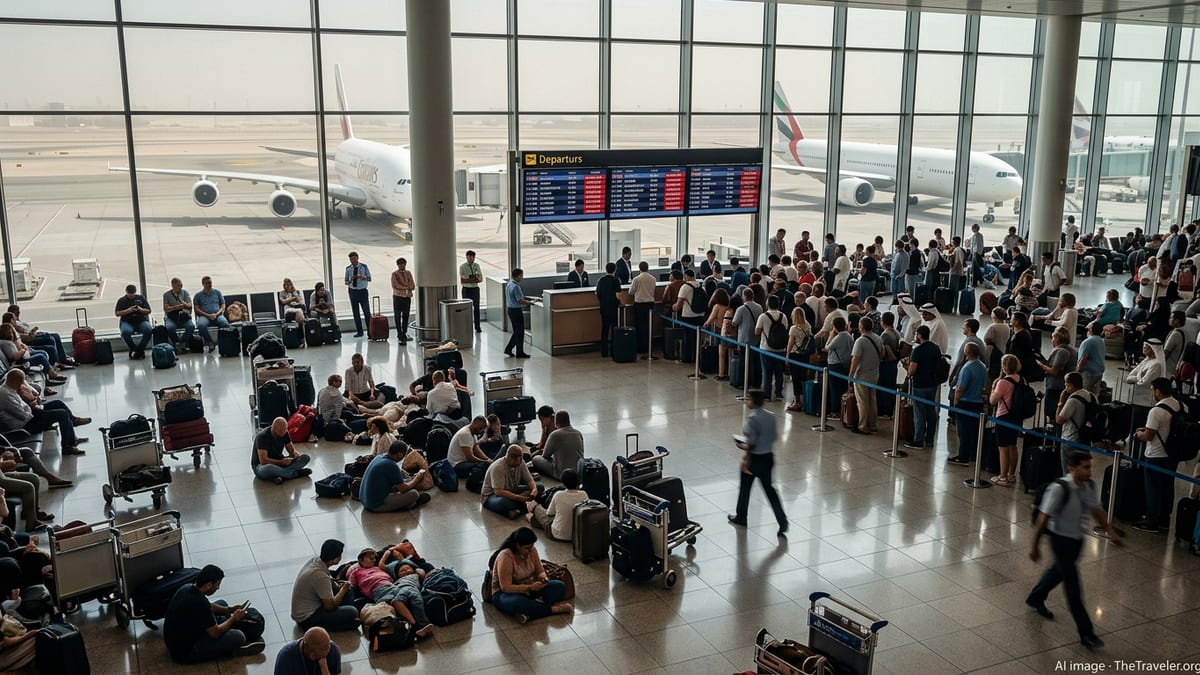
The closures have trapped a diverse mix of leisure travelers, migrant workers and business passengers across Gulf states. Dubai, usually the world’s busiest international airport, has seen days of near-paralysis, with concourses filled with passengers sleeping on luggage carts and terminal floors while they wait for word of rescue flights. Similar scenes have been reported at Doha’s Hamad International Airport and Bahrain International Airport, where normal commercial operations remain largely shut.
Many of those stranded are UK nationals who were transiting through the region when the airspace restrictions came into force at short notice on February 28. Some had already begun long-haul journeys from Asia or Australasia when their connecting flights into the Gulf were cancelled mid-route, forcing unplanned diversions to Saudi Arabia or Oman and leaving them reliant on hastily arranged ground transfers and scarce hotel rooms.
Passengers report long queues at airline service desks and overwhelmed call centres, with rebooking priority going to families with young children, elderly passengers and those with urgent medical needs. Others have been offered vouchers and hotel stays while they wait for seats on repatriation flights that can only operate along narrow, pre-approved corridors, often at awkward overnight departure times.
Visa rules and local accommodation caps are adding another layer of complexity. In parts of the UAE and Qatar, visitors whose stays were meant to be just a few hours in transit are now facing extended hotel stays and questions over visa validity, prompting coordination between airlines, immigration authorities and embassies to avoid travelers falling foul of overstays.
Gulf and UK Carriers Pivot to Rescue and Rerouting
Gulf airlines that normally act as the backbone of east west connectivity are themselves hobbled by the closures, but have begun piecing together limited evacuation and relief operations. Qatar Airways and Gulf Air have launched small numbers of outbound flights using aircraft that were outside Doha and Bahrain when the shutters came down, operating from airports in Saudi Arabia and Oman where airspace remains open.
Emirates and Etihad, based in Dubai and Abu Dhabi, are running reduced schedules as they navigate partial reopenings of Emirati airspace. Both carriers say they are prioritising passengers whose previous flights were cancelled and have cautioned travelers not to proceed to the airport without a confirmed rebooking. Capacity is being focused on trunk routes to Europe, including London Heathrow and Gatwick, to help clear the backlog of stranded visitors.
For their part, UK airlines have converted some suspended scheduled flights into dedicated repatriation services. British Airways and Virgin Atlantic have been operating select services into Saudi Arabian and Omani airports, where passengers can be consolidated onto onward flights to the UK. These flights, many operating at or near full capacity, are subject to late-notice timing and routing changes as regional authorities adjust risk assessments day by day.
Smaller European and Asian carriers serving the UK are also improvising. Some have opted to avoid the Gulf entirely, rerouting via Central Asia or the eastern Mediterranean at the cost of significantly longer flight times and higher fuel burn. Others have cancelled services outright until there is clearer visibility on when more Gulf airspace might reopen to commercial traffic.
Saudi Arabia Becomes a Critical Lifeline Corridor
With Bahrain, Qatar and large portions of Emirati airspace restricted, Saudi Arabia’s open skies have suddenly become the primary east west bridge for airlines trying to maintain a skeleton network. Routes that once cut directly across the central Gulf are now bending south and west, threading through Saudi-controlled corridors before turning toward Europe and the UK.
Riyadh and Jeddah have emerged as key diversion and transit points for stranded travelers. Hotels near both airports are nearing capacity as airlines bus in passengers from Dubai, Doha and other Gulf cities by road, sometimes over journeys of 12 hours or more, to connect with relief flights. Saudi air traffic controllers are contending with congested skies and complex sequencing as rerouted flights from Asia, Africa and the Indian subcontinent all converge on a narrower set of tracks.
While Saudi airspace has remained open, aviation officials there have warned of rolling delays and the possibility of temporary flow restrictions to manage safety as traffic volumes surge. British and European carriers are working closely with Saudi authorities to secure reliable slots, with some airlines choosing to thin out frequencies on less critical routes in order to free up aircraft for higher priority UK services.
Travel insurers and risk analysts say the reliance on a single major corridor through Saudi Arabia introduces its own vulnerabilities, leaving global schedules exposed should the security situation in the wider region deteriorate further or if additional states decide to impose restrictions.
Uncertain Outlook for UK Travelers Planning Gulf Transits
For UK residents contemplating travel that would normally route through Gulf hubs, the outlook in early March remains highly uncertain. While some carriers and governments have suggested that certain airspace closures could be eased in phases later this week, there is no firm public timeline for a full restoration of normal traffic flows in and out of the UAE, Bahrain and Qatar.
Airlines and travel agents are advising UK passengers to avoid booking itineraries that rely on tight connections through Gulf hubs, and to consider routings via Europe or Central Asia instead, even if they involve longer journey times. Those who already hold tickets via the Gulf are being urged to monitor airline channels closely and to accept flexible rebooking or refund options where offered, rather than waiting for last-minute cancellations.
Fares on alternative routes have already spiked as capacity is diverted away from the Gulf and demand for scarce long-haul seats rises. Aviation economists warn that, even once more airspace reopens, higher war-risk insurance premiums and longer routings could keep ticket prices elevated on many UK to Asia and Australasia routes for months to come.
Until a sustained de-escalation allows Gulf airspaces to fully reopen, UK travelers can expect a volatile mix of cancellations, diversions and extended journey times. For the thousands already stranded across the Gulf, the priority remains a simple one: securing a confirmed seat home amid one of the most severe regional aviation disruptions in recent memory.