

More news on this day
Flagship carriers across the Gulf and wider Asia are confronting a sudden collapse in revenues as the Iran war triggers sweeping airspace shutdowns, mass flight cancellations and a sharp reversal in tourism flows to the United Arab Emirates, Saudi Arabia and Qatar.
Get the latest news straight to your inbox!
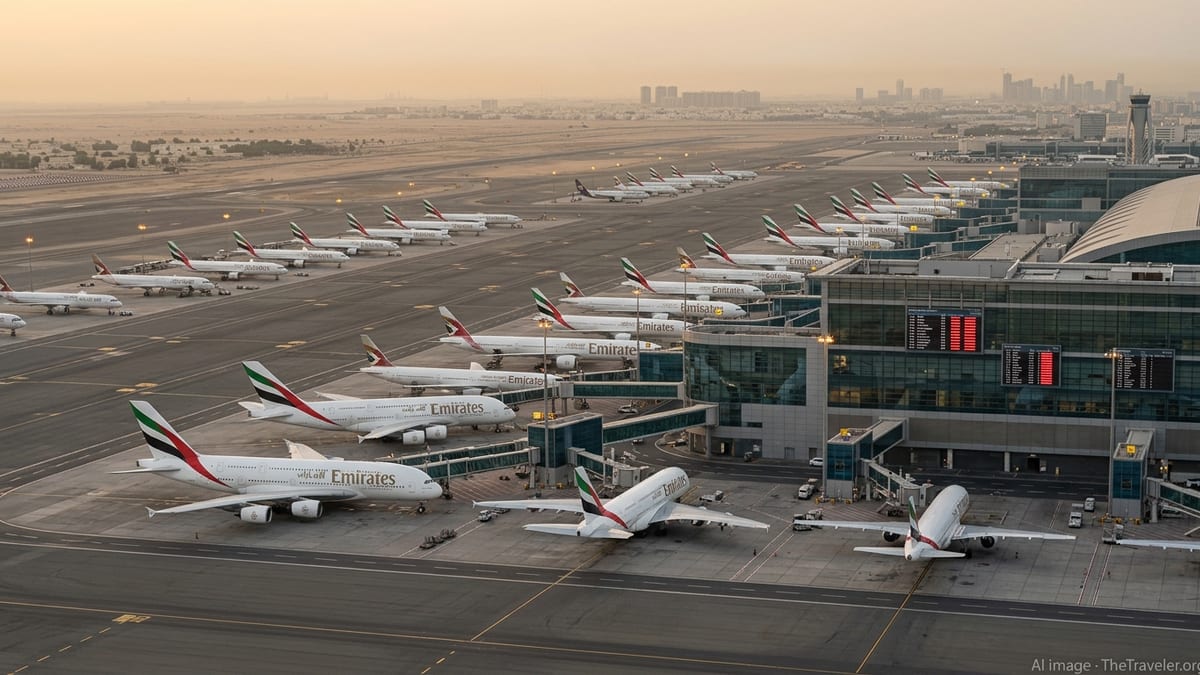
Airspace Closures Push Gulf Carriers to the Brink
Publicly available traffic data and industry briefings indicate that airspace closures across Iran and multiple Gulf states since late February have wiped out much of the region’s commercial aviation activity. The United Arab Emirates, Qatar, Bahrain, Kuwait and other states have restricted or closed their skies, forcing airlines to ground or reroute thousands of flights on core corridors between Europe, Asia and Africa.
Emirates, Etihad and Qatar Airways, which built their business models on dense transfer traffic through Dubai, Abu Dhabi and Doha, have seen daily movements collapse from normal levels of more than 2,000 combined flights to a fraction of that volume. Several assessments describe this as the most severe aviation disruption since the Covid 19 pandemic, with Gulf carriers operating at well under half of their pre conflict capacity and Qatar reportedly down to low double digit percentages of normal schedules.
These cuts are feeding directly into a steep fall in revenue. Analysts tracking ticket sales and capacity say each day of near paralysis erases hundreds of millions of dollars in fares, cargo fees and ancillaries for the Gulf’s big three carriers and their partners. With wide body fleets optimised for long haul connectivity now sitting idle or flying long detours around closed airspace, unit costs are rising even as income shrinks.
The pressure is compounded by higher fuel prices linked to the Strait of Hormuz crisis. The conflict has disrupted a major share of regional oil exports, pushing up jet fuel costs and further squeezing already thin operating margins on the limited services that can still operate.
Shockwaves for Singapore Airlines, British Airways and Cathay Pacific
The turmoil is not confined to Gulf based airlines. Long haul carriers such as Singapore Airlines, British Airways and Cathay Pacific rely heavily on Middle Eastern corridors and Gulf hubs for traffic between Europe, Asia and Australasia. Published schedules, airline notices and routing data show widespread cancellations and diversions on these routes since the start of hostilities.
Singapore Airlines has been forced to suspend or reroute flights that normally overfly Iran, Iraq and the Gulf, while also facing disruption on services touching Dubai and other Middle Eastern gateways. British Airways has cancelled most flights to the wider region during peak periods of airspace closure, and passengers report onward connections via Doha and other hubs being dropped or rebooked on alternative routings.
Cathay Pacific, which has been rebuilding its long haul network in the wake of the pandemic and previous regional tensions, is again facing severe constraints on Europe Middle East Asia flows. Longer routings to avoid conflict zones increase block times and crew costs, while reduced frequencies cut into premium demand from corporate travellers who value flexibility and multiple daily options.
Industry observers note that network carriers built around complex connections are particularly exposed. Their business models assume open skies along the shortest great circle routes between continents. With key airspace effectively off limits, these airlines have had to choose between operating sharply longer flights at higher cost or cancelling services outright, both of which undermine revenue forecasts for the current quarter.
Tourism and Hospitality in UAE, Saudi Arabia and Qatar Stumble
The aviation standstill is feeding directly into a sudden downturn in tourism and hospitality across the Gulf. Economic analysis published in recent days indicates that visitor numbers to the United Arab Emirates, Saudi Arabia and Qatar have slumped as travellers abandon or postpone trips amid uncertainty over flight availability and safety.
Hotels in major destinations such as Dubai, Abu Dhabi, Riyadh and Doha are reporting sharp drops in occupancy, according to local tourism and business media. Conference organisers and exhibition centres in the UAE, which had banked on a strong calendar of international events, face large scale cancellations and postponements as delegates struggle to secure flights or corporate travel departments freeze trips to the region.
Qatar’s tourism and hospitality sector, which invested heavily in infrastructure following the 2022 World Cup, appears especially exposed. Multiple missile strikes and the closure of Qatari airspace at the onset of the conflict caused extensive disruption at Hamad International Airport, severing a vital gateway for inbound leisure and business travellers. With Qatar Airways reducing schedules to a small number of repatriation and essential flights, many visitors have diverted to alternative destinations in Europe, Asia and the Indian Ocean.
Saudi Arabia’s ambitions to rapidly grow inbound tourism under its Vision 2030 strategy are also facing a reality check. While much of the kingdom’s development pipeline targets longer term projects, current headline attractions and religious travel flows depend on stable air connectivity. Prolonged disruption would risk eroding investor confidence in new resorts and entertainment complexes along the Red Sea and in key urban centres.
Global Flight Cancellations and Rerouting Ripple Worldwide
The airspace shutdown over and around Iran is having consequences far beyond the Middle East. Routing maps and flight tracking platforms show Europe Asia corridors being pushed north and south around the conflict zone, with aircraft forced to add significant time and distance. This has prompted schedule cuts across carriers that are not directly based in the Gulf but normally rely on overflying the region.
For passengers, the result has been widespread cancellations, long delays and complex rebookings. Travel forums are filled with accounts of travellers stranded in Gulf hubs or forced to piece together alternative journeys via secondary airports in Turkey, Central Asia and East Africa. Some governments have organised repatriation flights on limited safe corridors, but these operations cover only a fraction of disrupted demand.
Air cargo has also been severely affected. The big Gulf airlines have become critical players in global freight, using their geographic position to connect manufacturing centres in Asia with markets in Europe, Africa and the Americas. With many of these flights curtailed, logistics firms report bottlenecks and rising rates on remaining lanes, particularly for high value and time sensitive goods such as electronics, pharmaceuticals and fashion.
Analysts caution that even if airspace restrictions are partially eased in the coming weeks, airlines may take much longer to restore full schedules. Aircraft and crew have been repositioned, demand patterns have shifted and insurers are reassessing war risk coverage for operations near the Gulf, all of which complicate a rapid return to pre war flight volumes.
Revenue Outlook Darkens as Recovery Timelines Stretch
Financial forecasts compiled since the conflict began point to a deteriorating revenue outlook for Emirates, Etihad, Qatar Airways, Singapore Airlines, British Airways, Cathay Pacific and Turkish Airlines. With a large share of their long haul networks either suspended or operating on costly detours, these carriers are facing a simultaneous hit to both top line and profitability.
Equity and credit analysts tracking the sector now expect that second quarter and possibly full year earnings for several of these airlines will fall well below earlier guidance. Some projections suggest that Gulf based carriers could see double digit percentage declines in annual revenue if airspace closures and traveller caution persist into the peak northern summer season.
Tourism industries in the UAE, Saudi Arabia and Qatar are bracing for similar shocks. Real estate markets tied closely to hospitality, such as hotel and serviced apartment investments, could face valuation pressures if occupancy and average daily rates remain suppressed. Retail, dining and entertainment venues that depend heavily on international visitors are likely to see reduced footfall, even if domestic spending holds up in the near term.
Much will depend on the duration and intensity of the Iran war and any further escalation that might widen the conflict or prolong airspace restrictions. For now, publicly available information points to a travel and aviation environment marked by high uncertainty, fragile demand and a deep near term revenue slump for many of the world’s best known airlines and their host tourism economies.