

More news on this day
Thousands of tourists across the Middle East are stranded after sudden airspace shutdowns forced widespread flight cancellations at key hubs including Dubai, Abu Dhabi, Doha, Sharjah, Kuwait and Bahrain, with regional and international carriers scrapping more than 2,650 services in less than 48 hours.
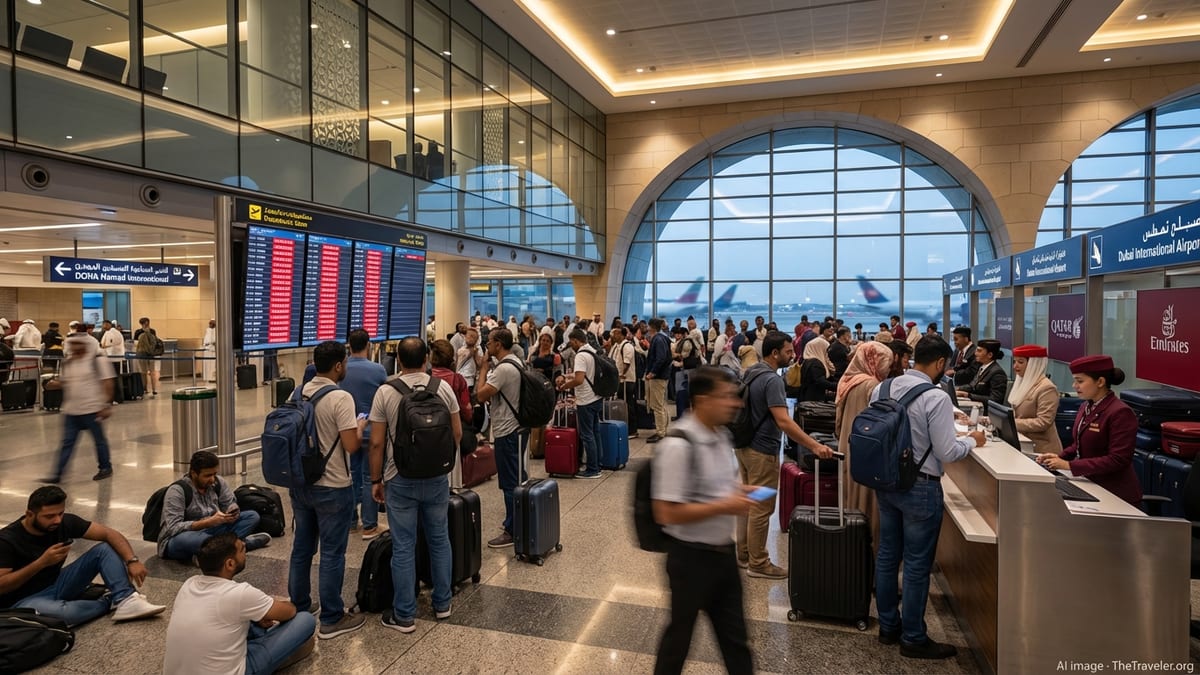
Major Gulf Hubs Fall Silent as Airspace Closes
What began as rolling airspace restrictions late on February 28 has rapidly escalated into one of the most severe shocks to global aviation in years, as authorities in the United Arab Emirates, Qatar, Kuwait and Bahrain ordered near-total closures of their skies in response to escalating military strikes involving the United States, Israel and Iran. Radar maps show vast swathes of airspace over Iran, Iraq, Israel, the Gulf and parts of Jordan almost empty of commercial aircraft, a highly unusual picture in one of the world’s busiest transit corridors.
Dubai International and Al Maktoum International, normally among the busiest airports on the planet, suspended all flight operations after overnight missile and drone attacks and subsequent safety reviews. Abu Dhabi’s Zayed International, Doha’s Hamad International, Sharjah, Kuwait International and Bahrain International have all reported waves of cancellations, diversions and ground stops as national regulators moved to protect passengers and crews while military activity continues.
Aviation analytics firms and airport operators estimate that, across the region, more than 2,650 flights have already been cancelled or scrubbed from schedules since late Saturday, with hundreds more delayed, as airlines halt operations or attempt complex diversions around the affected skies. With many cancellations announced only hours before departure, passengers have found themselves suddenly trapped in terminals or turned back to their origin airports mid-journey.
Emirates, Qatar Airways, Etihad and Others Forced to Ground Fleets
The shutdown has hit the Gulf’s big network airlines particularly hard. Emirates has suspended all operations to and from Dubai for the duration of the UAE airspace closure, grounding a large portion of its long-haul fleet and severing its role as a global connecting hub. Sister airline FlyDubai has also frozen services, while Air Arabia has cancelled flights across its UAE bases in Abu Dhabi, Sharjah and Ras Al Khaimah.
In Doha, Qatar Airways has paused departures and arrivals at Hamad International, where normal traffic of more than 100,000 daily passengers has fallen to a trickle of repositioning and emergency flights. Abu Dhabi’s Etihad Airways has suspended most departures from Zayed International until at least Sunday afternoon local time, warning that further disruption is likely as security assessments evolve and airspace restrictions are updated.
Other regional carriers including Flynas, Saudia, Kuwait Airways, Gulf Air, Jazeera Airways and Royal Jordanian have issued their own waves of cancellations as Bahrain, Kuwait and neighboring states tighten or fully close their airspace. International airlines such as Turkish Airlines, Air India, Lufthansa, British Airways, Delta and United have in parallel halted services into the region or rerouted aircraft via longer corridors over Saudi Arabia, Egypt and the eastern Mediterranean, adding hours to flight times.
Analysts note that the Middle East has become even more central to global aviation since many airlines began avoiding Russian and Ukrainian airspace in 2022. With multiple Gulf hubs now effectively offline, carriers are confronting a sudden loss of key refuelling and transfer points on routes linking Europe, Africa and Asia.
Stranded Tourists Face Uncertainty in Dubai, Doha and Beyond
For tourists on the ground, the closures have translated into long queues, improvised sleeping arrangements and mounting uncertainty. At Dubai International, where some terminals briefly lost partial power during overnight strikes, passengers have described crowded departure halls, limited seating and hours-long waits to reach airline service desks. Many travellers report receiving cancellation notifications only after arriving at the airport, with onward connections already erased from global booking systems.
Similar scenes have been reported at Abu Dhabi and Doha, where stranded passengers lined up to secure hotel vouchers or rebooking options amid limited availability. Families on holiday in the UAE, pilgrims transiting through the Gulf and students on group trips have all found themselves unable to leave, as airlines prioritize safety and await clearer guidance from civil aviation regulators and military authorities.
Tourism boards and hotel groups across Dubai, Abu Dhabi and Qatar are coordinating with airlines to extend stays for stranded guests at discounted rates where possible, but capacity in airport hotels has quickly filled. Some travellers with flexible visas have relocated into city hotels to wait out the disruption, while those with tighter entry conditions are being asked to remain airside until flights resume.
Travel insurers and consumer advocates are advising tourists to keep all receipts for additional accommodation, meals and transport, while warning that coverage will vary depending on policy wording and whether a country’s official travel advice now discourages non-essential trips to the region.
Ripple Effects on Global Routes and Future Bookings
Beyond the immediate humanitarian and logistical challenges at Gulf airports, the airspace closures are rippling across the global route network. With Iran, Iraq, Israel and much of the Gulf off-limits, airlines are funnelling long-haul services through narrower corridors over Saudi Arabia, Egypt and Cyprus, increasing congestion, flight times and fuel burn. Aviation security experts caution that, even once some airspace begins to reopen, rerouting and capacity constraints are likely to linger for days or weeks.
Industry analysts say the cancellations already recorded in the Gulf, coupled with hundreds of diversions and delays across Europe and Asia, will place pressure on airline finances just as many carriers were counting on strong spring and summer travel demand. Higher operating costs, potential insurance premiums and reduced aircraft utilization could feed through to higher fares on some long-haul routes if the disruption persists.
Forward bookings to major Gulf hubs and popular stopover destinations such as Dubai are expected to soften in the near term as travellers digest images of crowded terminals and missile-damaged infrastructure. At the same time, alternative hubs in Istanbul, Riyadh and Cairo may see a surge in demand, raising questions about how long they can absorb extra traffic while maintaining on-time performance and security standards.
Regulators in Europe and Asia are continuing to update conflict-zone advisories, and many carriers now face complex decisions about when it will be safe and commercially viable to restore normal schedules to affected airports. Until clear and coordinated guidance emerges, airlines are likely to err on the side of caution.
What Travellers Should Do If Their Flight Is Affected
With schedules changing by the hour, airlines and travel agents are urging passengers not to travel to airports in the UAE, Qatar, Kuwait or Bahrain unless they have written confirmation that their flight is still operating. Many carriers, including Emirates, Qatar Airways and Etihad, have introduced limited change-fee waivers and refund options, but processing times are slowed by the sheer volume of affected bookings.
Travellers currently stranded in Gulf airports are being advised to stay in close contact with their airline’s official channels, monitor departure board updates and, where possible, register their contact details for automated alerts. Those yet to depart are being encouraged to consider postponing or rerouting trips, especially for discretionary leisure travel, until there is clearer visibility on airspace reopening plans.
For tourists with complex itineraries involving multiple tickets or third-party booking platforms, consumer groups recommend documenting all communications and changes in case of future disputes over refunds or compensation. While many jurisdictions require airlines to assist or compensate passengers during major disruption, force majeure clauses linked to armed conflict and airspace closures may limit entitlements in some cases.
With no firm timeline for a full resumption of normal operations, travellers, airlines and tourism businesses across the Middle East and beyond are bracing for several more days of disruption. The episode underscores how quickly geopolitical tensions can cascade into global travel paralysis, particularly in regions that sit at the crossroads of international aviation.