

More news on this day
Global air travel has been thrown into turmoil as Emirates and Qatar Airways suspend most flights through their Dubai and Doha hubs, following sweeping airspace closures linked to the escalating US-Israel conflict with Iran.
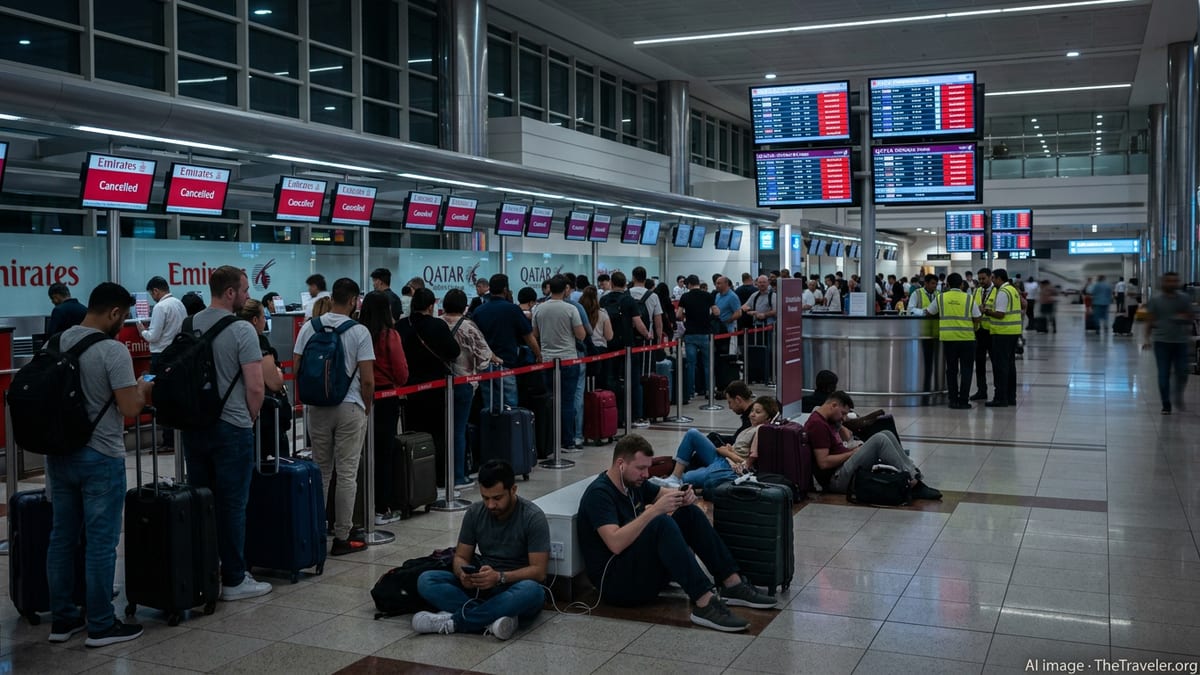
Major Gulf Hubs Fall Silent
Two of the world’s most important transit gateways, Dubai International Airport and Doha’s Hamad International Airport, are operating at a fraction of their usual capacity after regional authorities imposed tight airspace restrictions. Emirates has suspended all scheduled passenger flights to and from Dubai until 23:59 local time on March 4, maintaining only a limited number of repatriation and cargo services for stranded customers. Qatar Airways, whose global network depends almost entirely on its Doha hub, has halted all scheduled operations as Qatari airspace remains officially closed.
Qatar Airways confirmed on March 4 that its suspension will continue until the Qatar Civil Aviation Authority declares the skies safe to reopen. The airline has pledged to provide a further update by March 6 and is offering free date changes within 14 days of travel or refunds for passengers booked between February 28 and March 10. Emirates, meanwhile, is prioritising travellers with earlier bookings on the handful of outbound services operating under special approvals, while warning others not to travel to the airport unless they have received direct confirmation of a seat.
UAE regulators say only restricted emergency corridors are currently available, allowing a capped number of departures each hour primarily for repatriation and essential cargo. Despite the modest restart, the vast majority of regular long-haul services that rely on east west connections through Dubai and Doha remain grounded, effectively severing some of the busiest air routes linking Europe, Africa and the Americas with Asia and Australasia.
Conflict Fallout Ripples Across Global Networks
The grounding of Emirates and Qatar Airways coincides with widespread airspace closures across the Middle East, including over Iran, Israel, Kuwait and large parts of the United Arab Emirates. The shutdown follows days of missile and drone exchanges tied to the US-Israel campaign against Iran, which has targeted both military facilities and critical infrastructure across the Gulf. Authorities in Qatar and the UAE have confirmed that civilian aviation infrastructure came under fire, prompting an uncompromising safety-first approach by regulators.
Industry trackers estimate that more than 11,000 flights have been cancelled since the weekend, with some analyses putting the figure above 12,000 when diversions and last minute turn-backs are included. That number is rising by the hour as airlines continue to pull services that would ordinarily overfly the Gulf region, even if they do not land there. Carriers in Europe and Asia are racing to redraw routes to avoid closed or high risk airspace, adding hours to flight times, straining crew schedules and sharply increasing fuel costs.
With two of the world’s biggest long-haul carriers largely offline, global connectivity has suffered a sudden and severe shock. Emirates and Qatar Airways together carried tens of millions of passengers a year before this crisis, funnelling traffic through their hubs on dense networks of one stop itineraries. Their simultaneous suspension has removed a critical layer of redundancy from the international system, leaving smaller carriers and point-to-point operators scrambling to absorb demand that they are ill-equipped to handle at short notice.
Travellers Stranded From Asia to Europe
Scenes of confusion and frustration have been reported at airports from Dubai and Doha to London, Mumbai and Singapore as passengers grapple with rolling cancellations and limited information. At Dubai International, photos and eyewitness accounts describe departure boards dominated by the word “cancelled,” with passengers sleeping on terminal floors or queuing at service desks for hours in the hope of rebooking. Similar disruption has been reported in Doha, where the abrupt closure of Qatari airspace forced Qatar Airways to halt both regional shuttles and long haul departures with little warning.
Downstream effects are being felt across Asia and Europe. Vietnam’s aviation regulator reported that Qatar Airways has cancelled multiple services to and from Ho Chi Minh City and Hanoi this week, affecting thousands of passengers. In Europe, some airlines have begun resuming carefully selected services to the Gulf, but many onward connections that rely on Emirates or Qatar Airways remain unavailable, leaving travellers to piece together complex multi stop journeys or abandon trips altogether.
Hotel occupancy in hub cities has surged as airlines issue meal and accommodation vouchers for those unable to depart, while ground transport providers are seeing spikes in demand from passengers seeking alternative routes by road or rail. With many governments now formally advising citizens to leave parts of the region as soon as practicable, demand for any available seats out of the Middle East far outstrips supply.
Limited Exceptions and Patchwork Alternatives
Despite the broad suspensions, a patchwork of limited operations is emerging across the region. Emirates and fellow UAE carrier Etihad are running a small number of repatriation and freighter flights under special approvals, focusing on clearing backlogs of passengers and cargo already in the system. Low cost operator flydubai has also resumed a handful of services on authorised corridors, while some foreign carriers, including a few European airlines, have cautiously restarted selected flights into Dubai under tight security protocols.
However, these exceptions provide little relief for most international travellers who would normally rely on seamless connections through Dubai or Doha. Seats on the few outbound flights are being allocated primarily to those whose journeys were disrupted earlier in the crisis, and airlines are warning that walk up passengers without prior confirmation will not be accepted. Travel agents report that alternative itineraries, especially between Europe and South or Southeast Asia, are becoming increasingly convoluted, often involving detours via central Asia, Africa or southern Europe.
The rerouting of long haul flights away from closed airspace is also creating new bottlenecks in skies that are not designed to handle such concentrated traffic. Air traffic management agencies in neighbouring regions are coordinating to accommodate the surge, but longer flight times and crew duty limitations are forcing airlines to trim schedules, further constraining capacity at a moment of intense demand.
Uncertain Timeline, Mounting Economic Cost
As of March 4, there is no clear timetable for a full resumption of normal operations through Dubai and Doha. Qatar Airways has pledged to provide its next detailed update on March 6, while Emirates has tied its own restart to guidance from the UAE’s General Civil Aviation Authority, which is reviewing the security situation on a rolling basis. Industry analysts caution that even once airspace is formally reopened, restoring complex hub operations and reconnecting aircraft, crew and passengers scattered around the world will take days, if not weeks.
The financial impact on Gulf carriers and the wider travel industry is already significant. Every day of suspension translates into hundreds of millions of dollars in lost ticket revenue, additional fuel and staffing costs, and compensation or care obligations for stranded travellers. Airports, ground handling companies, catering providers and tourism businesses that rely on the steady flow of transit passengers through Dubai and Doha are bracing for a sharp short term downturn.
For passengers, the immediate priorities remain information and flexibility. Both Emirates and Qatar Airways are offering fee free date changes and, in many cases, refunds for tickets covering the disrupted period, though call centres and online channels are under heavy strain. Travel trade bodies are urging customers to monitor airline advisories closely, avoid unnecessary trips to airports, and prepare for the possibility that disruption to routes through Dubai and Doha could persist beyond this week if the security situation in the region fails to stabilise.