

More news on this day
Thousands of travelers are stranded across the Gulf and beyond after Qatar, the United Arab Emirates and Kuwait moved to shut their airspace on February 28 in response to escalating regional conflict, forcing airlines to halt or reroute flights from key hubs in Doha, Dubai, Abu Dhabi and Kuwait City.
Coordinated Airspace Closures After New Strikes on Iran
The sudden wave of airspace closures came hours after a joint United States and Israeli attack on targets inside Iran, followed by retaliatory missile launches that rattled governments and aviation authorities across the Middle East. Officials in Qatar, the UAE and Kuwait cited security concerns and the risk to civilian aircraft as they confirmed that skies over their territories would be temporarily closed to most commercial traffic.
Qatar’s civil aviation authority said all air traffic in and out of the country had been suspended, effectively freezing operations at Hamad International Airport, one of the world’s busiest long haul hubs. Qatar Airways, the national carrier, announced a temporary suspension of flights to and from Doha and said it would resume operations only once airspace is deemed safe by regulators.
In the UAE, authorities ordered a partial but sweeping shutdown of airspace, prompting Emirates, Etihad and flydubai to ground or divert flights at Dubai International and Abu Dhabi International. Kuwait followed with its own closure, halting flights and tightening security after being identified among countries at risk amid the widening confrontation between Iran and its rivals.
Regional officials framed the measures as precautionary and temporary, but acknowledged that the timing and scope of the shutdown were unprecedented in a region that serves as a crossroads for global air travel between Europe, Asia, Africa and the Americas.
Global Carriers Scramble as Hubs Go Dark
As the closures rippled across the region on Saturday, major airlines in Europe, Asia and North America scrambled to adjust schedules, cancel services or plot lengthy detours around affected airspace. Long haul routes that normally rely on overflying Iran, Iraq and the Gulf to connect cities such as London, Paris, Frankfurt and Amsterdam with destinations in Asia and Australia were especially disrupted.
Carriers including Emirates, Etihad and Qatar Airways halted large portions of their networks, warning passengers of extensive cancellations and delays. European groups such as Lufthansa and Air France suspended flights to Dubai and other Gulf destinations for at least the weekend, while low cost operator Wizz Air paused services to Dubai and Abu Dhabi. Several airlines also extended existing suspensions to Tel Aviv, Beirut and Muscat as a wider conflict zone emerged on aviation risk maps.
Industry trackers reported that some aircraft departing earlier in the day were forced to circle or divert after airspace closures were activated, with several Qatar Airways flights returning to Doha or holding over neighboring countries before being rerouted. Aviation analysts said the pattern was reminiscent of earlier conflict flare ups, but on a broader scale that now encompasses multiple Gulf states simultaneously.
Airlines are also contending with warnings from European and international safety regulators, which have advised carriers to avoid large swathes of Middle Eastern airspace at all altitudes. That guidance effectively closes off some of the most direct and fuel efficient corridors between continents, adding both time and cost to any remaining services that can still operate.
Passengers Face Long Waits, Limited Options
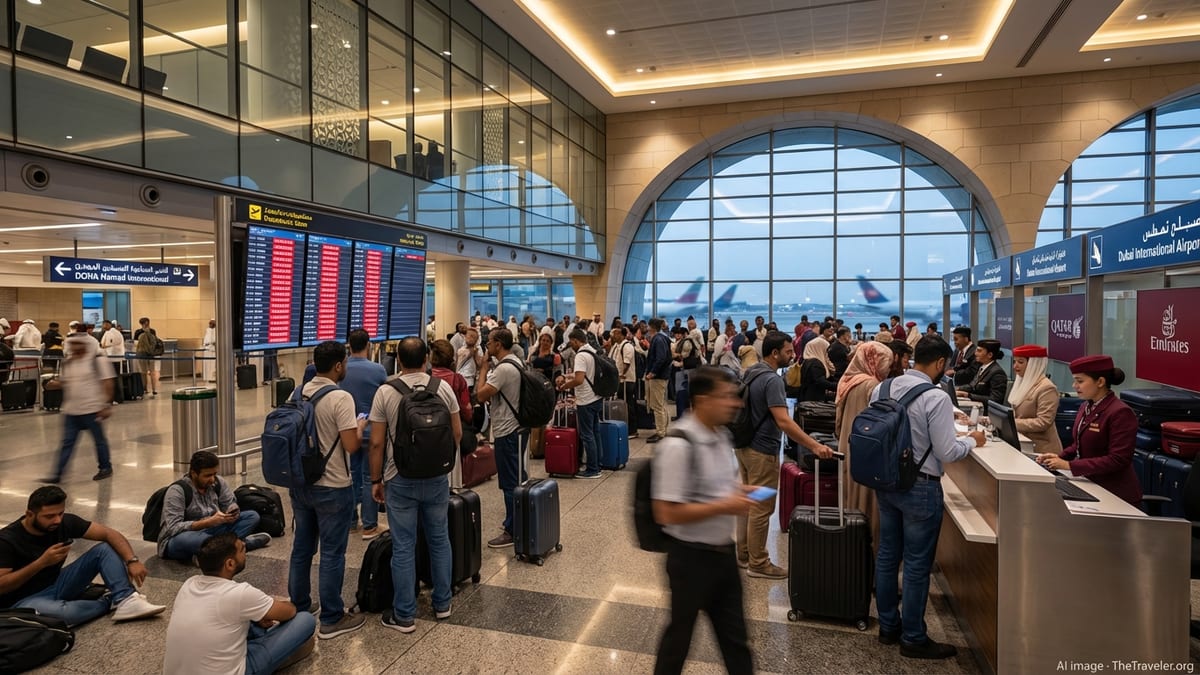
For travelers on the ground, the sweeping shutdown has translated into crowded terminals, snaking queues at customer service desks and an acute shortage of immediate alternatives. At Hamad International Airport in Doha, one of the most important transit hubs for Europe to Asia and Africa routes, passengers reported sudden gate changes followed by blanket cancellations as flight information boards flipped to red.
Qatar Airways said it had deployed additional staff at Hamad International and at other key airports to assist affected customers, offering rebooking and accommodation where possible. However, with airspace officially closed, airlines have little visibility on when normal schedules might resume, leaving many travelers stuck in limbo and struggling to secure onward connections on unaffected routes.
Scenes were similar in Dubai and Abu Dhabi, where the grounding of Emirates and Etihad services created bottlenecks for passengers traveling between Europe, India, Southeast Asia and Australasia. Some travelers have resorted to booking last minute tickets on carriers routing via alternative hubs such as Istanbul or Cairo, though those options are limited and rapidly filling as demand surges.
Travel agencies and online booking platforms reported a spike in calls and messages from anxious customers seeking clarity. With airlines updating advisories by the hour, industry experts are urging passengers to monitor official airline channels, avoid heading to airports without confirmed rebookings and consider delaying non essential trips through the region.
What Travelers Need to Know Right Now
Aviation regulators and airlines emphasize that safety remains the overriding priority behind the current closures, with authorities assessing missile activity, military operations and radar coverage before allowing any gradual reopening of airspace. Until that happens, travelers should expect rolling cancellations, longer flight times on rerouted services and a high likelihood of missed connections.
Passengers with tickets on Qatar Airways, Emirates, Etihad, flydubai or Kuwait Airways are being offered fee waivers for rebooking or travel vouchers in many cases, although exact policies differ by carrier and fare type. Travelers are advised to manage bookings directly through airline apps or call centers rather than third party intermediaries where possible, as this can speed up the process of securing new travel dates once flights resume.
Those already overseas and relying on Gulf hubs to return home may need to consider alternative routings via unaffected regions. However, aviation experts caution that availability will be tight and fares may rise quickly as remaining seats are snapped up. Travel insurance coverage also varies widely, so passengers should check whether policies include disruption caused by war or airspace closures before assuming eligibility for reimbursement.
For now, officials in Qatar, the UAE and Kuwait have not provided firm timelines for reopening their skies, stressing that any decision will depend on security assessments in the coming hours and days. With the conflict that triggered this crisis still unfolding, the Gulf’s usually seamless air bridges linking East and West have been abruptly severed, underlining how quickly geopolitical shocks can upend the global travel network.