

More news on this day
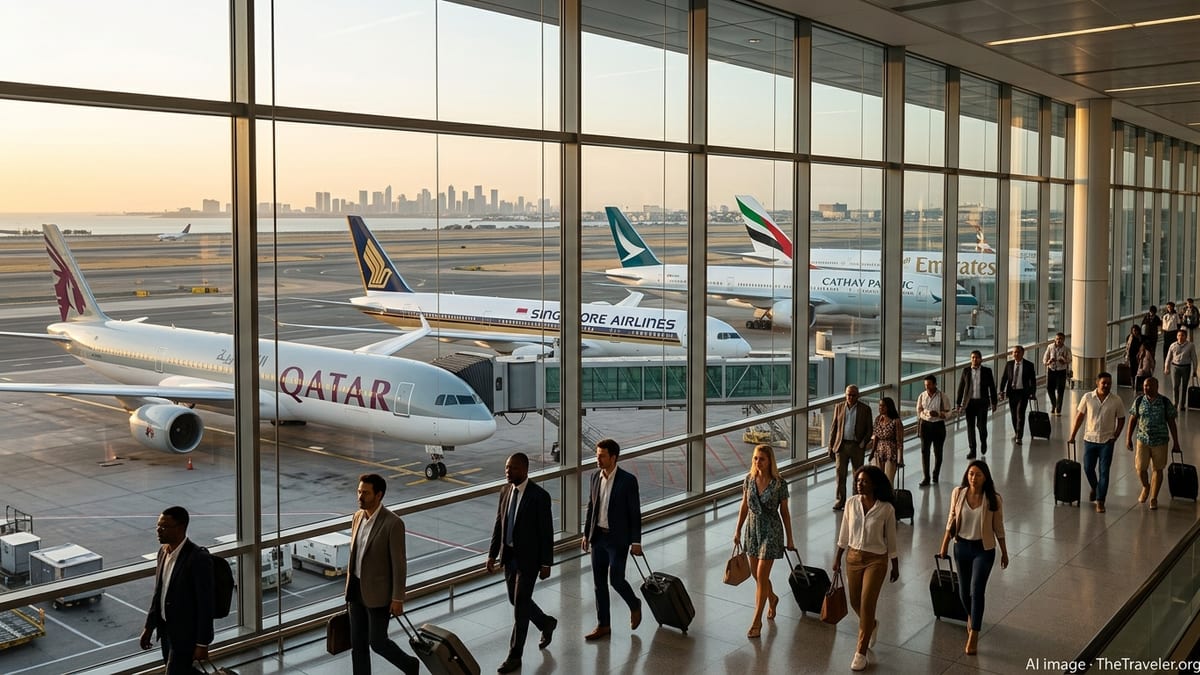
Qatar Airways is joining Singapore Airlines, Cathay Pacific and Emirates at the forefront of 2026’s global travel rebound, as a powerful shift toward premium long-haul flying channels higher-spending visitors into Spain’s resort regions and the United States’ luxury hotel market.
Get the latest news straight to your inbox!
Premium Long-Haul Capacity Surges Into 2026
Industry data for early 2026 points to a decisive upswing in international air travel, with long-haul routes and premium cabins leading the way. The International Air Transport Association reports that global passenger demand at the start of 2026 is up compared with the previous year, with international traffic expanding faster than domestic segments and airlines preparing for another year of growth in capacity and seats sold.
Within this landscape, Qatar Airways, Singapore Airlines, Cathay Pacific and Emirates have consolidated their positions as network leaders on intercontinental corridors linking Europe, Asia, the Middle East and North America. Publicly available schedules, capacity announcements and fleet plans show these carriers focusing heavily on widebody deployments, upgraded business-class products and increased frequencies on routes popular with high-yield leisure travelers and corporate clients.
Forecasts from global travel and business travel analysts indicate that premium-cabin and long-haul demand will continue to outpace overall market growth through 2026. That shift, combined with easing capacity constraints and gradually moderating fares in real terms, is expected to sustain a strong pipeline of international visitors for key tourism economies that can capture this higher-spending segment.
Qatar Airways and Singapore Airlines Target High-Value Flows
Qatar Airways is leaning on its Doha hub to rebuild and redirect traffic flows as schedules are adjusted through March 2026 and beyond. Updated timetables and travel notices show the carrier steadily restoring services across Europe, Africa and Asia, while maintaining a strong focus on connectivity that allows passengers from secondary cities to reach major leisure destinations in a single stop. Even with temporary disruptions on selected routes, the airline’s broad network and flexible rebooking policies are keeping premium demand anchored to its hub.
Singapore Airlines is meanwhile locking in substantial growth for the 2026 northern summer season. The airline has confirmed a schedule of more than two thousand weekly flights and a network approaching 80 destinations, supported by aircraft upgauges on high-demand routes. Published information shows that premium cabins are a particular focus, with the Airbus A380 being deployed on the Singapore–Dubai sector for the first time across the 2026 summer period, underscoring confidence in luxury and upper-cabin traffic on key connecting routes.
The carrier has also rolled out fare sales and promotional campaigns in early 2026 covering Europe and the United States, including discounted business-class offers on selected dates. These initiatives, combined with announcements of an “enhanced travel experience” unveiling during 2026, signal a strategy built around capturing travelers who are willing to pay more for comfort and service, while still responding to price-sensitive demand with targeted discounts.
Cathay Pacific and Emirates Deepen Transcontinental Premium Offerings
Cathay Pacific continues to rebuild its long-haul network, adding back European destinations such as Rome and Brussels and expanding into new gateways including Munich and Dallas. Company traffic updates and investor reporting for 2025 detail a steady march toward more than 100 destinations when combined with low-cost affiliate HK Express, with a particular emphasis on long-haul flights to North America and Europe that attract both business travelers and affluent leisure passengers.
New and refurbished aircraft are central to this push. Cathay Pacific has begun operating retrofitted Boeing 777-300ER jets on routes between Hong Kong and major U.S. cities such as San Francisco, featuring its latest Aria Suite in business class, a redesigned premium economy cabin and refreshed economy seating. The product upgrade is aimed squarely at travelers prioritizing privacy and comfort on lengthy transpacific journeys, many of whom then continue onward to European resort markets or onward within the United States.
Emirates, for its part, remains a dominant force on trunk routes that link Europe and the Americas with the Middle East and Asia. While the airline has not yet detailed its full 2026 schedule, published network trends and fleet deployment patterns point to continued heavy use of Airbus A380 and Boeing 777 aircraft on city pairs such as Dubai to Madrid, Barcelona, New York and Los Angeles. The carrier’s investment in premium economy cabins, along with its established first and business-class products, is designed to capture a broad spectrum of higher-spend customers feeding into both European resort destinations and U.S. luxury city stays.
Spain’s Resort Regions Catch the Wave of High-Spend Tourism
Spain is emerging as one of the principal European beneficiaries of the 2026 premium travel upswing. Forecasts from Spanish and European tourism analysts compiled over late 2025 and early 2026 point to another strong year for inbound arrivals, with particular resilience in higher-income visitor segments. These travelers are typically more insulated from short-term economic volatility and are more likely to book longer, higher-value stays in resort areas.
Airline capacity decisions are reinforcing this pattern. Publicly available schedule data for 2025 and 2026 show increasing or sustained widebody and high-frequency connections into major Spanish gateways such as Madrid and Barcelona from hubs in Doha, Dubai, Singapore and Hong Kong. From there, strong domestic links and regional low-cost carriers distribute visitors onward to the Balearic Islands, Costa del Sol, Canary Islands and emerging upscale coastal enclaves, where resort operators have spent the past several years upgrading inventory and amenities to target the premium leisure segment.
Banking and tourism-sector research published in late 2025 already highlighted Spain’s outperformance in international overnight stays, and projections into 2026 suggest that this growth will increasingly be led by travelers arriving from long-haul markets. With Qatar Airways, Emirates, Singapore Airlines and Cathay Pacific collectively funnelling more high-yield passengers into European hubs, Spain’s resort regions appear positioned to capitalize on the trend through higher daily spend, extended peak seasons and growing interest in wellness, gastronomy and experiential travel offerings.
U.S. Luxury Hotels Ride Rising Transpacific and Transatlantic Demand
On the other side of the Atlantic, luxury properties in the United States are preparing for a strong 2026 driven by robust long-haul arrivals. Recent global business travel forecasts anticipate that North America will continue to record some of the highest average ticket prices worldwide, largely due to strong corporate travel and a pronounced tilt toward premium cabins on long-haul routes. This higher revenue per passenger provides airlines with incentives to sustain or expand capacity into major U.S. hubs, benefitting upscale hotels in gateway cities.
Network updates from Cathay Pacific, Singapore Airlines, Emirates and Qatar Airways collectively indicate a dense web of services into airports such as New York JFK, Newark, San Francisco, Los Angeles, Chicago and Dallas. Many of these flights feature next-generation business-class suites, premium economy cabins and upgraded lounges, appealing to travelers inclined to extend trips into luxury city breaks or combine business travel with high-end leisure stays.
Hospitality analysts tracking bookings for late 2025 and 2026 report that top-tier hotels in U.S. urban centers and resort markets are seeing sustained interest from international guests, even as domestic demand normalizes. The mix of corporate meetings, high-net-worth leisure trips and extended stays by remote workers is boosting demand for suites, club-level rooms and branded residences. With Gulf and Asian network carriers competing aggressively for the most profitable passengers, the United States’ luxury hotel segment is poised to see continued rate strength and elevated occupancy from international visitors throughout 2026.