

More news on this day
More than 20 flights operated by Gulf Air, China Eastern, Qatar Airways, Tibet Airlines and China Eastern’s regional partners were canceled or heavily disrupted on key China routes this week, severing links to Bahrain, Riyadh, Doha, Xi’an and several other cities and sending passengers scrambling to rebook at short notice.
Get the latest news straight to your inbox!
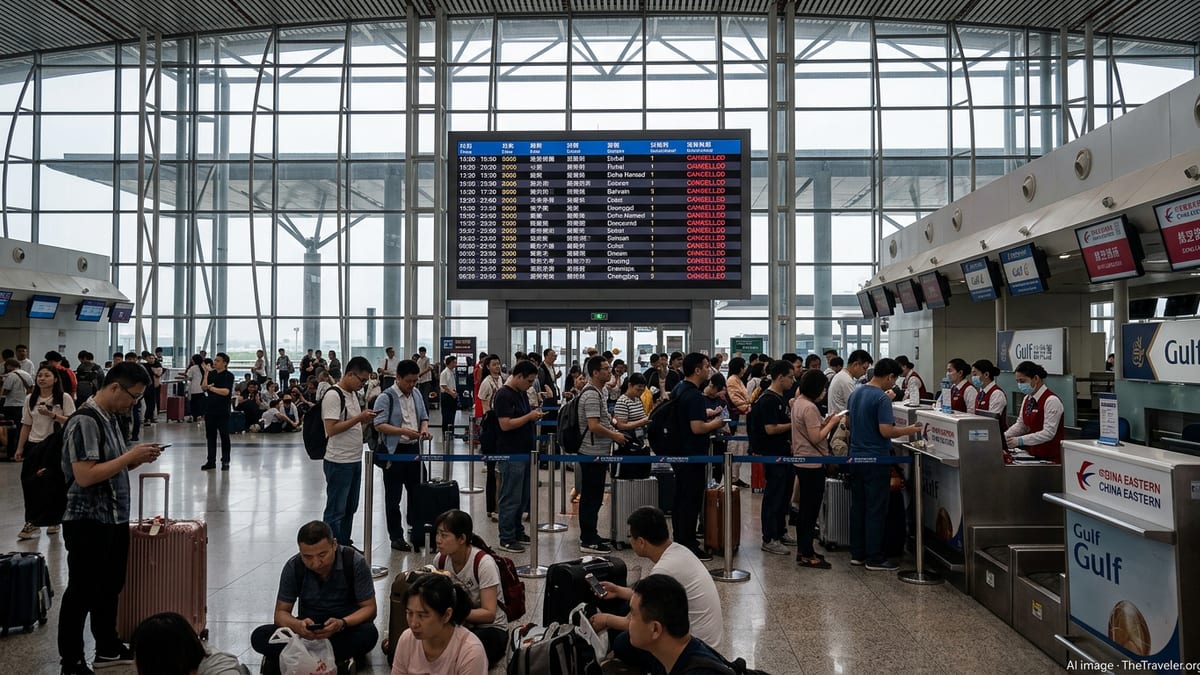
Wave of Cancellations Hits Key China–Gulf Routes
Publicly available flight status data and local media coverage indicate that a fresh round of cancellations has swept across routes connecting mainland China with the Gulf region since early March 2026. Services involving Gulf Air, Qatar Airways, China Eastern and Tibet Airlines have been especially affected, with a cluster of more than 20 flights scrubbed or significantly delayed on routes touching Bahrain, Riyadh, Doha, Xi’an and secondary Chinese hubs.
The latest disruption follows rolling airspace restrictions and operational suspensions around Bahrain and Qatar, which have already reshaped long haul schedules between Asia, the Middle East and Europe. Industry bulletins note that Bahrain International Airport continues to experience suspended or sharply reduced operations, while Qatar remains under temporary airspace limitations that are forcing carriers to reduce frequencies and reroute traffic.
As carriers adjust in near real time, China appears both as a destination and as an alternative transit point. Some passengers originally booked via Gulf hubs have been pushed onto China Eastern or other Chinese airlines instead, while others have seen those same replacement flights canceled as operational pressures spread into East Asia’s networks.
The result is a patchwork of last minute schedule changes, with flight trackers on Friday showing canceled and severely delayed services on China linked itineraries that would ordinarily funnel travelers through Manama, Doha or Riyadh to and from Europe, South Asia and Southeast Asia.
Gulf Air and Qatar Airways Under Pressure
Gulf Air remains among the hardest hit. Passenger advisories and airline updates issued in early March report that Bahrain based operations were temporarily suspended as a direct consequence of airspace closure around the kingdom. With Bahrain serving as the airline’s primary hub, the shutdown has effectively grounded much of Gulf Air’s network, including flights that would usually connect Chinese cities to Manama and onward to regional destinations such as Riyadh and Jeddah.
Qatar Airways has also sharply curtailed flights in and out of Doha following security related disruptions earlier this month. Travel industry summaries describe a combination of temporary airspace closures, re routing and selective cancellations, affecting connections from China to Doha and beyond. Routes that typically link Shanghai, Guangzhou or Beijing with Hamad International Airport have seen higher than usual cancellation rates, with passengers reporting last minute notices, same day rebookings and, in some cases, full refunds.
Reports from passenger forums suggest that while Qatar Airways has been expanding options to re route travelers on partner or interline airlines, capacity is under strain. Travelers scheduled to fly China–Doha–Bahrain or China–Doha–Riyadh have described being shifted to alternative routings via East Asia or South Asia, sometimes requiring overnight layovers and additional domestic connections within China.
These network level constraints explain why individual cancellations inside China now ripple far beyond a single point to point route. A scrubbed Doha service, for instance, can cascade into missed Bahrain or Riyadh connections, forcing wholesale rebookings across multiple tickets that touch Chinese airports.
China Eastern, Tibet Airlines and Domestic Knock On Effects
Chinese carriers are feeling the strain as they absorb rerouted demand while also managing their own schedule changes. China Eastern, a leading operator on China–Middle East corridors, is contending with disrupted traffic flows and aircraft rotations that have led to a series of cancellations and long delays on certain international and domestic legs.
Travel commentary in Chinese and international media highlights elevated cancellation rates for flights between Chinese hubs and Middle Eastern destinations since the start of March. Some China Eastern services connecting cities such as Shanghai, Xi’an and Kunming to Gulf hubs have been pulled from schedules or converted into irregular operations as the airline works around restricted air corridors and altered overflight permissions.
Tibet Airlines, identified by its TBA designator, has also seen schedule volatility on routes within China that act as feeders into international services. Flight logs show day of departure cancellations and delays on sectors linking inland cities such as Chengdu and Lhasa with major coastal gateways. These domestic disruptions complicate travel plans for passengers who rely on Tibet Airlines and other regional carriers to reach China Eastern or Qatar Airways long haul departures.
In effect, China’s vast internal network has become both a buffer and a stress point. While additional domestic sectors can sometimes rescue disrupted itineraries, unpredictability on routes into and out of Xi’an, Chengdu and other inland hubs means that even passengers holding confirmed tickets may face sudden changes as operational teams reassign aircraft and crews.
Passengers Scramble to Rebook and Reroute
The human impact of the latest wave of disruptions is visible in traveler accounts shared across social platforms and consumer forums. Many describe learning of cancellations only hours or a few days before departure, prompting urgent efforts to secure scarce replacement seats during a busy spring travel period.
Some passengers originally booked on Gulf Air or Qatar Airways via Bahrain or Doha report being rebooked on China Eastern or other Asian carriers at no additional fare, though seat availability can be limited on popular dates. Others have opted to purchase entirely new itineraries through alternative hubs such as Istanbul, Kuala Lumpur or Singapore to avoid uncertain Gulf routings, hoping to recover costs later through refunds or travel insurance claims.
Travel advice circulating widely this week emphasizes the importance of checking flight status frequently, not just through mobile apps but also via airline websites and airport departure boards. With schedules changing rapidly, passengers heading to or from China on routes involving Bahrain, Doha or Riyadh are being urged to confirm details at least 48 to 72 hours before departure and to monitor for real time updates on the day of travel.
In many cases, travelers are also being encouraged to keep flexible backup plans, such as alternative dates or nearby departure airports, in case their original China linked Gulf routing becomes unworkable at short notice.
What Travelers Should Expect in the Coming Days
Analysts and aviation consultancies tracking the situation caution that the pattern of rolling cancellations and late schedule changes is likely to continue in the short term. Airspace restrictions around parts of the Gulf, combined with ongoing security assessments, mean carriers may announce further adjustments on China–Gulf routes with limited warning.
For China bound passengers, this translates into a higher than normal risk of disruption on itineraries touching Bahrain, Doha or Riyadh, regardless of whether the ticket is issued by a Gulf airline or a Chinese partner. Even flights that appear confirmed can be rescheduled or rerouted as airlines respond to evolving operational constraints.
Travel planners recommend that those with imminent departures build in extra time for connections, particularly when itineraries include domestic segments within China feeding into long haul flights. Booking longer layovers, choosing earlier departure times on key days and ensuring that contact details are correctly registered with airlines can improve the chances of receiving and responding to last minute updates.
While carriers are gradually refining reaccommodation policies and publishing updated passenger guidelines, conditions remain fluid. For now, anyone traveling between China and the Gulf region should be prepared for potential cancellations, longer journeys and the possibility of unplanned stopovers as airlines work to keep essential links open amid ongoing constraints.