

More news on this day
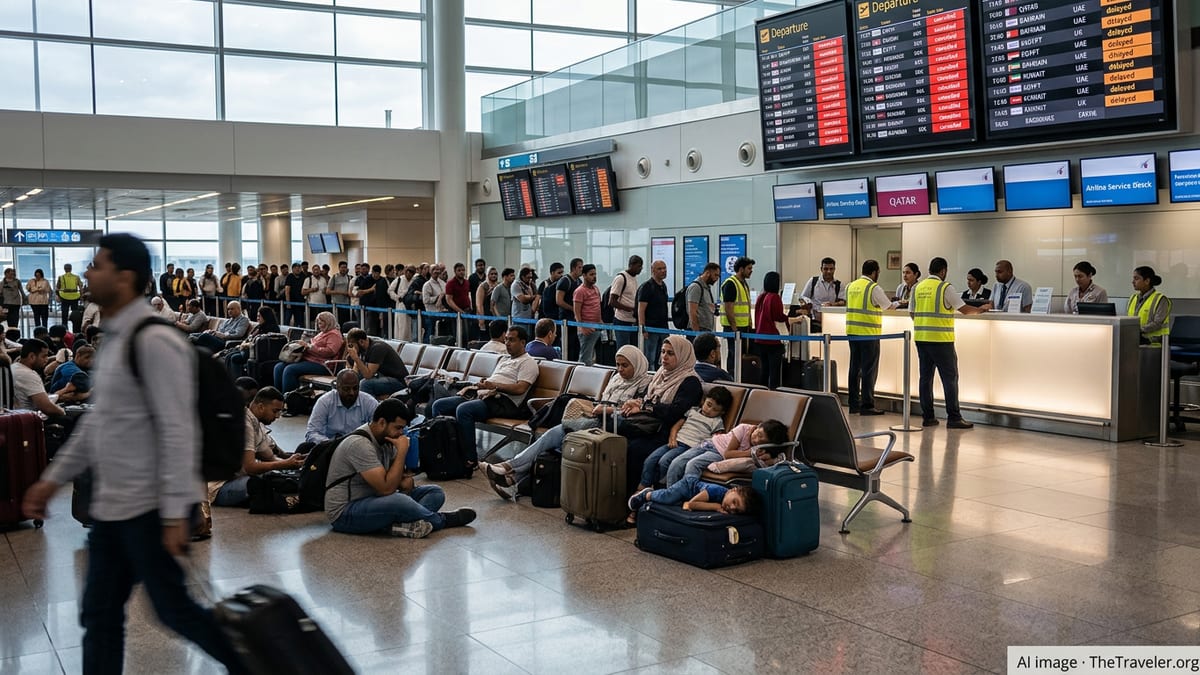
A fast‑moving aviation crisis across Qatar, Bahrain, Egypt, Kuwait and the United Arab Emirates is rippling through global travel networks, with regional data showing 374 flights scrapped and nine services postponed on routes involving Qatar Airways, Gulf Air and EgyptAir, leaving thousands of passengers stranded at major hubs and scrambling for alternative ways home.
Get the latest news straight to your inbox!
Regional Airspace Closures Trigger Wave of Cancellations
Published coverage across the Middle East indicates that a combination of airspace closures and rapidly changing security assessments has forced airlines in Qatar, Bahrain, Egypt, Kuwait and the UAE to slash schedules throughout early March. Aviation trackers and specialist industry outlets report that hundreds of flights have been grounded as carriers attempt to navigate restricted corridors, shifting NOTAMs and capacity constraints at key hubs.
Qatar Airways has been among the hardest hit, with Qatari airspace subject to tight controls and only limited operating corridors approved on specific days. The airline has announced a reduced schedule to and from Doha, focusing on select long haul and regional services while large parts of its usual network remain suspended. Gulf Air and EgyptAir have also trimmed frequencies or paused certain city pairs, particularly on links between Egypt and Gulf hubs that depend heavily on overflight permissions.
Aggregate disruption figures compiled by travel and aviation analysts point to 374 flights cancelled and nine services postponed across these three carriers alone on routes touching Qatar, Bahrain, Egypt, Kuwait and the UAE during the current phase of the crisis. The true impact on passengers is wider, as knock on effects cascade onto partner airlines and code share operations that rely on Gulf hubs for onward connections to Europe, Asia and Africa.
The situation is still evolving, with authorities periodically reviewing airspace restrictions and airlines adjusting timetables in response. As a result, schedules published days or even hours in advance have not always reflected what ultimately departs, increasing the risk of last minute cancellations for travelers who have already reached the airport.
Doha, Cairo, Manama and Gulf Hubs Under Strain
Hamad International Airport in Doha, Cairo International Airport, Bahrain International Airport and major UAE gateways have emerged as pressure points in this phase of disruption. Reports from airport monitoring services describe departure boards dominated by cancellations and delays on routes that would usually carry large volumes of transit traffic between Europe, Asia and Africa.
In Doha, a limited number of Qatar Airways flights have been operating under special approvals, but overall capacity remains far below normal levels. Many passengers have found themselves stranded in transit with missed onward connections and limited rebooking options, particularly where alternative routings would also cross restricted airspace. Social media posts and traveler accounts describe long queues at transfer desks and overwhelmed customer service channels.
Cairo has also seen repeated waves of cancellations affecting EgyptAir and other carriers serving Gulf destinations. Travel industry bulletins cite dozens of scrapped or heavily delayed departures on a single day, including flights to Doha, Dubai, Abu Dhabi, Kuwait City, Manama and Riyadh. For Egyptian travelers who rely on Gulf hubs for employment related travel or onward long haul journeys, the interruptions have been particularly disruptive.
In Bahrain and across key UAE airports, Gulf Air and other regional airlines have been operating a patchwork of services as restrictions ebb and flow. While some flights have been restored on a limited basis, backlogs of displaced passengers and tight seat availability mean that even operating flights are heavily oversubscribed, with some travelers reporting rebooking dates days or weeks after their original plans.
How Qatar Airways, Gulf Air and EgyptAir Are Responding
Publicly available information from the airlines shows a mix of temporary suspensions, limited rescue operations and revised commercial policies intended to give passengers more flexibility. Qatar Airways has announced constrained schedules on selected dates, with priority given to routes that can be operated via approved corridors and that help connect stranded travelers to their home countries. Industry reporting also points to a small number of repatriation style flights launched from nearby airports where airspace conditions permit.
Gulf Air has focused on maintaining a core network from Bahrain while suspending or reducing frequencies on affected routes. Travel advisories shared through media outlets outline options for free rebooking over an extended travel window and, in some cases, refunds for passengers whose flights fall within defined disruption periods. However, limited seat availability and uncertainty over future restrictions have made it challenging for some travelers to secure suitable alternatives.
EgyptAir has adopted a phased approach, gradually resuming some services to the United Arab Emirates and other Gulf destinations while continuing to suspend others. Announcements carried by regional news outlets highlight step by step restorations, such as the return of limited daily flights on certain Egypt UAE routes, balanced against ongoing suspensions where operational or security conditions remain unclear. Passengers on cancelled flights are generally being offered change and refund options subject to the original ticket conditions and the specific disruption policy in force.
Across all three airlines, customer communication has emerged as a major point of frustration. Travelers report difficulty reaching call centers, inconsistent information between mobile apps, websites and airport staff, and uncertainty about whether future flights listed in booking systems will actually operate. This has added a layer of stress for passengers trying to make time sensitive decisions about rerouting.
What Affected Travelers Should Do Now
Travel specialists recommend that passengers with upcoming trips touching Qatar, Bahrain, Egypt, Kuwait or the UAE treat any itinerary as tentative until operations stabilize. Booking confirmations issued before the latest wave of changes may no longer reflect actual flying plans, particularly for travel scheduled in the next one to two weeks. Checking flight status repeatedly in the 24 hours before departure is essential.
Airline and airport advisories suggest that travelers avoid heading to the airport until their flight is clearly shown as operating and on time in the airline’s official channels. Where possible, passengers are urged to use airline apps and online self service tools to request rebooking or refunds, as call centers and ticket offices in affected cities are facing extremely high demand and long wait times.
For those already stranded in transit, travel insurance with disruption coverage may help recoup some costs related to accommodation, meals and alternative transport, but policy terms vary widely. Travelers without robust coverage are often reliant on what the operating airline chooses to provide as a gesture of goodwill in addition to its formal obligations under local and international passenger rights frameworks.
Experts also advise maintaining flexibility on routing and even on departure and arrival airports. In some cases, limited seats may be available from nearby cities where airspace restrictions are less severe or where airlines have added temporary services to help clear backlogs. Being open to indirect routings that bypass the Gulf entirely, such as via European or Asian hubs, can also increase the chances of finding a workable alternative.
Outlook for the Coming Days
Near term prospects remain uncertain. Aviation intelligence providers note that airspace notices and operational approvals are still being updated frequently, making it difficult for airlines to publish stable schedules more than a few days in advance. Some carriers have extended their formal disruption policies to cover travel well into mid March, reflecting expectations of continued volatility.
While limited resumptions, particularly on select Egypt Gulf and intra Gulf routes, offer a measure of relief, capacity remains far below normal. Even if more airspace corridors reopen, it may take time for airlines to reposition aircraft and crew, clear passenger backlogs and restore regular frequencies. Travelers should therefore be prepared for rolling waves of adjustment rather than a single, definitive restart date.
For now, the safest assumption for anyone planning to transit Doha, Cairo, Manama, Kuwait City, Dubai or Abu Dhabi in the immediate future is that plans may need to change at short notice. Monitoring official airline communications closely and building additional time and flexibility into itineraries will be crucial until the regional aviation network stabilizes.
With global connectivity so heavily dependent on Gulf hubs, the impact of the current crisis is being felt far beyond the Middle East. From Europe and Africa to South and Southeast Asia, passengers who normally rely on seamless one stop connections through Qatar, Bahrain, Egypt, Kuwait and the UAE are confronting an unfamiliar landscape of uncertainty, scarce alternatives and crowded airport terminals.