

More news on this day
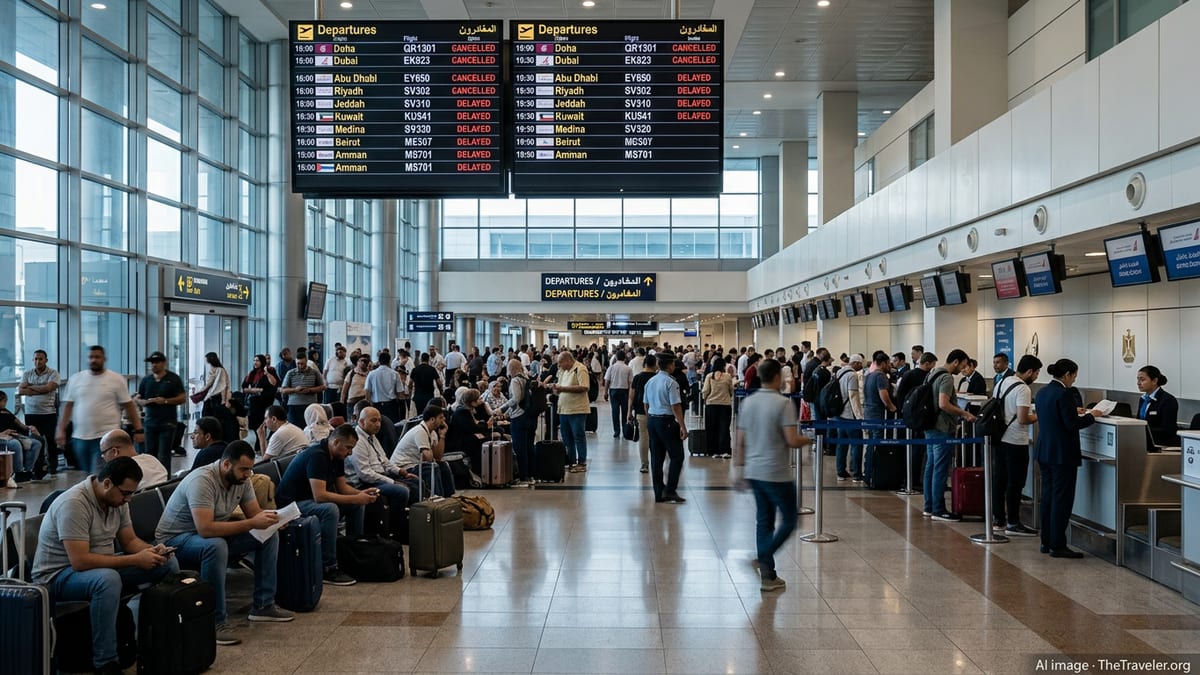
New rounds of flight cancellations by EgyptAir, Gulf Air, Emirates, Kuwait Airways and other regional carriers are intensifying travel disruption for passengers moving between Egypt and major Gulf hubs, with more than 20 additional services reportedly grounded on routes linking Cairo and Alexandria to Riyadh, Dammam, Abu Dhabi, Dubai, Sharjah, Bahrain, Kuwait City and Amman.
Get the latest news straight to your inbox!
Fresh Wave of Cancellations Hits Cairo and Alexandria
Air travel in and out of Egypt is facing renewed strain as regional carriers adjust operations in response to continued airspace constraints and wider Middle East security concerns. The latest schedule changes have resulted in more than 20 further flight cancellations across Cairo International Airport and Alexandria’s Borg El Arab–Alexandria International Airport, focusing heavily on services to Gulf destinations.
Publicly available airport schedules and airline advisories indicate that EgyptAir, Gulf Air, Emirates and Kuwait Airways are among the operators scaling back frequencies on short-haul routes that typically connect Egypt with Gulf business and expatriate markets. Flights serving Riyadh and Dammam in Saudi Arabia, Abu Dhabi and Dubai in the United Arab Emirates, and Bahrain and Kuwait City have seen a particular concentration of disruption.
Services to Sharjah and Amman have also been affected, reducing options for travelers who often rely on these secondary hubs for onward connections to Asia, Europe and North America. The pattern of cancellations, layered on top of previous suspensions earlier in March, is leaving many itineraries in flux and forcing last‑minute changes for both leisure and corporate travelers.
The cumulative impact is especially visible at Cairo, long established as a regional gateway for North Africa and the Levant. With multiple airlines trimming operations simultaneously, passengers are encountering longer connection times, rebooked routings through alternative hubs, or outright trip postponements.
Regional Security Tensions Weigh on Airline Planning
The latest cancellations are unfolding against a backdrop of heightened geopolitical tensions and intermittent airspace restrictions across parts of the Middle East. Travel advisories issued in early and mid March highlight how airspace closures and rerouted corridors around conflict zones continue to complicate flight planning for carriers operating between North Africa and the Gulf.
Open-source travel security assessments note that key airports in Saudi Arabia, the United Arab Emirates, Bahrain, Kuwait and Jordan have all experienced varying degrees of disruption in recent weeks, ranging from temporary suspensions to sharply reduced schedules. These constraints have knock‑on effects for services originating in Egypt, particularly for carriers that rely on overflight permissions and stable regional corridors to maintain dense shuttle-style operations.
Airlines are using a mixture of cancellations, consolidations and aircraft swaps to manage operational risk while preserving at least some connectivity on high-demand routes. Industry reports describe a patchwork of partial resumptions and limited rotations, with some services operating as repatriation or relief flights rather than as part of a normal commercial timetable.
For Egypt-based travelers, this dynamic translates into a moving target: a flight that appears on the departure board one day may be withdrawn the next as carriers respond to evolving security assessments and route-availability updates. This fluid environment has become a defining feature of regional air travel through March 2026.
Gulf Hubs Reduce Capacity on Egypt Routes
Gulf-based airlines that normally channel large passenger flows through their hubs are taking a cautious approach to their Egypt schedules. According to published coverage and community flight trackers, Emirates has intermittently adjusted its Cairo rotations, while also prioritizing a limited set of departures from Dubai for essential travel and onward long-haul connections.
Gulf Air has focused on preserving core Bahrain operations while periodically redirecting or consolidating services through Dammam as an alternative gateway, affecting how often Egypt–Bahrain flights can be offered. Kuwait Airways has meanwhile been reshaping its timetable around Kuwait City, with Egypt services subject to change as the carrier balances regional constraints with continuing demand from expatriate communities.
These strategic trims are particularly visible on historically busy city pairs such as Cairo–Dubai, Cairo–Kuwait and Cairo–Riyadh, where reduced frequencies are replacing the pre‑disruption pattern of multiple daily options. In some cases, flights from Alexandria that once fed Gulf hubs are being cut first, with Cairo maintained as the primary point of service when capacity is limited.
Travel analysts note that hub carriers are also re‑evaluating which time slots and aircraft types best align with current restrictions, sometimes combining passengers from multiple cancelled departures onto a single remaining flight. While this approach helps keep some routes alive, it further reduces flexibility for travelers trying to match connections or urgent travel needs.
Passengers Confront Rebooking Challenges and Longer Journeys
For passengers in Egypt and across the Gulf, the operational adjustments are translating into practical challenges at check‑in counters and on airline websites. Reports from traveler forums describe multiple last‑minute cancellations, repeated rebookings and long hold times as call centers work through backlogs of disrupted itineraries.
Some travelers report being shifted from direct Egypt–Gulf flights onto more complex routings via third‑country hubs that remain less affected by overflight constraints. These alternative journeys can add many hours to total travel time and often require overnight stops, further complicating plans for families and business travelers who had expected short regional hops.
Flexible change policies introduced earlier in the month by several airlines remain important for affected passengers, allowing date changes or credits in cases where routes are temporarily withdrawn. However, availability on remaining services is limited, particularly around peak travel dates, which can leave travelers choosing between delayed departures and partial refunds to rebook with a different carrier.
At airports in Cairo and Alexandria, visible signs of disruption include longer queues at customer service desks, frequent public announcements of schedule changes, and flight information screens showing clusters of cancelled departures to Gulf hubs that, until recently, operated with high regularity.
Outlook: Gradual Adjustments Rather Than Rapid Normalisation
Industry observers expect that airlines serving Egypt–Gulf corridors will continue to recalibrate schedules in the coming days, responding to evolving security conditions and any incremental reopening of affected airspace. Rather than a single date when operations snap back to normal, current indications point to a gradual process of restoration, with frequencies added step by step as carriers regain confidence in route stability.
In practical terms, this means travelers planning journeys between Egypt and cities such as Riyadh, Dammam, Abu Dhabi, Dubai, Sharjah, Bahrain, Kuwait City and Amman may face short-notice changes well into the coming weeks. The most resilient itineraries are likely to be those that build in longer connection buffers and that remain flexible on departure dates and times.
Publicly available flight tracking data suggests that some airlines are beginning to reintroduce limited rotations on previously suspended routes, often labeling them as special or one‑off services. While these additions offer vital capacity for stranded passengers, they do not yet represent a full restoration of the dense pre‑crisis network.
For Egypt’s role as a regional aviation crossroads, the current disruptions underscore how closely its connectivity is tied to the operational health of Gulf hubs and shared regional airspace. Until those underlying factors stabilize, EgyptAir, Gulf Air, Emirates, Kuwait Airways and other operators are expected to maintain a cautious stance on new capacity, even as demand for travel between Egypt and the Gulf remains strong.