

More news on this day
Travel across China has been thrown into fresh uncertainty as Qatar Airways, China Southern Airlines, Gulf Air, and China Eastern Airlines cancel more than 50 flights, disrupting links to key hubs including Beijing, Shanghai, Guangzhou, Chengdu, Shenzhen, and Kunming, according to flight-tracking data and airline schedule updates reviewed in recent days.
Get the latest news straight to your inbox!
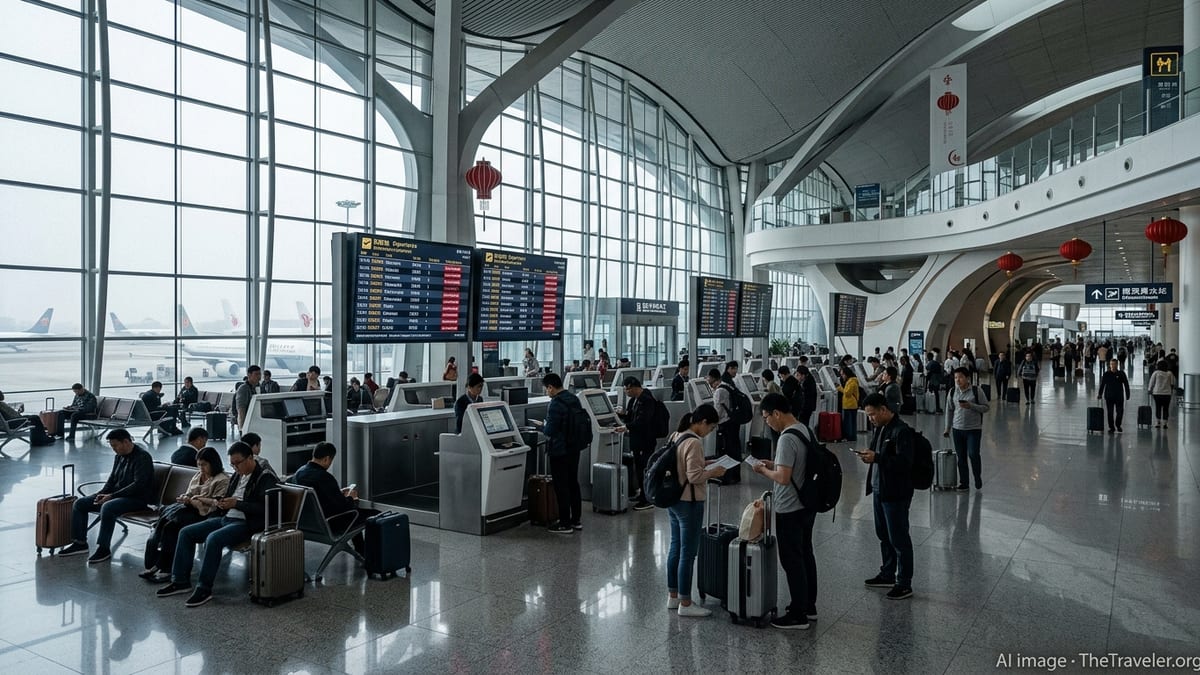
Wave of Cancellations Hits Major Chinese Hubs
Published flight-status feeds and operational notices indicate that dozens of services operated by the four carriers have been withdrawn or marked as canceled over the past several days, affecting both inbound and outbound traffic. The disruptions are concentrated on trunk routes linking Doha, Gulf hubs, and major Chinese cities but are also touching secondary destinations where schedules had only recently recovered toward pre pandemic levels.
Routes connecting Doha with Beijing Daxing, Shanghai Pudong, Guangzhou, and Chengdu appear among the most affected on Qatar Airways, while China Southern and China Eastern have trimmed a mix of domestic and international rotations that feed these same hubs. Gulf Air cancellations, while smaller in absolute number, are having an outsized impact on long haul connections from Bahrain into mainland China, where frequencies are comparatively limited.
Across Beijing, Shanghai, Guangzhou, Shenzhen, Kunming, and other key airports, the removal of more than 50 individual flights in a short window has tightened seat availability and reduced options for same day or next day rebooking. Publicly visible schedules suggest that some of these gaps are being filled only partially by other carriers, leaving noticeable holes in connectivity at peak times.
Although the precise number of cancellations continues to shift as airlines adjust timetables, industry trackers show an elevated cancellation rate on China linked services for all four brands compared with earlier in the month, a sign that the disruption is not confined to isolated flights but reflects a broader schedule reset.
Operational Pressures Behind the Sudden Pullbacks
Publicly available information from airline updates and aviation analysts points to a combination of operational and geopolitical pressures driving the sudden cutbacks. Gulf based carriers have been grappling with airspace closures and rerouting requirements that lengthen flight times on key corridors, adding fuel burn and crew scheduling complexity on services into East Asia.
At the same time, Chinese carriers are fine tuning domestic and regional networks following a rapid ramp up in capacity over the past year. China Southern and China Eastern in particular have been consolidating frequencies on overlapping city pairs while redirecting widebody aircraft toward higher yielding international routes. The latest cancellations suggest a willingness to trim marginal services quickly in response to shifting demand and operational constraints.
Analysts note that when long haul routes must detour around restricted airspace, block times can increase significantly, which in turn reduces aircraft and crew availability for subsequent rotations. This effect can cascade across a network, forcing airlines to drop or reschedule certain flights to maintain on time performance on their most strategic routes.
In this environment, carriers appear to be prioritizing a reduced but more reliable pattern of operations. Qatar Airways, for example, has recently publicized a revised interim schedule that concentrates on a smaller set of China gateways with limited weekly frequencies rather than attempting a full restoration of its previous network.
Passengers Face Missed Connections and Packed Alternatives
For travelers, the most immediate consequence has been a spike in missed connections and unexpected overnight stays. Reports on passenger forums and social channels describe itineraries involving Doha or Gulf hubs unraveling when a single long haul leg to or from China disappears from the schedule, leaving downstream segments unusable.
Alternative options have proven difficult to secure in some cases. Users tracking availability on popular booking platforms describe heavily booked services to Beijing, Shanghai, and Guangzhou on remaining carriers, with economy cabins sometimes sold out days in advance on historically less busy midweek departures. Larger Chinese airlines and regional competitors have absorbed some displaced travelers, but available seats are not always aligned with original travel dates or preferred routings.
In several instances highlighted in public discussion threads, travelers have been rebooked onto China Eastern or China Southern flights via Shanghai or Guangzhou after losing Qatar Airways connections through Doha. Others have opted to reroute entirely through different regions, using European or Southeast Asian hubs to reach mainland China when Gulf corridor itineraries became unviable.
Even where rebooking is possible, schedule changes are creating knock on effects for hotel reservations, high speed rail tickets, and domestic connections within China. Travelers with multi city itineraries that include stops in cities such as Chengdu, Kunming, or Shenzhen are having to reconstruct carefully planned sequences of flights and trains to keep trips intact.
Policy Adjustments and Limited Relief for Affected Travelers
Each of the four airlines has been updating its customer guidance in response to the disruption, and publicly accessible notices outline varying degrees of flexibility. In the case of Qatar Airways, recent updates describe expanded options for refunds or complimentary date changes for passengers whose flights fall within specified disruption windows, subject to conditions and booking channels.
China Southern and China Eastern have also been adjusting their irregular operations policies in line with Chinese regulatory requirements, generally offering free changes or refunds when flights are formally canceled or significant schedule shifts occur. Gulf Air, operating a smaller China network, has focused its published guidance on rebooking passengers through alternative dates or nearby gateways where seats are available.
However, accounts shared on travel and airline specific forums suggest that implementation on the ground can be uneven. Some passengers report smooth rebooking experiences within hours of a cancellation notice, while others describe long call center wait times and difficulties securing comparable routings, especially when travel involves multiple carriers on a single ticket.
Travel advisors recommend that passengers monitor their reservations closely in the lead up to departure and confirm the operating status of each segment directly through airline channels. With schedules in flux, a flight that appears in a booking record several weeks out may still be subject to later adjustment as carriers continue to refine their China operations.
What Travelers to China Should Expect in the Coming Weeks
While there is no unified timeline for a full restoration of services, published schedule filings and airline announcements indicate that a gradual recalibration rather than an immediate return to previous frequencies is the most likely scenario. Some routes that have been cut outright may not come back quickly, while others may reappear with reduced weekly frequencies.
Aviation analysts watching the China market expect airlines to track load factors closely on remaining services to major hubs such as Beijing, Shanghai, Guangzhou, and Shenzhen before committing additional capacity. Cities like Chengdu and Kunming, which rely heavily on connecting traffic, could see slower recovery as carriers funnel limited resources into the busiest trunk routes first.
For travelers planning new trips to or through China, this environment calls for added flexibility. Industry observers suggest allowing longer connection windows, avoiding tight same day links between international and domestic segments where possible, and considering travel insurance that explicitly covers schedule disruptions. Booking directly with airlines, rather than through multiple intermediaries, may also simplify rebooking if flights change again.
Despite the current turbulence, China remains a central market for both Gulf carriers and Chinese airlines, and network maps still show a core set of flights linking major Chinese cities to Doha and other regional hubs. As conditions stabilize and airspace restrictions ease, further adjustments to schedules are expected, but for now travelers face a patchwork of cancellations, limited alternatives, and the need to stay alert to rapidly evolving information.