

More news on this day
Emirates has become the latest major Gulf carrier to slash services and operate near-empty flights as war in the Middle East, sweeping airspace closures and growing traveler anxiety trigger a sharp exodus of passengers from the region’s once-booming aviation hubs.
Get the latest news straight to your inbox!
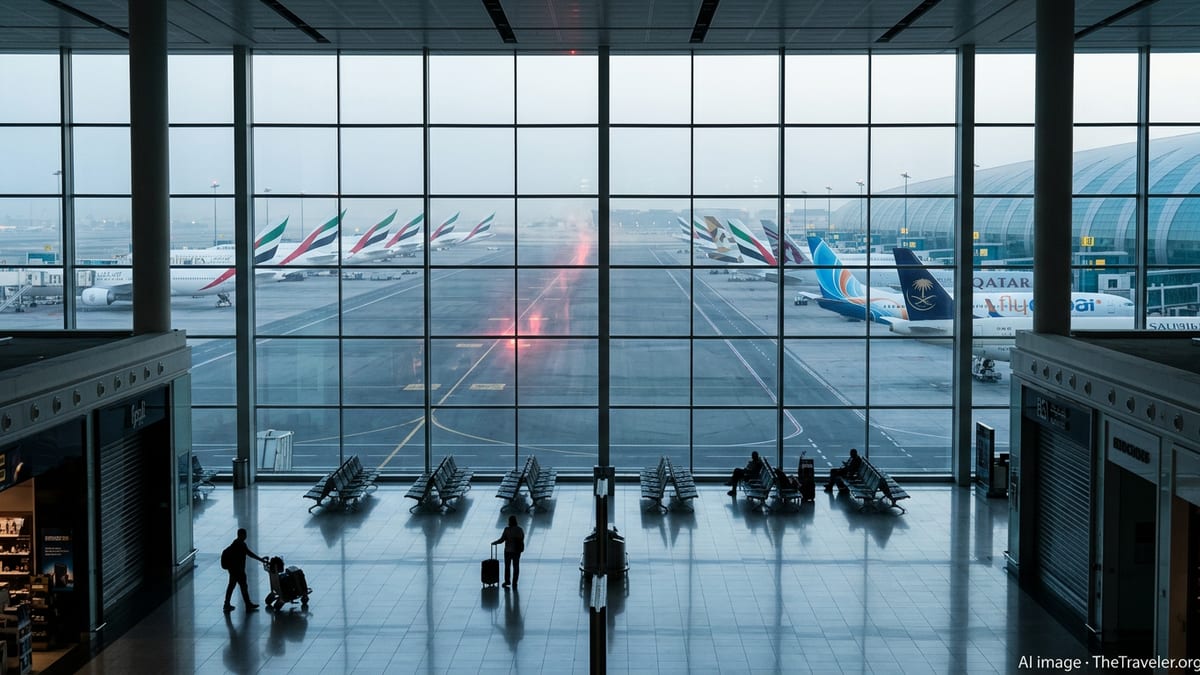
War Turns Gulf Super-Connectors into Ghost Hubs
Once marketed as seamless global crossroads, airports in Dubai, Abu Dhabi and Doha are now grappling with minimal passenger footfall and grounded aircraft. Published coverage indicates that widespread closures of airspace over Iran, Iraq, Jordan and parts of the Gulf since late February have effectively severed the shortest corridors between Europe and Asia, undermining the business model that helped Emirates, Qatar Airways and Etihad dominate long haul travel.
Recent analysis of regional economies suggests that airlines in the United Arab Emirates are operating at less than half of their pre-conflict capacity, with Qatar’s activity reduced to barely a fraction of earlier levels. With connecting flows disrupted and many travelers choosing to postpone or reroute journeys away from the Middle East altogether, carriers report that some services are departing with far more empty seats than usual, even when they operate reduced schedules.
Travel industry reporting describes scenes of partially lit concourses, shuttered retail outlets and long rows of parked wide-body jets at Gulf hubs that only months ago were struggling to keep pace with surging post-pandemic demand. For airlines that rely on high load factors to make sprawling networks profitable, the combination of collapsing demand and higher operating costs is particularly damaging.
Industry observers note that this downturn has arrived just as Gulf economies were leaning heavily on aviation, tourism and logistics to offset weaker oil revenues. The sudden contraction in air travel volumes is feeding into wider concerns over employment, investment and hotel occupancy in cities that position themselves as safe, globally connected gateways.
Emirates, Qatar, Etihad and Peers Forced into Deep Cutbacks
Publicly available flight data and schedule updates show that Emirates has joined Qatar Airways, Etihad Airways, flydubai, Gulf Air, Saudia and other regional carriers in implementing sweeping cancellations. Travel and aviation outlets report that more than 20,000 to 25,000 flights across the Middle East have been scrapped or heavily disrupted since the latest phase of the conflict began, with Gulf-based airlines accounting for a significant share of the lost capacity.
According to recent travel trade coverage, Emirates has sharply reduced its network from Dubai, concentrating on a limited set of trunk routes while suspending or thinning frequencies to markets in the Levant, Iran and parts of the wider region. Etihad is operating a skeleton schedule from Abu Dhabi, while Qatar Airways continues to face severe constraints as Qatari airspace has been restricted to emergency and evacuation flights, leaving most commercial services on hold.
Smaller Gulf carriers are also under strain. Low cost operator flydubai has pulled back from numerous destinations in Iran, Iraq, Syria and beyond, and is running cut-down operations out of Dubai International. Bahrain-based Gulf Air and Saudi Arabia’s flag carrier Saudia have cancelled or reduced flights on multiple regional routes, particularly those that would normally traverse contested skies or rely on feeder traffic from neighboring hubs.
The pattern is uneven, with some departure banks restored for evacuation and essential travel, while other time periods remain largely devoid of traffic. For passengers, this has translated into a confusing patchwork of last minute schedule changes, empty check in halls at certain times of day and cramped conditions on the few heavily booked services that do operate.
Airspace Closures Inflate Costs and Erode Confidence
Even for flights that continue to operate, detours around conflict zones have transformed routine journeys into lengthy endurance tests. Aviation consultants quoted in regional business media estimate that rerouting wide body aircraft around closed airspace can add four to six hours to some Europe Asia sectors, alongside a 20 to 30 percent increase in fuel burn on affected routes.
Industry calculations cited in earlier analyses suggest that a single long haul flight forced onto a longer track may incur several thousand dollars in additional fuel and navigation charges. Multiplied across a daily schedule, those costs quickly eat into already thin margins, particularly at a time when passenger numbers are falling and many travelers are opting for alternative routings that bypass the Gulf entirely.
Parallel disruptions to shipping through the Strait of Hormuz and nearby waterways have added to the sense of fragility in the region’s transport infrastructure. Business publications warn that sustained instability could fuel higher prices for imported goods, reduce air cargo volumes and make airlines more cautious about restoring full schedules, even if airspace were to reopen more broadly.
For travelers, the volatility is eroding confidence in Gulf stopovers that once marketed reliability and efficiency as their core advantages. Reports describe corporate travel managers steering staff away from routings via Dubai, Doha or Abu Dhabi where possible, while leisure travelers delay trips or seek itineraries that avoid the Middle East altogether until the security outlook becomes clearer.
Passenger Exodus Leaves Carriers Chasing Fewer Travelers
While any remaining services that link the Gulf to evacuation points or alternative hubs are often heavily booked, demand on many traditional connecting routes has slumped. Travel and tourism outlets note that bookings for discretionary leisure travel into and through the region have weakened sharply, leading to empty seats in premium cabins and reduced yields even on flights that depart.
Some airlines have responded by waiving change fees, offering flexible rebooking policies and promoting one way segments to help stranded passengers leave conflict affected areas. However, these measures do little to offset the loss of high yielding connecting traffic from Europe, Asia and Australasia that previously filled Emirates’ A380s, Qatar Airways’ long haul fleet and Etihad’s wide bodies.
Industry analysts caution that the current passenger exodus may have a lingering psychological impact. Even after ceasefires or partial reopenings, travelers may take months to regain confidence in routings that pass near conflict zones. That hesitancy could depress forward bookings well into upcoming travel seasons, limiting the pace at which airlines can restore capacity without risking more lightly loaded flights.
Tourism boards across the Gulf had been investing heavily in campaigns to attract visitors for business events, cultural festivals and leisure stays. The abrupt collapse in regional air connectivity now threatens those ambitions, with some hotel and hospitality operators already reporting a wave of cancellations tied directly to airline disruptions.
Longer Term Questions for the Gulf Aviation Model
The current crisis is also prompting broader questions about the resilience of the Gulf hub and spoke model. For two decades, Emirates, Qatar Airways, Etihad, flydubai, Gulf Air and Saudia built strategies around exploiting their geographic position at the midpoint between major population centers, funnelling millions of passengers through a small cluster of airports.
Specialist aviation publications suggest that prolonged conflict and recurring airspace closures could undermine that model if travelers increasingly favor more direct point to point flights on European or Asian carriers, even when journeys are slightly longer or more expensive. Some long haul airlines outside the region have already shifted capacity toward routes that bypass the Gulf, citing both security concerns and changing demand patterns.
At the same time, fleet and infrastructure investments made during the boom years have left Gulf carriers with high fixed costs. Giant new terminals, large orders of wide body jets and ambitious expansion plans were calibrated for continuous growth in connecting traffic. Operating those assets at significantly reduced load factors for an extended period would put pressure on balance sheets and, in some cases, may accelerate consolidation or strategic realignments.
For now, airline timetable updates and airport operations remain in flux from day to day. Observers expect that Gulf carriers will continue to juggle thin demand, empty cabins on some services and surging interest in a limited number of safe corridors, all while monitoring the shifting front lines of a conflict that has abruptly reordered the global map of air travel.