

More news on this day
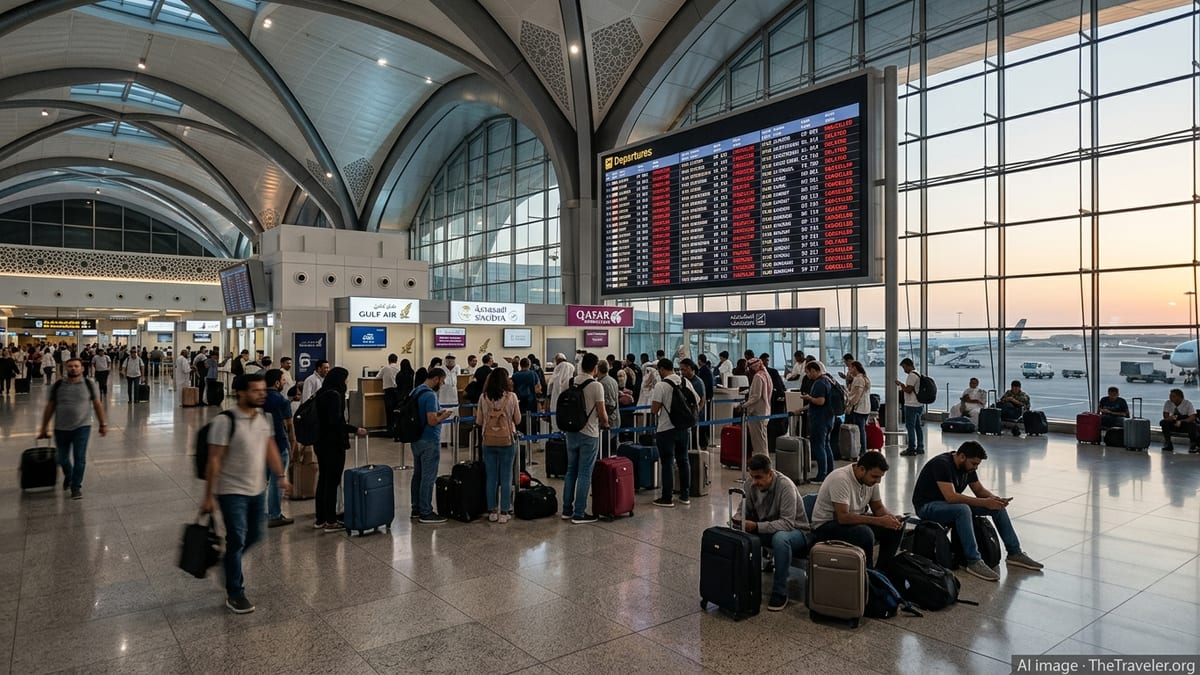
Major Gulf and regional airlines including Gulf Air, Saudia and Qatar Airways have cancelled or reshaped at least 85 flights in recent days, as continuing airspace restrictions and regional tensions ripple across key routes connecting Bahrain, Cairo, Kuwait, Istanbul, London, Hong Kong, Amsterdam and multiple Saudi cities.
Get the latest news straight to your inbox!
Airspace Restrictions Trigger Fresh Wave of Cancellations
Publicly available operational notices and travel advisories show that airlines based in the Gulf and wider Middle East have entered a new phase of disruption, with at least 85 services cancelled or heavily modified across the network. The latest changes follow temporary closures or restrictions of airspace over parts of the Gulf and neighboring states after a sharp escalation in regional tensions in late February and early March 2026.
Industry bulletins indicate that carriers have been forced to repeatedly rework schedules as aviation authorities keep tight controls on key flight corridors. While some airlines have operated limited repatriation and relief flights, regular commercial schedules remain far from normal, particularly for services that would typically cross restricted airspace or rely on busy hubs for onward connections.
The pattern of cancellations affects both short regional hops and long-haul sectors to Europe and Asia. This combination has broken many of the usual one-stop connections that link secondary cities in the Middle East with major global capitals, placing additional strain on the flights that do still operate and complicating options for stranded travelers.
Gulf Air, Saudia and Qatar Airways Among Hardest Hit
Gulf Air, Bahrain’s flag carrier, has been directly affected, with Bahrain’s position in the middle of several restricted flight corridors forcing adjustments to departures and arrivals. Timetable changes and cancellation notices show that flights serving nearby Gulf points, as well as longer routes toward Europe and Asia, have been trimmed or retimed as the airline works around constrained airspace and operational windows at Bahrain International Airport.
Saudia, which normally operates dense schedules connecting Riyadh, Jeddah, Dammam and other Saudi cities with destinations across the Middle East and beyond, has also seen a noticeable wave of cancellations. Published advisories referencing Saudi airports describe limited operations, particularly at key international gateways, and warn of ongoing delays and short-notice schedule changes as the situation develops.
Qatar Airways has been contending with similar pressures. Public updates describe a network running at reduced capacity, with temporary suspensions and a pivot toward special relief or repatriation flights on select days. The complexity of rerouting flights to avoid sensitive airspace has increased flying times on some sectors and made others temporarily unviable, contributing to the tally of at least 85 affected services across the region’s main carriers.
Key Routes to Europe, North Africa and Asia Disrupted
The disruption is most visible on a series of high-profile routes linking Gulf and Middle Eastern hubs with major international cities. Flight information compilations and schedule snapshots highlight repeated cancellations or limited one-off services on routes to London, Amsterdam and other European destinations that would normally see multiple daily frequencies from regional hubs.
Similar volatility is evident on services to Hong Kong and other major Asian gateways, where carriers have shifted toward ad hoc operations rather than published daily schedules. Travelers relying on these connections are encountering fewer options and more complex routings, often involving overnight waits at alternative hubs or last-minute rebookings as airlines respond to changing airspace permissions.
Within the broader Middle East and North Africa, routes to Cairo, Kuwait and Istanbul have also been repeatedly reshaped. Some carriers have mounted special departures to move stranded passengers from these cities, while other planned flights have been removed from the timetable entirely. The result is a patchwork of operations in which a small number of services proceed under tight constraints while other flights on the same corridor are cancelled or rerouted on short notice.
Saudi Domestic Network and Secondary Cities Feel the Strain
Beyond long-haul international services, the crisis is putting pressure on domestic and regional connectivity, particularly in Saudi Arabia. Advisories for major Saudi airports describe a situation of constrained capacity, with reductions in the number of daily movements at Riyadh and Jeddah and a knock-on effect for flights serving secondary cities across the kingdom.
Passengers traveling between Saudi regional centers and international hubs in Bahrain, Qatar or the United Arab Emirates are especially exposed to disruption. Cancellations on one leg of a journey can render entire itineraries unworkable, prompting a cycle of rebooking and further schedule adjustments. This in turn contributes to the running total of disrupted flights, as airlines trim frequencies to stabilize operations.
The strain on the domestic network also affects cargo capacity, which is often transported in the holds of passenger aircraft. With fewer flights operating between Saudi cities and key cargo gateways such as Bahrain, Istanbul and European hubs, logistics providers face tighter space and longer lead times for shipments that previously moved on overnight or same-day services.
What Travelers Need to Know Before Heading to the Airport
For passengers, the evolving situation means that even confirmed bookings on Gulf Air, Saudia, Qatar Airways and other regional airlines may be subject to change right up to departure time. Airline statements and travel-advisory documents consistently urge travelers to verify the status of each flight segment on the day of travel and to monitor updates through official channels rather than relying on older itinerary emails or screenshots.
Rebooking policies are being adjusted frequently, with many carriers offering date changes, credit options or alternative routings when flights are cancelled. However, the limited number of available seats on operating services, especially to high-demand destinations such as London, Amsterdam and Hong Kong, means that same-day alternatives are not always available. Travelers may need to be prepared for extended layovers or overnight stays if connections are broken.
Industry observers note that the duration and scope of the disruption will depend on how quickly airspace restrictions are eased and whether further security incidents occur in the region. Until a clearer timeline emerges, the cancellation of at least 85 flights by leading Gulf and Middle Eastern airlines is likely to be a floor rather than a ceiling, and travelers planning to fly to or through Bahrain, Cairo, Kuwait, Istanbul, London, Hong Kong, Amsterdam and Saudi cities should plan for continued volatility in the weeks ahead.