

More news on this day
Major Gulf carriers including Gulf Air, Saudia and Qatar Airways have cancelled at least 85 flights in recent days, disrupting connections between Bahrain, Cairo, Kuwait, Istanbul, London, Hong Kong, Amsterdam and a string of Saudi cities as regional tensions and airspace restrictions continue to reverberate through global aviation.
Get the latest news straight to your inbox!
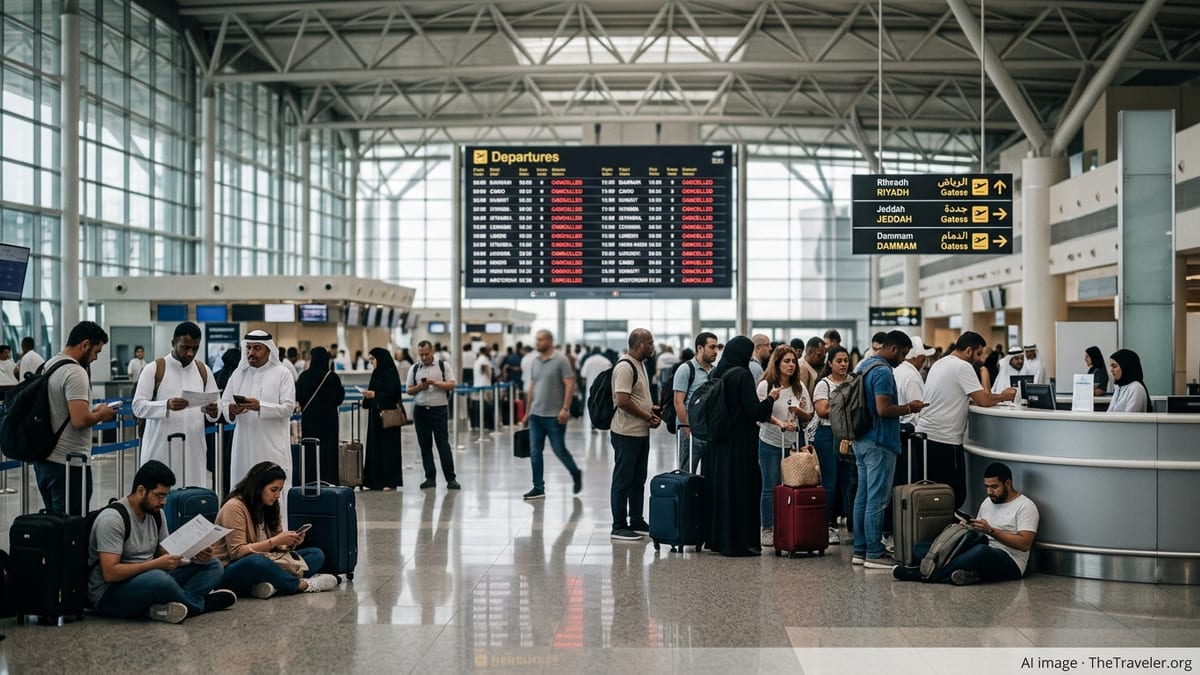
Wide-Ranging Cancellations Hit Regional and Long-Haul Routes
Publicly available schedules and airport information indicate that the latest wave of cancellations is concentrated on routes linking Bahrain, Saudi Arabia and other Gulf states with major regional hubs such as Cairo, Kuwait City and Istanbul, as well as long-haul destinations including London, Amsterdam and Hong Kong. The affected flights span both outbound and inbound services, reducing options for travelers who rely on the Gulf’s hub-and-spoke networks for onward connections to Europe, Asia and Africa.
Reports from flight-tracking dashboards and airport departure boards show that Gulf Air has scrubbed multiple rotations touching Bahrain International Airport, particularly services feeding into Dammam, Riyadh and Jeddah, while also limiting connectivity onward to Europe and Asia. Saudia has pulled services on several domestic and regional sectors, with Riyadh and Jeddah experiencing repeated schedule changes as aircraft and crews are reassigned.
Qatar Airways, which has already been operating under constrained conditions due to airspace and security concerns in recent weeks, continues to run a reduced program with rolling updates to its timetable. Passengers transiting Doha report a pattern of late-notice cancellations and rebookings, underscoring how quickly operating conditions can change for carriers in the Gulf at the moment.
Flight disruption data compiled by independent aviation analysts point to a cumulative total of at least 85 cancellations attributable to this latest adjustment cycle among Gulf Air, Saudia, Qatar Airways and a handful of regional partners. Given the fluid situation, those figures are expected to shift as airlines retime, merge or reinstate flights.
Airspace Restrictions and Security Concerns Drive Operational Choices
The cancellations are unfolding against a backdrop of heightened regional tension and intermittent airspace constraints affecting parts of the Gulf and surrounding air corridors. According to published coverage, recent missile and drone activity in the wider region has led civil aviation authorities and airlines to reassess routings, divert traffic away from sensitive areas and, in some cases, temporarily suspend certain city pairs altogether for safety and operational reasons.
In practice, this has translated into longer routings for some flights, narrower windows of permitted operations and more complex flight planning around key hubs such as Doha, Manama and major Saudi gateways. When combined with existing congestion and crew-placement challenges, these constraints can quickly cascade into wholesale cancellations if carriers conclude that delays, diversions or holding patterns would be unsustainable.
Industry observers note that large network airlines like Gulf Air, Saudia and Qatar Airways are particularly exposed when regional airspace becomes restricted, since their business models depend on dense banks of connecting flights built around precisely timed arrivals and departures. Disruption in one part of the network can ripple through dozens of onward connections, forcing airlines to proactively trim schedules to preserve reliability on remaining services.
Aviation risk specialists describe the current pattern of cancellations as a reflection of cautious decision-making in the face of uncertainty. Cutting frequencies, consolidating flights and temporarily suspending some destinations allows carriers to reduce their exposure while keeping core corridors open where possible.
Passengers Face Missed Connections, Limited Alternatives and Higher Costs
For travelers, the immediate impact has been missed connections, extended layovers and, in some cases, trips being postponed entirely. Accounts posted by passengers in recent days describe repeated cancellations on itineraries involving Bahrain, Doha, Riyadh and Dammam, often after multiple rounds of rebooking. Some report that journeys originally planned as straightforward same-day connections have stretched into multi-day efforts to secure alternative flights.
With seat availability tightening on unaffected routes, fares on remaining services have risen, particularly on high-demand city pairs linking the Gulf with London, Istanbul and major South Asian gateways. Travel agents in the region report that customers are increasingly asking for routings that avoid the most affected airspace, adding complexity and cost to trip planning.
The knock-on effects extend beyond point-to-point passengers. Corporate travelers, expatriate workers and transit passengers bound for Africa and Asia via Gulf hubs have found themselves competing for a limited pool of seats. Some have shifted to carriers based outside the immediate region where routings allow, though this can require significant detours through Europe or South Asia.
Airport operations have also felt the strain. Check in counters and customer service desks at several Gulf airports have seen surges in demand as travelers seek last-minute rebookings or refunds, while hotels near major hubs report increased bookings from stranded passengers awaiting the next available flight.
Airlines Adjust Networks While Urging Travelers to Monitor Bookings
In response to the evolving situation, Gulf carriers are revising their networks on an almost daily basis. Publicly posted travel advisories from the airlines outline flexible rebooking and refund options for passengers on affected flights, with many allowing changes free of standard penalties within defined date windows. Some carriers have also merged lightly booked services or upgauged aircraft on remaining flights to accommodate disrupted passengers.
Travel industry analysts suggest that airlines are prioritizing key trunk routes and high-demand origin and destination markets while placing secondary routes on hold. This approach helps preserve critical connectivity to cities such as London, Istanbul and key South Asian hubs, even as total frequencies are reduced. At the same time, regional spokes such as smaller Saudi cities and some short-haul Gulf links are seeing more frequent cancellations.
Given the pace of change, travelers are being urged by airlines, airports and travel advisors to monitor their bookings closely and to check flight status repeatedly in the 24 hours before departure. Many carriers are using email, SMS and app notifications to push updates, but delays in messaging and time zone differences can mean that some passengers only discover cancellations when attempting to check in.
Industry watchers expect that Gulf Air, Saudia, Qatar Airways and their partners will continue to fine-tune schedules over the coming days as operational conditions evolve. While some flights could be reinstated at short notice if circumstances improve, further cancellations remain possible if airspace or security restrictions tighten again.
Planning Ahead: What Travelers Should Expect in the Coming Days
For those with upcoming trips touching Bahrain, Saudi Arabia, Qatar or nearby hubs, the current disruption underscores the value of flexibility. Travel consultants recommend allowing longer connection times, avoiding tight self-connecting itineraries between separate tickets and considering fully refundable or changeable fares where budgets permit.
Passengers are also being advised to ensure that airlines and booking platforms hold up to date contact details, including mobile numbers and email addresses, to improve the chances of receiving timely updates. Keeping digital copies of tickets, receipts and travel insurance policies can speed up the process of claiming refunds or additional expenses if journeys are significantly disrupted.
Given that airlines are periodically adding relief or replacement flights, travelers may find that options improve closer to departure dates, even if current schedules appear limited. However, with at least 85 flights already removed from timetables across the region in this latest wave, those planning essential journeys in the short term should be prepared for last minute changes and have backup plans in mind.
While the timeline for a full normalization of flight operations remains uncertain, publicly available information suggests that Gulf carriers are continuing to balance safety, regulatory requirements and commercial demand as they navigate one of the most complex operating environments the region has seen in recent years.