

More news on this day
Passengers travelling through Singapore Changi Airport are facing a new round of disruption as Qatar Airways, Gulf Air, Etihad Airways, Turkish Airlines and other regional carriers cancel nearly a dozen services, severing or sharply reducing links to Doha, Jakarta, Abu Dhabi, Istanbul, Kuala Lumpur and several secondary destinations across Asia and the Gulf.
Get the latest news straight to your inbox!
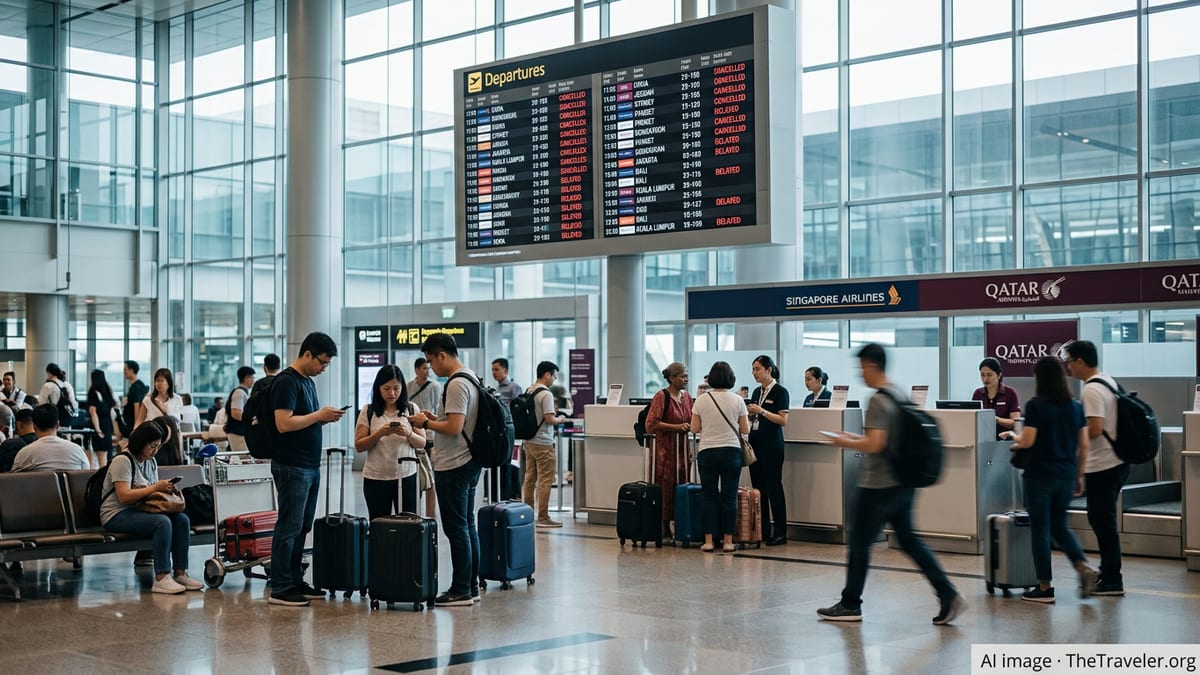
Fresh Wave of Cancellations Hits Key Changi Routes
Flight information displays at Singapore Changi on Friday showed a cluster of cancellations on services operated by Qatar Airways, Gulf Air, Etihad Airways and Turkish Airlines, with most affected flights bound for or arriving from major regional hubs. Airport sources said close to a dozen movements involving these carriers had been pulled from the schedule over the past 24 hours, impacting both point to point travellers and those using Changi as a transfer gateway.
Routes hardest hit include Singapore to Doha on Qatar Airways, Abu Dhabi on Etihad, Istanbul on Turkish Airlines and selected links that rely on Gulf carriers for onward connectivity to Jakarta, Kuala Lumpur and other Southeast Asian cities. Several return legs to Singapore were also removed, leaving aircraft and crew out of position and complicating recovery efforts over the coming days.
While some affected flights were lightly loaded following weeks of uncertainty in Gulf airspace, others were operating near capacity as travellers sought alternative routings around the conflict zone. The sudden cancellations have left many passengers stranded with limited immediate options, especially those holding separate tickets or complex itineraries.
Operationally, the cuts represent a further tightening of capacity on already stressed Asia Middle East corridors, which had begun to show signs of stabilization after the initial shock of regional airspace closures earlier this month.
Regional Security Crisis Keeps Qatar Hub Partially Offline
The latest disruption at Changi is closely tied to the ongoing security crisis centered on Qatar, where airspace restrictions and heightened military activity continue to constrain normal commercial operations. Although emergency and limited evacuation flights have been permitted in recent days, regular hub activity at Doha remains a fraction of pre crisis levels.
Qatar Airways, which normally operates multiple daily services between Singapore and Doha, has been forced to keep much of its long haul network on pause or heavily curtailed. With Hamad International functioning under tighter controls and with overflight rights in surrounding airspace still volatile, the airline has limited flexibility to restore its Changi schedule beyond a handful of special or ad hoc services.
Other Gulf based airlines, including Etihad Airways and Gulf Air, are facing similar constraints as they balance safety considerations with the need to preserve their global networks. Even when individual routes to Singapore are technically possible, disrupted banks of connecting flights in the Middle East make many of these services commercially and operationally unviable.
For Changi, long regarded as one of the world’s most resilient hubs, the sustained loss of reliable access to Doha and other Gulf super connectors is a significant blow. The affected carriers serve not only point to point demand but also funnel traffic between Southeast Asia, Europe and Africa, a role that is difficult to replace quickly.
Knock On Impacts for Jakarta, Kuala Lumpur and Beyond
The suspension and thinning out of Gulf carrier schedules at Changi are reverberating across Southeast Asia, particularly in markets such as Jakarta and Kuala Lumpur that depend heavily on one stop connections via Doha, Abu Dhabi and Istanbul. Travellers who would normally fly from secondary cities through Singapore and then onto the Gulf for onward links to Europe or the Americas are now finding their options sharply reduced.
Some itineraries that previously involved a short hop to Singapore followed by an overnight flight to the Gulf now require multiple changes, longer layovers or detours through alternative hubs such as Bangkok, Hong Kong or key European gateways. For corporate travellers and time sensitive cargo, these additional segments add cost and complexity just as regional trade and tourism were gathering pace.
Indonesia and Malaysia based passengers are also being squeezed by reduced capacity on certain Singapore feeder routes, where schedules have been trimmed in anticipation of weaker connecting demand. In practical terms, this means fewer convenient departure times and a higher risk of bottlenecks on the remaining flights, particularly around weekends and school holidays.
Travel agents across the region report that they are spending hours untangling affected bookings, often reissuing tickets several times as airlines continue to adjust schedules on short notice. Many have shifted to advising clients to build in longer buffers between connections or to favor more direct routings where possible.
Airlines Offer Rebooking, But Seats Are Limited
In response to the latest wave of cancellations, Qatar Airways, Etihad, Gulf Air and Turkish Airlines are generally offering free rebooking, refunds or rerouting options, depending on fare conditions and the extent of the disruption. However, with capacity tight on remaining services and partner airlines also operating close to full, securing a new seat is far from guaranteed.
Passengers whose journeys began or were due to begin in Singapore are being urged to contact their airline or booking agent as soon as they receive notification of a cancellation. Those already in transit face more complicated scenarios, particularly if they are holding separate tickets on different carriers that may not have interline agreements in place.
Industry observers note that while most carriers are honoring basic obligations to transport or refund passengers, the scale of the disruption means that many travelers are accepting suboptimal alternatives: overnight airport stays, long detours through third country hubs, or downgrades in cabin class. For some, especially those on tight schedules, the only realistic option is to abandon or postpone trips entirely.
Travel insurers are also bracing for a spike in claims related to missed connections, additional accommodation costs and non refundable portions of affected itineraries. Policy wording varies widely, and experts advise travelers to keep detailed records of all airline communications, receipts and proof of disruption.
What Travelers Through Changi Should Do Now
With the situation in the Gulf still fluid and further schedule adjustments likely, passengers planning to travel between Singapore and destinations that normally rely on Gulf hubs are being advised to adopt a more cautious, flexible approach. That starts with checking booking status frequently, including in airline apps, as some schedule changes are appearing there before formal email notifications are sent.
Where possible, travelers are being encouraged to favor itineraries that use alternative hubs not directly affected by the Qatar airspace crisis, even if that means a longer routing or a modest fare premium. For essential trips, booking fully flexible fares or ensuring that separate tickets are aligned on the same alliance or interline partners can help reduce the risk of being stranded mid journey.
At the airport, Changi is deploying additional ground staff at affected check in zones and transfer counters to assist with rebooking and customer service, according to airport employees. Passengers with imminent departures on Qatar Airways, Etihad, Gulf Air or Turkish Airlines are urged to arrive earlier than usual to allow time for potential changes at the desk.
For now, the hope among carriers and airport authorities is that a more stable security environment in the Gulf will allow airspace restrictions to ease and normal schedules to resume. Until that happens, travelers using Singapore as a springboard to Doha, Abu Dhabi, Istanbul and beyond should be prepared for ongoing uncertainty and keep contingency plans close at hand.