

More news on this day
Travelers across the Gulf and key international hubs are facing fresh disruption as Gulf Air, Qatar Airways and Royal Jordanian cancel 45 flights and delay a further 20, disrupting connections through Doha, Manama, Amman, Singapore, London and other major cities, according to airline notices and airport operations data published in recent days.
Get the latest news straight to your inbox!
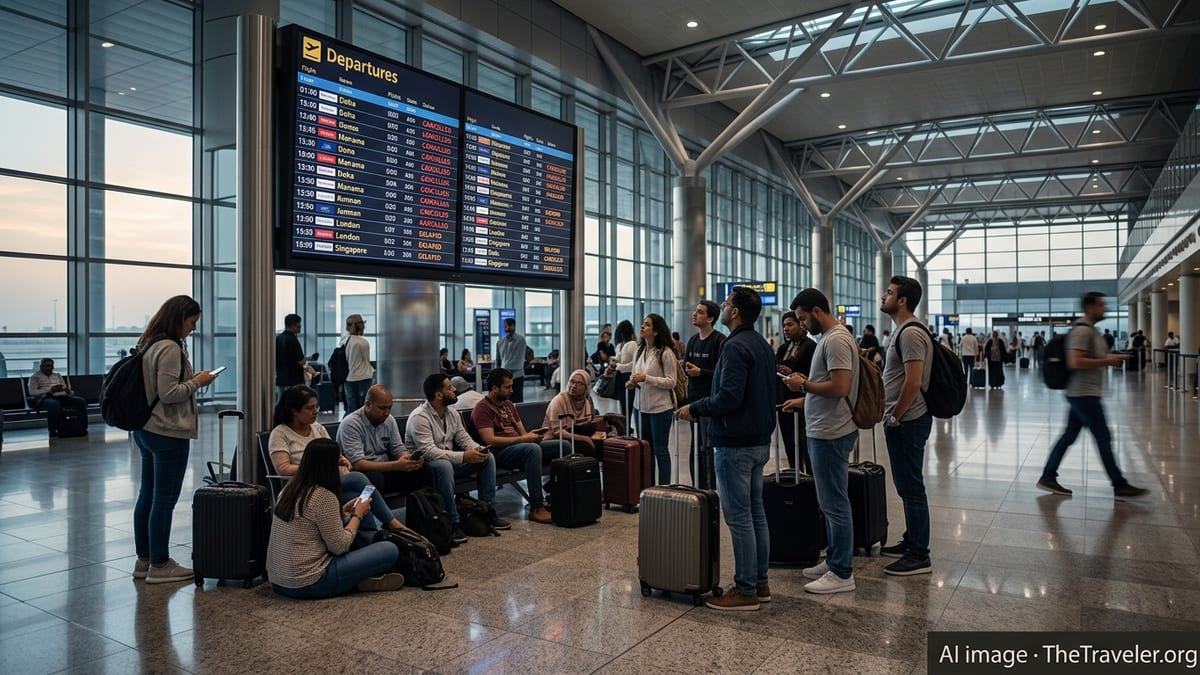
Wave of Cancellations Hits Key Gulf and Global Hubs
Publicly available schedules and airport boards indicate that a new wave of short notice cancellations and multi hour delays has swept through networks operated by the three carriers since late this week. The affected flights include regional links across the Gulf and Levant alongside long haul services to Europe and Asia, compounding several weeks of irregular operations triggered by regional security concerns and temporary airspace restrictions.
Operational data reviewed on Sunday points to at least 45 flights cancelled and around 20 significantly delayed on routes touching Doha, Manama and Amman. Among the hardest hit are services linking Doha with London and Singapore, Manama with London, and Amman with major European and Asian gateways, where aircraft and crew rotations remain under pressure.
Published coverage of recent disruptions across the region suggests that airlines have been repeatedly forced to trim schedules, retime departures and consolidate services as they navigate changing overflight permissions and congested alternative corridors. The latest adjustments by Gulf Air, Qatar Airways and Royal Jordanian fit into that wider pattern, with many flights removed from sale or marked as cancelled only a few days before departure.
In several cases, passengers reported online that itineraries which had appeared on time in carrier apps later showed as cancelled or heavily delayed when they checked airport departure boards. These late stage changes are contributing to crowding at rebooking desks and extended waits at transit hubs, particularly in Doha and Manama.
Doha, Manama and Amman Under Sustained Operational Strain
Doha’s Hamad International Airport remains one of the most affected hubs, as Qatar Airways continues to operate a reduced schedule amid evolving airspace guidance. Megathreads on travel forums tracking flight status into and out of Doha highlight a pattern of rolling cancellations and selective relief flights, especially on popular routes to London, Frankfurt and Singapore. Travelers connecting through Doha report that finding alternative space on near term departures has become increasingly difficult.
In Bahrain, publicly available information from Manama’s airport shows Gulf Air cancelling and delaying multiple services across its regional network, with knock on effects for onward long haul flights. Reports indicate that some Bahrain departures to London and other European destinations have been pulled or retimed, forcing passengers to accept reroutes via third country hubs or to postpone trips altogether.
Amman’s Queen Alia International Airport has also been grappling with disruption. Jordan’s partial airspace restrictions earlier in the month and subsequent adjustments have translated into ongoing schedule reshuffles for Royal Jordanian, particularly on eastbound and westbound trunk routes. Coverage in regional media and flight tracking data indicate that some Amman based passengers have shifted to alternative carriers that can offer more predictable routings via other hubs.
Across the three capitals, airport operations remain technically open but constrained, with carriers using a mix of cancellations, aircraft swaps and tactical retimings to cope with crew duty limits and limited airspace capacity. This has created an uneven picture in which some flights depart close to schedule while adjacent services on the same route vanish from departure boards.
Knock On Effects in London, Singapore and Other Long Haul Markets
The disruption is being felt far beyond the Gulf as passengers in long haul origin and destination markets run into reduced connectivity. London, one of the most important European gateways for all three airlines, has seen repeated cancellations of Doha and Manama services in recent days, according to traveler accounts and airport board snapshots shared online. Some passengers report being offered rerouting on partner or non partner airlines via alternative hubs when direct Gulf services are removed.
In Singapore, Qatar Airways connections via Doha and Royal Jordanian links via other regional hubs have seen timing changes and cancellations, disrupting carefully planned itineraries for business and leisure travelers. Forum discussions describe cases where itineraries such as Frankfurt to Doha to Singapore have been broken up when the Gulf sector is cancelled, leaving passengers to negotiate new routings at short notice.
Other major markets, including European cities such as Frankfurt, Paris and Madrid and Asian destinations such as Manila and key Indian metros, are experiencing similar ripple effects. With aircraft and crews repositioned to support priority routes and relief operations, secondary frequencies are more vulnerable to cancellation or extended delays, leaving fewer options for travelers who rely on Gulf carriers’ dense connecting networks.
The combination of reduced capacity through Doha, Manama and Amman and strong seasonal demand has also pushed more travelers toward competitors based in Dubai, Abu Dhabi, Istanbul and other hubs. Travel forums and social media posts point to a rise in last minute bookings on Emirates, Etihad, Turkish Airlines and various Asian and European carriers when Gulf Air, Qatar Airways or Royal Jordanian cancel sectors.
Passenger Experience: Long Queues, Rerouting Battles and Limited Clarity
Accounts shared on travel communities and social media outline a difficult experience for many passengers caught in the current wave of cancellations and delays. Some report spending hours on hold with airline call centers, only to learn that there are no near term seats available to London, Singapore or other key destinations. Others describe lengthy queues at airport service desks in Doha and other hubs, as travelers compete for limited rebooking options on alternative flights.
Several passengers traveling on award tickets or complex multi city itineraries say they have faced additional hurdles. Reports indicate that while some have successfully secured rerouting on partner or even non partner airlines, others have been advised to wait until a flight is officially cancelled before new options can be processed. This has led to uncertainty and, in some cases, last minute overnight stays in transit cities when cancellations are confirmed only shortly before departure.
Refund and voucher timelines are another source of frustration. Publicly available airline guidance indicates that change and cancellation fees have been relaxed within specific travel windows, but travelers report that reimbursement processing can still take several weeks. For those who decide to purchase new tickets on other carriers at higher prices, this delay creates an additional financial burden.
Despite the challenges, some travelers have reported positive experiences when engaging directly with airport staff, particularly at check in counters where agents may have more flexibility to identify creative rerouting options through secondary hubs. Success stories shared online include reroutes via Istanbul, Kuala Lumpur, Abu Dhabi and other cities that allow passengers to bypass the most congested Gulf corridors.
What Travelers Should Watch in the Days Ahead
With at least 45 cancellations and 20 significant delays already recorded across Gulf Air, Qatar Airways and Royal Jordanian services tied to the current disruption, the situation remains fluid. Public statements and travel advisories from airlines and aviation authorities in the region suggest that schedules may continue to change at short notice as operational and security assessments evolve.
Travel industry analyses recommend that passengers with upcoming trips through Doha, Manama or Amman monitor their bookings closely and check both airline apps and airport departure boards, as changes are not always reflected across all platforms at the same time. Where possible, travelers are advised to allow longer connection times, consider alternative routings through less affected hubs and keep contact details updated in airline profiles so carriers can issue automated notifications.
For travelers already stranded or facing imminent departure, recent experience shared by passengers indicates that persistence can improve outcomes. Multiple contact attempts via different call center numbers, messaging channels or in person visits to airport counters have, in some cases, produced rerouting options that were not initially offered. Travel agents and corporate travel departments may also have additional tools to access inventory on partner airlines.
As the Gulf’s aviation sector works through the latest wave of disruption, the episode underscores the vulnerability of highly centralized hub and spoke networks to sudden airspace constraints. For many global travelers, the coming days will hinge on whether Gulf Air, Qatar Airways and Royal Jordanian can steadily stabilize their schedules and restore the high frequency links that normally make Doha, Manama and Amman central crossroads of international air travel.