

More news on this day
More than 35 flights operated by Qatar Airways, Royal Jordanian, EgyptAir and Gulf Air have been abruptly canceled across key Iraqi airports this week, unleashing fresh travel chaos on routes linking Baghdad, Erbil, Basrah, Najaf and Sulaimaniyah with hubs such as Doha, Amman, Cairo, Athens and Amsterdam as regional airspace restrictions continue to ripple through global networks.
Get the latest news straight to your inbox!
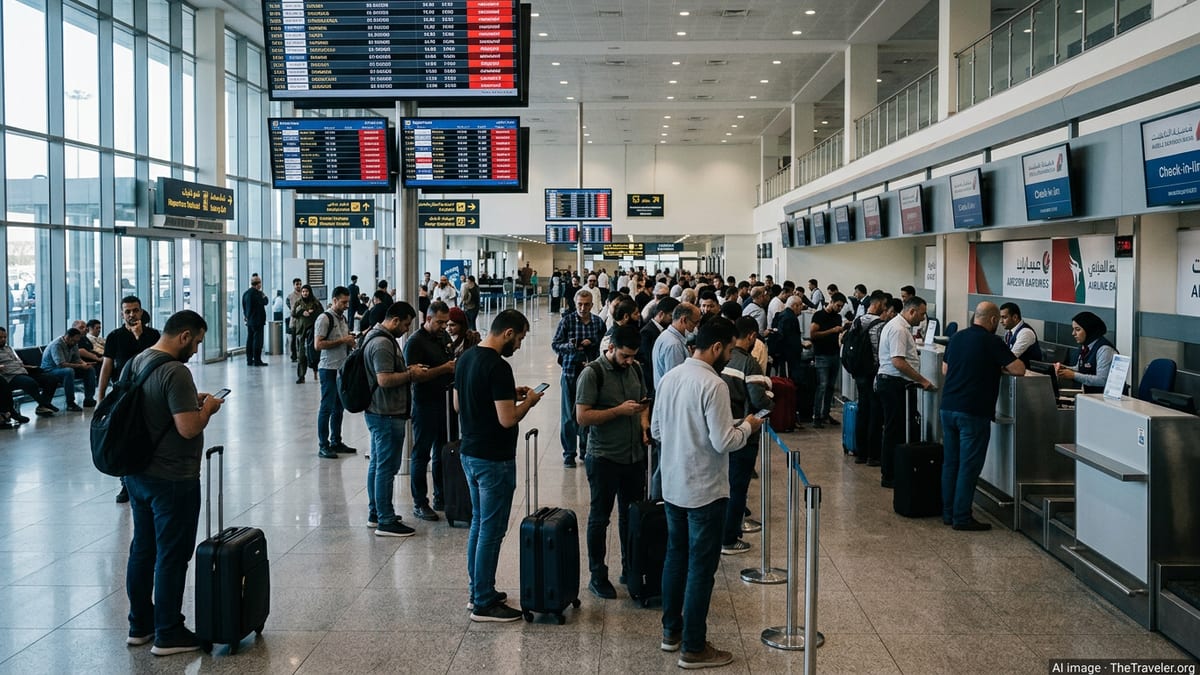
Regional Airspace Crisis Triggers New Wave of Cancellations
The latest disruption comes as parts of the Middle East remain under tight airspace controls following recent military escalation involving Iran and neighboring states, which has forced airlines to reroute or ground services that normally overfly Iraq and adjacent territories. Civil aviation authorities in the region have imposed a patchwork of closures and restrictions, prompting carriers to repeatedly adjust timetables at short notice.
Qatar Airways continues to run a sharply reduced schedule to and from Doha, prioritizing limited relief and repatriation flights while warning that normal commercial operations will not resume until regulators declare regional corridors fully safe. Recent travel alerts and timetable updates show the airline focusing on a narrow set of long haul destinations while trimming or canceling many services that depend on Iraqi airspace, contributing to the disruption now seen in Baghdad and Erbil.
Royal Jordanian and EgyptAir, both heavily reliant on cross border connections linking Amman and Cairo to Iraqi cities, have also taken multiple flights off the board as they respond to evolving security assessments and slot constraints. Gulf Air, based in Bahrain, has meanwhile joined other Gulf carriers in scaling back regional rotations, with Iraq routes among those most exposed to sudden operational changes.
Although some European and Gulf airlines have begun cautiously restoring select frequencies, they are largely avoiding overflight of Iran and parts of Iraq, which has lengthened flight times and reduced available capacity. That shift has made direct connections into Iraq from hubs like Doha and Amman harder to sustain on a stable schedule, increasing the likelihood of day to day cancellations.
Iraqi Gateways Hit: Baghdad, Erbil, Basrah, Najaf and Sulaimaniyah
The heaviest disruption for passengers is centered on Iraq’s main international gateways. Baghdad, the country’s busiest airport, has seen multiple departures and arrivals cut or retimed as carriers attempt to work around restricted air corridors. Travelers bound for or transiting through the capital report abrupt schedule changes, with some flights scrubbed only hours before departure.
In the Kurdistan Region, Erbil and Sulaimaniyah airports have likewise been affected as key regional airlines scale back service. Erbil, a crucial link between northern Iraq and hubs in the Gulf and Europe, has experienced intermittent cancellation waves from Gulf and European carriers that typically provide onward connections to destinations such as Athens and Amsterdam. Reduced operations into Sulaimaniyah are further constraining options for business travelers and diaspora passengers.
Basrah and Najaf, both important for labor traffic and religious tourism, are also caught in the turmoil. Flights serving Najaf in particular are tightly tied to pilgrimage flows to and from regional capitals. With limited services from Amman, Cairo and Doha, tour operators and religious groups are facing cascading itinerary changes, hotel rebookings and in some cases last minute charter arrangements to keep journeys viable.
Airport authorities across Iraq have urged passengers to remain in close contact with their airlines or travel agencies, stressing that local terminals often receive definitive cancellation notices only after carriers finalize regional routing decisions. That timing gap has left many travelers arriving at check in to discover that their flights are no longer operating.
Knock on Effects for Global Routes via Doha, Amman and Cairo
The cancellations in Iraq are reverberating far beyond the country’s borders because the affected flights feed some of the world’s busiest connecting hubs. With Qatar Airways, Royal Jordanian, EgyptAir and Gulf Air all reshaping their timetables, passengers traveling between Iraq and Europe, North America, Africa and Asia are seeing carefully planned itineraries unravel.
Doha, normally a major one stop gateway from Iraq to long haul destinations, is operating on a skeleton schedule that prioritizes select trunk routes while curtailing shorter regional sectors. That has squeezed capacity not only between Iraq and Qatar but also onward to cities such as Amsterdam and other Northern European points that depend on smooth connections.
Amman and Cairo, key hubs for Royal Jordanian and EgyptAir, are experiencing similar strain. Capacity cuts on Iraq flights mean fewer seats into those hubs, which in turn restricts access to onward services to Athens, European capitals and North American gateways. Even where long haul flights are still departing, passengers from Iraqi cities often cannot reach them in time due to canceled feeders.
Travel agents across the region report that itineraries once built around single airline connections are now being reassembled using multi airline combinations, overnight layovers and indirect routings via Istanbul, the Gulf or even secondary European airports. The result is longer travel times, higher fares on remaining routes and heightened risk of missed connections when schedules change again.
What Stranded and Prospective Travelers Need to Do Now
For travelers currently stuck in Iraq or at downline hubs, airline guidance has focused on flexibility. Qatar Airways, Royal Jordanian, EgyptAir and Gulf Air are offering a mix of free date changes, rerouting options and refunds for tickets covering the most affected travel period, although exact policies vary by carrier, route and fare type. Passengers are being urged to use official apps and call centers rather than relying solely on third party booking platforms, which can lag behind in reflecting real time schedule changes.
Given the pace of operational shifts, industry experts recommend that anyone due to transit through Baghdad, Erbil, Basrah, Najaf or Sulaimaniyah in the coming days treat their itinerary as tentative until they receive explicit confirmation from the operating airline. Travelers are advised to monitor flight status repeatedly in the 24 hours before departure and avoid heading to the airport until their flight is showing as operating with a gate assignment.
Where alternative routes exist, such as indirect journeys via less affected hubs, passengers may find that accepting a longer path or an overnight stop is the quickest way out of the region. Travel counselors are warning, however, that seats on these detour options are filling rapidly as airlines prioritize repatriation and operational recovery rather than schedule expansion.
Travel insurance that includes trip interruption or missed connection coverage may provide some cost relief for accommodation and rebooking fees, but policy terms differ widely. Passengers are being urged to document all communications with airlines and keep receipts for unexpected expenses in case claims are later accepted.
Outlook for the Coming Days
While there are tentative signs of stabilization as regulators and airlines gain clearer visibility on safe corridors, the outlook for flights linking Iraq to Doha, Amman, Cairo and beyond remains uncertain over the short term. Airline operations teams are continuing to publish rolling updates, often only confirming exact flight lists for the next 24 to 48 hours.
Carriers such as Qatar Airways are signaling an intention to gradually broaden their schedules as soon as regional authorities relax or refine airspace restrictions, but they have stopped short of offering firm timelines for a full return to normality. Royal Jordanian, EgyptAir and Gulf Air are taking a similarly cautious stance, mindful that renewed flare ups or fresh security advisories could quickly reverse any gains.
For now, travelers planning new trips involving Iraq are being advised by industry sources to build in extra time, favor fully flexible tickets where possible and consider backup routings that do not depend on a single high risk corridor. Those with non essential travel are being encouraged to postpone journeys until airlines publish more stable schedules and airspace conditions ease.
Until then, the combined effect of more than 35 cancellations by four major regional carriers, compounded by cuts from European and other Gulf airlines, is likely to keep Iraq’s main airports in a state of flux. For passengers, that means continuing uncertainty, crowded rebooking desks and a premium on up to the minute information as the situation evolves day by day.