

More news on this day
Travelers flying between Iraq and key hubs across the Middle East and Europe are facing fresh disruption after Qatar Airways, Royal Jordanian, Gulf Air and other regional carriers cancelled more than 30 flights, cutting connections to Doha, Amman, Cairo, Athens and several other major cities.
Get the latest news straight to your inbox!
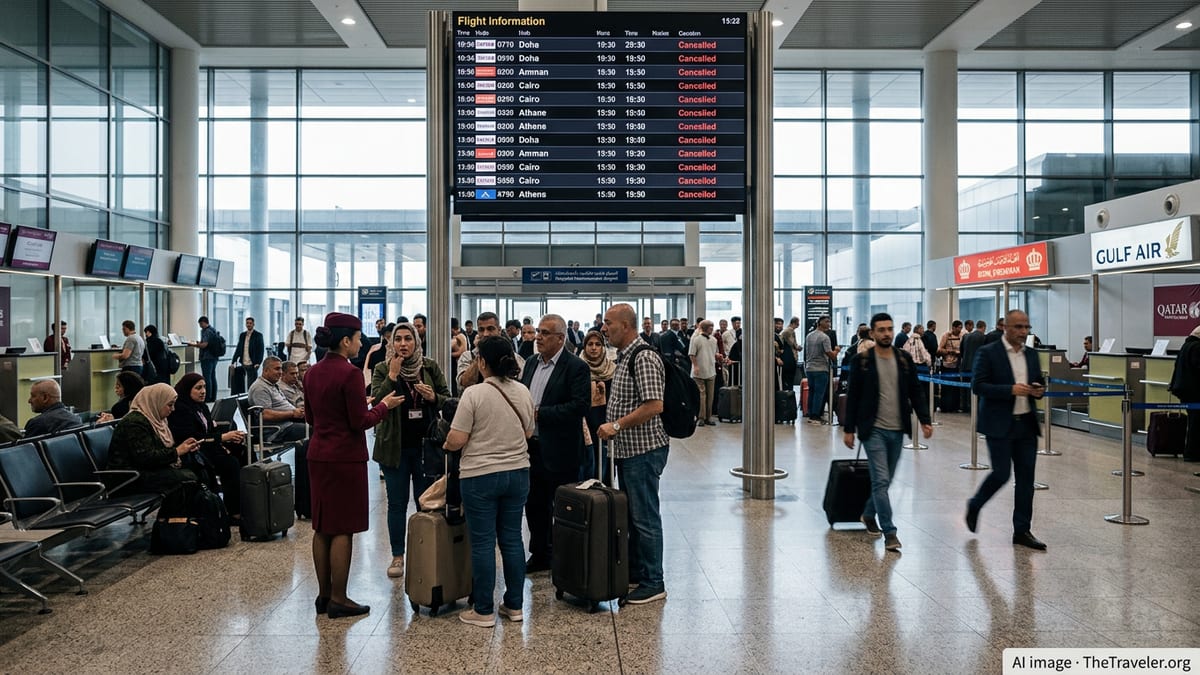
Wave of Cancellations Hits Baghdad and Erbil
The latest schedule changes follow days of mounting airspace restrictions across the region, as authorities respond to heightened security concerns and intermittent closures over Iraq and neighboring countries. Airlines serving Baghdad and Erbil have pulled multiple frequencies from their timetables, leaving departure boards dominated by the word “cancelled” and forcing many passengers to abandon or rapidly rework their plans.
Operations to and from Iraq are particularly vulnerable because many flights rely on shared corridors that have been periodically shut or heavily restricted. Carriers say they are working with civil aviation regulators to secure safe routings, but several have concluded that suspending selected Iraq services for now is the only viable option.
Airport officials in Iraq report that more than 30 international flights have been cancelled over recent days as a direct result of the evolving situation. The cuts span both outbound services from Iraq and inbound flights from key regional hubs, affecting business travelers, migrant workers and families heading for school holidays or medical appointments.
Passengers arriving at Baghdad and Erbil terminals describe long queues at airline desks as travelers seek last-minute rerouting or refunds. Some have been told to expect multi-day delays before a replacement itinerary can be confirmed, particularly for long-haul journeys that usually rely on Gulf and Levantine hubs.
Qatar Airways Trims Iraq Links as It Runs Limited Doha Schedule
Qatar Airways, one of the largest foreign operators into Iraq, has withdrawn a portion of its services between Doha and Iraqi cities while it continues to run an already reduced schedule at its Hamad International Airport hub. Following the recent regional tensions and temporary airspace closures, the airline has been operating on a limited basis under emergency corridors approved by the Qatar Civil Aviation Authority.
The carrier has published short-term destination lists outlining which routes will operate on specific dates, focusing on long-haul trunk sectors and a handful of regional connections. While flights to major gateways such as Cairo, London, Frankfurt and New York are being prioritized, several frequencies to Iraq have been removed from these provisional timetables, leaving many travelers without their usual Doha connection.
Qatar Airways has urged passengers holding tickets to or from Iraq to check the latest status of their flights and to expect potential last-minute changes as the situation remains fluid. The airline is offering rebooking options, including the possibility of rerouting via alternative gateways where space permits, but capacity is constrained and not all requests can be accommodated on original travel dates.
Travel agents in the region report a surge in calls from passengers based in Iraq who were planning to connect in Doha onward to Asia, Europe and North America. Many are now being advised to switch to other hubs or postpone travel entirely until a more stable schedule is restored.
Royal Jordanian, Gulf Air and Regional Carriers Cut Services
Royal Jordanian, which has long positioned Amman as a bridge between Iraq and the wider world, has also scaled back flights as the airspace situation has deteriorated. While the airline continues to operate a limited network following earlier closures, several rotations linking Iraqi cities with Amman have been cancelled or consolidated, affecting onward connections to Cairo, Athens and popular European destinations.
Gulf Air, the Bahraini flag carrier, has taken an even more cautious stance. Industry operational updates indicate that the airline has suspended a swath of flights in the region, including services that would normally overfly or connect with Iraqi airspace. This has narrowed options for passengers who rely on Bahrain as a secondary hub when seats via Doha or Dubai are not available.
Other carriers in the Gulf and wider Middle East, including low-cost operators, have similarly adjusted their schedules, scrapping selected departures or placing temporary holds on ticket sales for Iraq-bound routes. Collectively, these moves have reduced daily seat capacity into Baghdad and Erbil, creating a knock-on effect for passengers from across the region looking to reach destinations as varied as Cairo, Athens, Istanbul and beyond.
Airlines stress that passenger safety is the overriding priority and that any flight cancellations or diversions are being made in close coordination with national aviation regulators and air traffic control authorities. While this has offered reassurance to some travelers, it has also underscored the likelihood that disruption could continue as long as regional tensions persist.
Connections to Cairo, Athens and Europe Under Pressure
The suspension of multiple Iraq services has particularly affected itineraries that rely on smooth same-day connections via Amman, Doha and other hubs. Routes to Cairo and Athens, traditionally served by a mix of nonstop and one-stop options through the Gulf and Levant, are among those seeing the most pronounced impact.
Passengers who would normally fly from Baghdad or Erbil to Amman with Royal Jordanian and connect onward to Cairo or Athens are finding that their Iraq feeder flight has been cancelled, even when the onward sector is still scheduled to operate. Similarly, those booked on Qatar Airways itineraries via Doha are discovering that their initial leg to or from Iraq has been removed and must now be re-accommodated on alternative routings.
This fragmentation of once-reliable connections is prompting airlines to offer creative but sometimes circuitous alternatives, such as rerouting Iraq-origin passengers via additional stops in the Gulf or Turkey to maintain access to European capitals. For many, this means longer journey times, overnight layovers and the risk of missed onward flights if further operational changes are announced at short notice.
Corporate travel managers say they are temporarily advising staff to avoid nonessential trips involving Iraqi airports or transits through the most affected hubs. Where travel cannot be postponed, companies are building in extra buffer days and encouraging flexible ticket options to account for potential last-minute schedule shifts.
What Affected Travelers Should Do Now
With schedules changing rapidly and official timetables often lagging behind real-time decisions, aviation analysts and consumer advocates are urging affected travelers to be proactive. Passengers holding tickets on Qatar Airways, Royal Jordanian, Gulf Air or other regional carriers for journeys involving Iraq are advised to monitor flight status frequently and to register contact details with their airline or travel agent for direct notifications.
Many carriers have introduced temporary flexibility policies that allow passengers whose flights are cancelled to change their travel dates or reroute without additional change fees, subject to fare rules and availability. In some cases, travelers may be entitled to refunds if the disruption is significant and no reasonable alternative can be offered within a practical timeframe.
Experts also recommend that passengers check their travel insurance policies for coverage related to airspace closures or security incidents, as some plans may offer compensation for extended delays, missed connections or additional accommodation costs. However, coverage varies widely, and not all policies treat these events in the same way.
Although airlines and regulators are working to reopen routes where possible, industry observers warn that schedules to and from Iraq, and through key hubs such as Doha and Amman, may remain volatile in the coming days. For travelers planning new trips, the prevailing advice is to build in extra flexibility, consider alternative routings and be prepared for further changes as the regional situation evolves.