

More news on this day
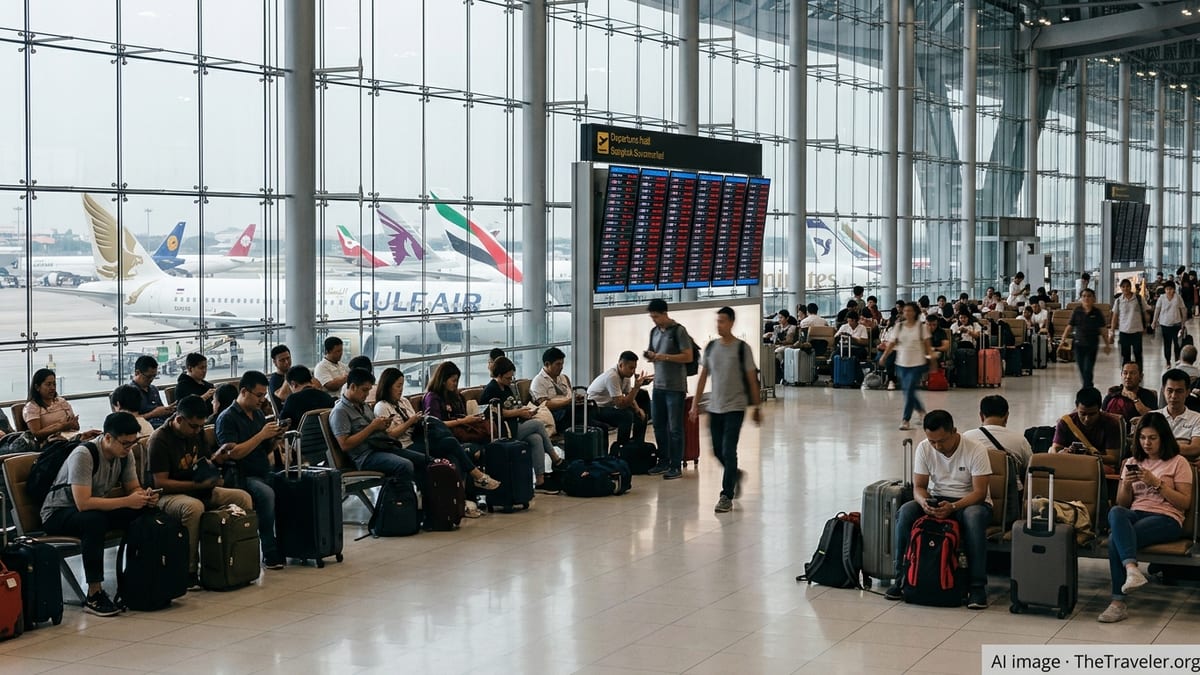
Major Gulf and regional airlines including Gulf Air, Qatar Airways, Emirates and Iran Air have cancelled or severely curtailed flights serving Thailand in recent days, leaving passengers stranded in Bangkok and Phuket and disrupting links to Bahrain, Doha, Dubai, Tehran, Tel Aviv and other hubs across the Middle East and beyond.
Get the latest news straight to your inbox!
Regional Conflict Ripples Into Thailand’s Air Corridors
Published coverage of the escalating conflict involving Iran, Israel and several Gulf states indicates that airspace closures across Bahrain, Qatar, Iran, Israel, Kuwait and the United Arab Emirates are now directly affecting long-haul traffic to and from Southeast Asia. Thailand, a major regional gateway for travelers heading between Europe, the Middle East and Asia-Pacific, has become one of the most visible pressure points.
Bangkok Suvarnabhumi and Phuket International Airport have both seen abrupt cancellations on routes that normally connect Thai holiday destinations with Gulf hubs such as Doha, Dubai and Manama. Flight-tracking data and airline advisories show that the disruption is concentrated on services that would usually overfly or connect through the most affected Middle Eastern airspace, forcing airlines either to ground aircraft or adopt longer, less economical routings.
Analysts note that Thailand’s heavy reliance on Gulf carriers for one-stop connections to Europe and the wider Middle East has magnified the impact. With multiple hubs now subject to restrictions or intermittent closures, carriers have been trimming schedules, prioritizing evacuation and essential flights, and cancelling many leisure-oriented services.
For passengers, that has translated into last-minute text messages and app notifications advising that outbound and inbound flights are cancelled, often with limited immediate alternatives available from the same carrier.
Gulf Air Grounded, Qatar Airways and Emirates Cut Back
Publicly available passenger updates show that Gulf Air remains fully grounded as of early March following the closure of Bahraini airspace, a decision that has effectively halted its network and eliminated direct Thailand links via Manama. The airline’s advisories describe the suspension as temporary but without a firm restart date, leaving travelers who had planned connections between Bangkok or Phuket and Bahrain searching for replacement itineraries.
Qatar Airways, which has long marketed Doha as a key one-stop gateway between Thailand and Europe, has also sharply reduced operations. Advisory documents and traveler reports describe a period of complete suspension of regular commercial flights through Doha, with only limited emergency and evacuation services permitted under tight constraints. Passengers booked from Bangkok to Doha, and onward to destinations such as Lisbon, Amsterdam and various German cities, describe multiple rolling cancellations and rebookings that ultimately did not operate.
Emirates, based in Dubai, initially announced a broad suspension of services amid airspace uncertainty and security concerns. Subsequent reports suggest the carrier has been restoring a portion of its schedule, but operations remain volatile, with some long-haul departures operating while others are cancelled at short notice. Travelers describe switching from Qatar Airways to Emirates in hopes of securing a way out of Thailand, only to face new rounds of disruptions as Dubai’s own air traffic has been periodically constrained by regional developments.
Iran Air and other regional airlines that link Thailand with Tehran and onward destinations have also been affected by the closure or restriction of Iranian airspace and by the wider pattern of airlines avoiding certain flight corridors. That has disrupted not only point-to-point traffic between Thailand and Iran but also connecting flows that rely on Tehran as an intermediate hub.
Stranded Travelers in Bangkok and Phuket Face Tough Choices
Social media posts and online travel forums are filled with accounts of passengers stuck in Bangkok and Phuket after their flights via Doha, Dubai or Bahrain were cancelled, sometimes only hours before departure. Many describe being rebooked onto later services that were then also cancelled, creating a cycle of uncertainty as travelers watch new itineraries disappear from airline apps.
Some passengers report turning to alternative routings on carriers that do not rely on the most affected Gulf airspace, including connections through Hong Kong, Seoul or European and East Asian hubs. However, the sudden surge in demand, coupled with school holidays and peak travel periods for parts of Europe, has pushed up fares and limited seat availability, making it difficult for stranded tourists and overseas workers to secure affordable options.
Thailand’s own consumer regulations require airlines operating from the country to offer rebooking, refunds or alternative transport when flights are cancelled, and traveler advocates are encouraging affected passengers to insist on those rights. In practice, though, those remedies can take days or weeks to process, and they do not always resolve the immediate challenge of finding a new way home from Thailand as quickly as needed.
Hotel stays, missed workdays and replacement tickets are adding unexpected costs for many travelers. Some describe moving between budget hotels near Bangkok’s main airport while they wait for confirmation of new flights, while others have opted to cut short their trips and fly back via significantly longer routes that skirt the troubled region altogether.
Tel Aviv and Other Destinations See Continuing Disruptions
Connections between Thailand and Tel Aviv, which often rely on Gulf or Turkish hubs, have been especially affected by the combination of Israeli airspace restrictions and broader Middle East overflight bans. Airline schedule data and regional media coverage show that flights to Israel from multiple global regions remain heavily curtailed, and routes from Bangkok or Phuket typically require complex multi-stop itineraries that avoid the most sensitive areas.
Travelers bound for other cities such as Tehran, Amman and Kuwait City face similar challenges. With Iran, Iraq, Israel and several Gulf states subject to varying degrees of closure or operational limitation, airlines are routing around large swaths of airspace. That adds flight time and cost, and in many cases carriers have concluded that temporarily cancelling services is the only viable option.
Long-haul operators from Europe, North America and Asia are also adjusting by suspending or rerouting flights to Dubai and Doha, further reducing the number of viable connections from Thailand to the wider region. Industry observers say that as long as major hubs in the Gulf operate under intermittent restrictions, knock-on effects will continue to be felt in far-flung markets like Bangkok and Phuket.
The result for Thailand-bound and Thailand-based travelers is a patchwork of schedules that can change day by day. Routes that appear bookable one week may be cancelled the next, and many experienced travelers are now advising others to avoid connections through Doha, Dubai, Bahrain or Tehran where possible until the situation stabilizes.
Unclear Timeline for Recovery of Thailand–Gulf Links
While some official notices from aviation authorities in the Gulf refer to temporary measures and scheduled review points, there is currently no clear timetable for a full restoration of normal flight operations across the region. Safety concerns, evolving military activity and the risk of further attacks on infrastructure continue to shape decisions on whether to reopen or keep airspace restricted.
According to publicly available travel risk assessments, airlines are likely to remain cautious even if certain corridors technically reopen, particularly for overflights routed close to conflict zones. Carriers must balance commercial pressure to resume profitable routes with the operational realities of rerouting, fuel costs and crew safety requirements.
For Thailand’s tourism sector, the uncertainty comes at a sensitive moment. The country has worked to rebuild international arrival numbers, and Gulf carriers play a key role in bringing visitors from Europe, the Middle East and parts of Africa. Any extended suspension of flights from Doha, Dubai, Bahrain and Tehran risks slowing that recovery and may push more traffic onto East Asian and European hubs instead.
Travel industry analysts suggest that travelers with imminent trips involving Gulf hubs should regularly monitor airline announcements, consider flexible tickets and be prepared to adjust itineraries on short notice. Until the security environment in the Middle East improves and airspace closures ease, Thailand’s air links to Bahrain, Doha, Dubai, Tehran, Tel Aviv and other destinations tied to Gulf carriers are expected to remain fragile.