

More news on this day
International travelers in Thailand are facing mounting disruption as Gulf Air, Qatar Airways, Emirates, Iran Air and other carriers cancel multiple services linking Bangkok and Phuket with hubs in Bahrain, Doha, Dubai, Tehran, Tel Aviv and beyond, following escalating instability and airspace restrictions across the Middle East.
Get the latest news straight to your inbox!
Middle East Conflict Ripples Across Thai Tourism Routes
Recent escalation in the Iran war and related missile and drone exchanges around the Gulf region have led to widespread airspace disruptions, with knock-on effects now being felt as far away as Thailand. Publicly available aviation data and news coverage indicate that tens of thousands of flights across the broader Middle East have been canceled or rerouted in recent weeks, as airports in Qatar, the United Arab Emirates and Iran contend with periodic interruptions to normal operations.
Thailand, one of Asia’s most popular long-haul tourism destinations, is heavily connected to the Middle East through hub carriers that funnel passengers between Europe, the Gulf and Asia. Routes from Bangkok Suvarnabhumi and Phuket International to Bahrain, Doha, Dubai, Tehran and Tel Aviv are particularly exposed, as they depend on overflight corridors and airport operations in a region directly affected by the conflict.
As airspace is temporarily closed or restricted and airports manage heightened security and emergency procedures, Gulf-based and regional airlines have increasingly reduced or suspended services, leading to clusters of cancellations on some of Thailand’s busiest long-haul corridors.
Wave of Cancellations From Bangkok and Phuket
Reports from airline schedule trackers, passenger forums and travel advisories suggest that more than a dozen flights in recent days have been canceled on Thailand links to the Middle East, with the impact concentrated on departures from Bangkok and Phuket. Services that would normally operate daily or several times per week to Bahrain, Doha and Dubai have been thinned out or temporarily pulled from schedules as airlines adjust to volatile conditions in the Gulf’s airspace.
Qatar Airways flights between Doha and Bangkok, as well as Doha and Phuket, have seen repeated schedule revisions. While some services remain in operation, recent interim timetables show a reduced pattern of flights compared with normal high-season frequencies, and travelers report last-minute cancellations or changes to equipment and timings as the situation evolves.
Emirates and other United Arab Emirates based carriers have also faced intermittent disruption after drone and missile incidents near Dubai and Abu Dhabi led to short suspensions of airport activity and tighter operational constraints. Bangkok and Phuket are among their core Southeast Asian destinations, meaning cancellations on these routes have an outsized effect on leisure travelers trying to return to or transit through the Gulf.
Iran Air and other regional airlines serving Tehran and Tel Aviv via connecting points have been caught in the same web of restrictions and risk assessments. Adjustments to flight paths, avoidance of certain conflict-adjacent airways and changing security guidance have combined to make some Thailand to Middle East rotations operationally challenging or commercially unviable in the short term.
Stranded Passengers and Crowded Thai Airports
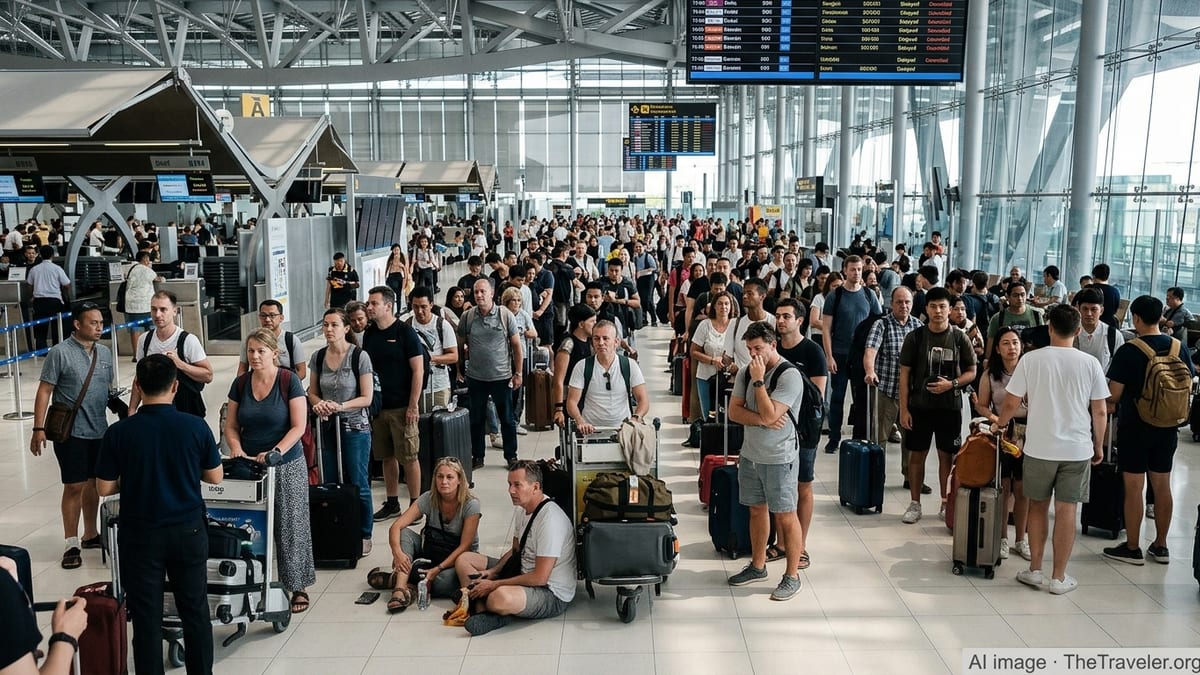
The immediate human impact is most visible in Thailand’s terminals. Social media posts and online travel communities describe long lines at airline counters in both Bangkok and Phuket as passengers seek rebooking after cancellations on Gulf and regional carriers. Some travelers report being stranded for several days while waiting for new itineraries that do not transit heavily affected hubs.
At Phuket International Airport, travelers attempting to reach Europe via Doha, Abu Dhabi or Dubai report that replacement flights are frequently either sold out or themselves at risk of disruption. Similar scenes are emerging at Bangkok Suvarnabhumi, where passengers on canceled Gulf Air, Qatar Airways and Emirates services are competing for scarce seats on East Asian and European carriers that route around the Gulf.
These bottlenecks come at a time when Thailand’s tourism sector is still in the process of rebuilding volumes after the pandemic era. With the country relying on international arrivals as a key economic driver, the sudden reduction in long-haul connectivity through major Gulf hubs is adding pressure to an already delicate recovery.
Rerouting via Europe and East Asia Drives Up Fares
As traditional one stop options via Bahrain, Doha, Dubai and other Middle Eastern hubs become less reliable, travelers are increasingly being pushed onto alternative routings. Public discussions among affected passengers highlight a pivot toward connections through East Asian and European hubs, such as Seoul, Tokyo, Hong Kong, Singapore and major cities in continental Europe.
However, the sudden surge in demand for itineraries that avoid conflict-affected airspace has driven up fares significantly. Travelers stranded in Thailand report steep price increases on remaining seats to Europe and North America, with some paying premium cabin prices simply to secure any outbound option that bypasses the Middle East.
Local and regional airlines not directly exposed to the Gulf conflict appear to be benefiting from this re-routing trend. Carriers based in Thailand and neighboring countries are seeing stronger bookings on long haul services to Europe and on feeder flights that connect passengers onward to alternative global hubs, further tightening capacity and adding to the upward pressure on ticket prices.
Uncertain Outlook for Thailand Middle East Links
The durability of Thailand’s flight disruptions remains closely tied to developments in the Iran war and the broader security picture in the Gulf. Analysts following the aviation industry note that the conflict has already become the sector’s most serious test since the pandemic, with airlines forced to repeatedly redraw route maps, reprice services and reconsider their exposure to volatile regions.
If missile and drone activity around key hubs such as Doha, Dubai and Tehran continues, airlines may opt to maintain reduced schedules or extended suspensions on routes connecting Thailand with the Middle East and onward to Europe. That would prolong the strain on Thai airports, keep fares elevated and potentially dampen demand from some long haul source markets wary of complex or uncertain itineraries.
For travelers currently in Thailand or planning imminent trips, publicly available guidance from travel agencies and airline notices generally urges close monitoring of flight status, flexibility on routing and an openness to itineraries that avoid the Gulf altogether. Until regional tensions ease and airspace restrictions are relaxed, Thailand’s role as a major long haul destination will remain entangled with a conflict unfolding thousands of kilometers away, and flight schedules between Bangkok, Phuket and the Middle East are likely to stay fluid from day to day.