

More news on this day
Regional aviation turmoil has intensified in Egypt as more than 30 flights linked to EgyptAir, Emirates, Gulf Air and Qatar Airways have been canceled or suspended on routes connecting Cairo and other Egyptian cities with major Gulf and Middle Eastern hubs, disrupting travel to and from Dubai, Doha, Bahrain, Kuwait, Abu Dhabi, Riyadh, Jeddah, Baghdad, Hurghada, Port Sudan, Sayun and additional destinations.
Get the latest news straight to your inbox!
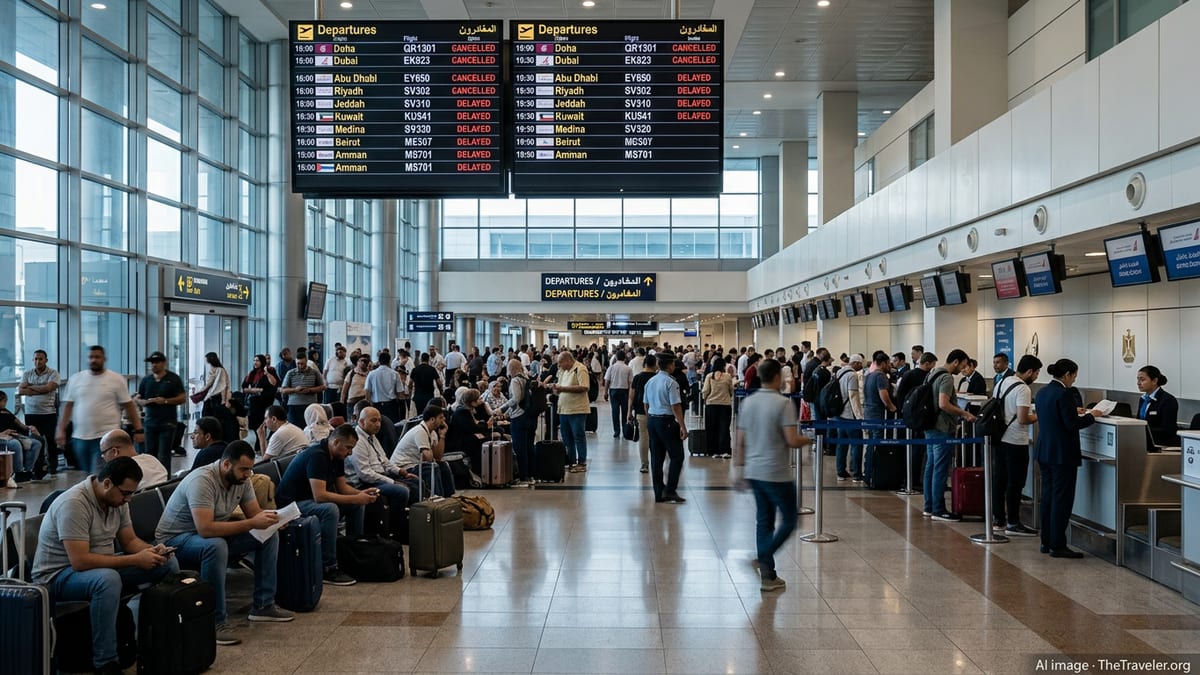
Airspace Closures Ripple Into Egypt’s Flight Schedules
Publicly available industry advisories show that ongoing airspace closures and restrictions across the Middle East and North Africa are at the heart of the latest cancellations affecting Egypt-linked routes. A regional security crisis has prompted partial or full airspace closures in several Gulf and Levant states, forcing airlines to repeatedly rework or suspend services.
Briefings from corporate travel and consulting firms in early March 2026 indicate that airspace over the United Arab Emirates, Bahrain, Qatar, Kuwait, Iraq and parts of the Levant has been intermittently restricted, sharply reducing capacity at hubs such as Dubai, Abu Dhabi and Doha. These disruptions have cascaded into neighboring markets whose own airspace remains technically open but whose carriers rely heavily on traffic to and through those Gulf hubs.
Egypt’s skies remain open and Egyptian airports operational, according to recent regional risk assessments, but connectivity is being battered by decisions taken in nearby states. Airlines have had to cancel point-to-point services, limit overflight, and cut frequencies on high-demand corridors that normally link Cairo and other Egyptian cities with the wider Gulf network.
For travelers, the distinction between open and closed airspace matters little in practice. What they experience are repeated cancellations, schedule changes and route suspensions, especially on services that rely on Gulf transit hubs to connect Egypt with Asia, Africa and Europe.
EgyptAir Pulls Back From Key Middle Eastern Cities
While Egyptian airspace remains available, EgyptAir has moved to reduce exposure to the affected region. According to recent mobility and immigration alerts prepared for multinational employers, the national carrier has temporarily suspended flights to at least 13 Middle Eastern cities in response to security concerns and regional airspace complexity.
These suspensions touch several of EgyptAir’s established routes, including services from Cairo to Gulf and Red Sea region destinations such as Dubai, Doha, Kuwait, Riyadh, Jeddah, Port Sudan and Baghdad. Published route lists for March 2026 still show these cities as part of the wider network, but current operational updates confirm that many of the flights are not operating as scheduled.
Domestic and leisure-focused connectivity has been affected as well. Hurghada, one of Egypt’s main Red Sea resort gateways, relies heavily on inbound traffic routed through Gulf hubs. The reduced ability of partner and competing carriers to feed traffic via Dubai, Doha or Bahrain is indirectly weighing on flight options and frequencies for Egypt-bound holidaymakers.
Industry observers note that EgyptAir’s pullback is part of a broader pattern across the region, with airlines choosing to concentrate on routes that can be reliably operated rather than maintain thin or high-risk links into partially closed airspace.
Emirates, Gulf Air and Qatar Airways Cut Services Into Egypt
The cancellations are not limited to Egypt’s national carrier. Major Gulf airlines that traditionally provide dense links between Egypt and the Gulf are also trimming their schedules. Corporate travel advisories and passenger communications issued in March point to a wave of cancellations by Emirates, Gulf Air and Qatar Airways on routes touching Egyptian airports.
Gulf Air has been particularly hard hit, with Bahrain’s airspace closure leading to a near-total grounding of its network in early March 2026. With Bahrain International Airport functioning only in a very limited capacity, routine links between Bahrain and Egyptian cities, including Cairo and potentially Hurghada, have been halted or heavily disrupted, cutting an important connection point for travelers moving between Egypt and the wider Gulf.
Emirates and Qatar Airways, two of the region’s largest long-haul carriers, have also made schedule cuts affecting Egypt-facing services as they navigate airspace restrictions and focus on limited interim networks. Egypt-bound flights that normally pass through Dubai and Doha now face tighter capacity, rerouting, or outright cancellation, affecting travel to and from cities such as Abu Dhabi via codeshares, as well as Riyadh and Jeddah through reconfigured regional networks.
In aggregate, publicly available information on canceled rotations suggests that more than 30 flights connecting Egypt with Gulf and nearby cities have been withdrawn over recent days, either as one-off cancellations or as part of broader temporary suspensions.
Destinations Most Affected: From Dubai to Port Sudan and Sayun
The impact is being felt across a wide arc of destinations traditionally tied into Egypt’s air travel ecosystem. Dubai, Doha and Abu Dhabi stand out given their role as global super-hubs that channel passengers between Egypt and long-haul markets in Europe, Asia, Australia and the Americas. Reduced frequencies and cancellations on these corridors mean fewer options, longer itineraries and higher fares for many passengers.
Saudi gateways including Riyadh and Jeddah are also experiencing knock-on effects. These routes are key for religious travel, business links and migrant worker traffic. Disruptions here are prompting some travelers to look for alternatives via secondary carriers or overland connections, further complicating journeys that would normally be straightforward short-haul flights between Egypt and the Kingdom.
Further south and east, services involving Port Sudan and the Yemeni city of Sayun have come under pressure as regional security risks, airspace limitations and airline risk assessments converge. These cities often depend on a patchwork of regional links via Cairo and Gulf hubs. When carriers like EgyptAir, Emirates, Gulf Air or Qatar Airways adjust their networks, the impact on such secondary destinations can be disproportionately severe.
Baghdad and other Iraqi airports, already constrained by their own airspace issues, have also seen further reductions in links involving Egyptian carriers or connections via Egyptian territory, limiting options for passengers whose itineraries combine Iraq, Egypt and Gulf states on a single multi-leg journey.
Travelers Face Limited Options and Ongoing Uncertainty
For passengers in Egypt and the wider region, the immediate challenge is handling last-minute changes. Reports from traveler forums and advisory notes from corporate travel managers describe a landscape of rolling cancellations, complex rerouting and long call-center waits as airlines prioritize safety and regulatory compliance over schedule stability.
Some travelers are turning to alternative carriers based in less-affected countries or to routes that avoid the most constrained airspace, even when that requires significant detours. Others are postponing or canceling trips altogether, especially where journeys rely on multiple sectors involving Egypt and Gulf hubs such as Dubai, Doha or Bahrain on the same ticket.
Airlines are publishing interim schedules and flexible rebooking policies, but the situation remains fluid. Operational plans are being adjusted as security assessments evolve and as aviation regulators in multiple countries review when and how to reopen key corridors. Passengers with imminent travel dates are being advised, in publicly available guidance, to monitor flight status closely and to maintain backup plans where possible.
With no clear timeline yet for a full normalization of airspace across the Gulf and surrounding regions, Egypt’s role as a key connector between Africa, the Middle East and Europe is likely to remain constrained in the near term, shaped less by its own infrastructure and more by evolving restrictions and cancellations among neighboring states and their national carriers.