

More news on this day
Gulf-based airlines and U.S. carriers are cancelling additional services, creating fresh disruption for travelers on routes linking Istanbul with key Gulf hubs and cutting connectivity between Marquette and Detroit as regional tensions and severe weather continue to unsettle air travel.
Get the latest news straight to your inbox!
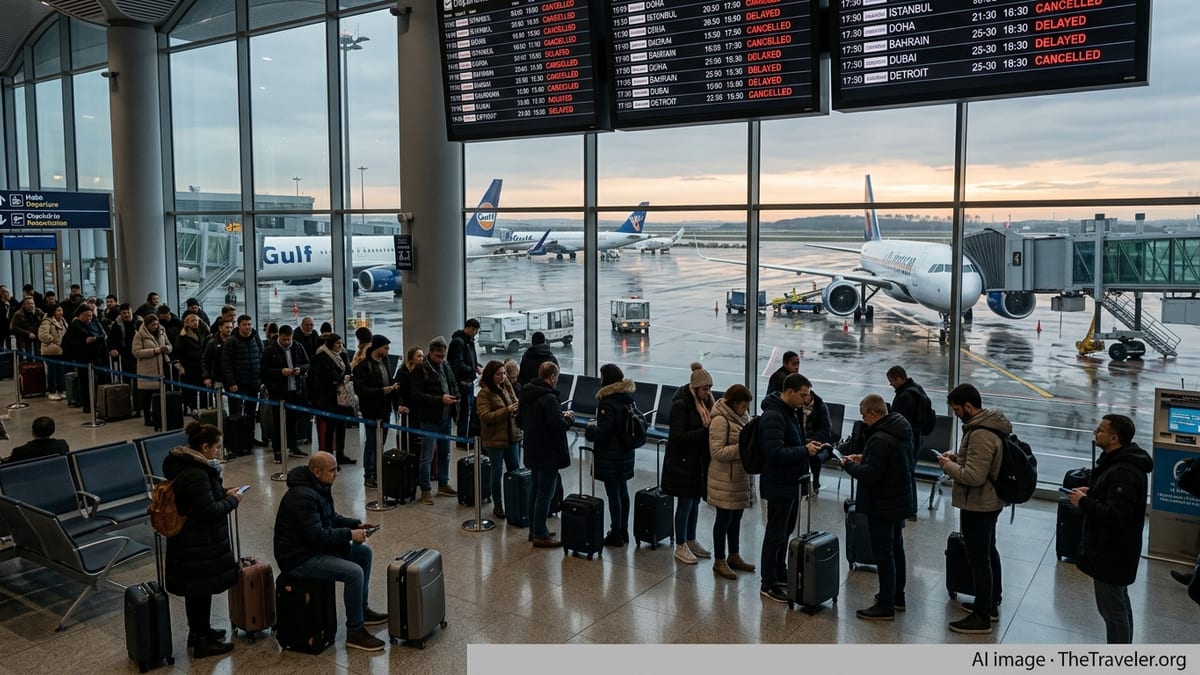
Fresh Wave of Cancellations Hits Istanbul–Gulf Routes
Near-daily schedule changes across the Middle East and Eastern Mediterranean are now rippling through Turkey, with Gulf Air, Qatar Airways and Flydubai among the carriers adjusting or cancelling flights that typically connect Istanbul with Bahrain, Doha and Dubai. Publicly available flight-status boards and timetable data as of March 21 indicate that nearly a dozen additional flights touching Turkish airspace have been withdrawn or re-routed in the latest round of changes.
The Istanbul to Bahrain corridor, traditionally an important link for business and transfer traffic via Gulf Air’s Bahrain hub, has seen particular strain. Reports from passengers and travel-industry trackers describe repeated cancellations and rebookings on services that would normally channel travelers from Istanbul Airport through Bahrain to destinations across the Gulf and South Asia.
Services between Istanbul and Doha are also being reshaped as Qatar Airways continues to navigate intermittent airspace restrictions and a significantly reduced operating program. According to published coverage on the broader regional disruption, the carrier has maintained a skeleton network focused on repatriation and essential connections, leading to reduced frequencies and short-notice timetable changes on routes that would usually see multiple daily flights.
Flydubai’s Istanbul links into Dubai’s low-cost and regional network remain subject to operational review as the airline balances demand against route viability and available flight paths around closed or restricted airspace. Flight-status snapshots for late March show several Istanbul–Dubai rotations removed from sale or listed as cancelled, adding to uncertainty for travelers who rely on the carrier’s point-to-point model.
Regional Tensions and Airspace Limits Drive Middle East Disruption
The renewed cancellations come against the backdrop of a conflict-driven airspace crisis affecting multiple Gulf and neighboring states. Analyses of the wider 2026 Iran-related conflict note that closures or heavy restrictions in the skies over Qatar, Bahrain, Kuwait and portions of surrounding airspace have forced airlines to condense or suspend operations, dramatically reducing available capacity across the region.
According to recent summaries of the economic impact of the conflict, major Middle Eastern carriers including those based in the United Arab Emirates and Qatar have already suspended many flights and are contending with thousands of daily cancellations tied to safety considerations and route viability. Turkey, positioned as a key transit point between Europe, the Middle East and Asia, is experiencing spillover effects as airlines recut schedules, consolidate services and funnel remaining demand through a smaller number of viable corridors.
Operational updates circulated by aviation risk and logistics consultancies describe a patchwork of open and closed airspace, with Gulf-facing routes in particular subject to rapid change. For flights into and out of Istanbul, this has translated into longer routings, altered departure waves and, increasingly, cancellations where detours are impractical or commercial demand has fallen away amid traveler caution.
Travelers attempting to connect between Istanbul and Gulf hubs report that some itineraries can still be constructed via alternative carriers or indirect routings through Europe, but at the cost of longer journey times and higher fares. In practice, the latest cancellations by Gulf Air, Qatar Airways and Flydubai are further tightening what was already a constrained network linking Turkey with Bahrain, Doha and Dubai.
Marquette–Detroit Link Strained by Severe U.S. Weather
At the same time, travelers in the United States are facing their own wave of disruption linked to extreme weather. A powerful March storm system that swept across the Central United States and into the Upper Midwest has led to widespread cancellations and delays, with regional routes in Michigan among those heavily affected.
Meteorological summaries of the March 13 to 17 storm complex describe it as a large and historic event, combining blizzard conditions, ice and severe thunderstorms that disrupted ground transport and air travel across multiple states. Airlines serving Detroit Metropolitan Wayne County Airport implemented substantial schedule reductions as conditions deteriorated, with knock-on effects that have lingered even after skies cleared.
The relatively small but strategically important Marquette–Detroit connection, typically operated by regional affiliates feeding into Detroit’s hub network, has seen multiple flights scrubbed or consolidated as carriers reposition aircraft and crews in the storm’s aftermath. Flight-tracking data and local coverage indicate that cancellations out of Marquette have continued into the second half of March, periodically severing the Upper Peninsula’s main air link to the broader domestic and international network.
For travelers relying on Detroit to connect onward to the Middle East or Europe, these localized cancellations compound the impact of the turmoil affecting Gulf carriers. In some cases, passengers who successfully secure rebookings from Istanbul or other overseas points are then finding their domestic feeder flights from Marquette to Detroit disrupted by weather-related schedule changes.
Travelers Face Complex Rebookings and Limited Alternatives
The combination of conflict-driven airspace restrictions in the Gulf region and severe weather in North America is creating unusually complex itineraries and rebooking challenges. Reports shared by passengers on airline-focused forums describe repeated cancellations on Gulf Air and Qatar Airways services, followed by efforts to re-route via Turkish gateways or alternative European hubs, only to encounter further disruption when connecting onto U.S. domestic legs.
Publicly available information from airline advisories suggests that carriers are offering a mix of flexible change policies, refunds and limited alternative routings, with specific options varying by date, route and ticket type. In many cases, however, constrained capacity out of Istanbul and other key hubs means that open seats on near-term departures are scarce, particularly in peak travel windows.
For those traveling between Istanbul and the Gulf, some itineraries are being reconfigured to avoid the most affected airspace, occasionally adding hours of flying time. Meanwhile, travelers in regional U.S. markets such as Marquette are often reliant on a single carrier or alliance to reach Detroit, leaving few same-day alternatives when storms force cancellations.
Travel agents and online booking platforms are reporting heavy demand for real-time updates and for routings that keep options open, such as tickets with more flexible fare rules or itineraries that include robust backup connections via larger hubs. However, the fast-moving nature of both the airspace situation in the Gulf and late-winter weather in North America continues to limit the effectiveness of longer-range planning.
What Passengers Can Do Amid Ongoing Volatility
With both geopolitical and meteorological factors in play, travel planners indicate that passengers on routes touching Istanbul, Bahrain, Doha, Dubai or regional Michigan airports should prepare for last-minute changes well into late March. Industry guidance and recent experience from affected travelers point to several practical steps for managing the situation.
First, monitoring bookings closely through airline apps and flight-status tools has become essential, as many changes are being implemented within 24 to 48 hours of departure. Travelers on Gulf Air, Qatar Airways and Flydubai are also being urged by travel advisors to ensure contact details are up to date so they can receive schedule-change notifications and rebooking offers promptly.
Second, where possible, choosing itineraries with longer connection windows and avoiding tight same-day links between international arrivals and regional departures can help absorb unexpected delays. For passengers connecting from Istanbul or Gulf hubs into Detroit, leaving additional time before onward flights to smaller cities such as Marquette may reduce the risk of misconnected journeys when storms or operational issues arise.
Lastly, publicly available airline advisories suggest that flexible tickets and clear familiarity with each carrier’s disruption policy can make a significant difference in securing favorable outcomes when cancellations occur. While the current wave of changes involving Gulf Air, Qatar Airways, Flydubai and U.S. regional carriers may ease as weather stabilizes and airspace conditions evolve, travelers on these corridors are likely to face elevated uncertainty in the near term.