

More news on this day
Hundreds of travelers across the Middle East, Europe, and Asia are facing major disruption after Gulf Air, Qatar Airways, and Royal Jordanian canceled at least 45 flights and delayed around 20 more, snarling traffic through key hubs in Doha, Manama, and Amman and affecting long-haul routes to cities including Singapore and London.
Get the latest news straight to your inbox!
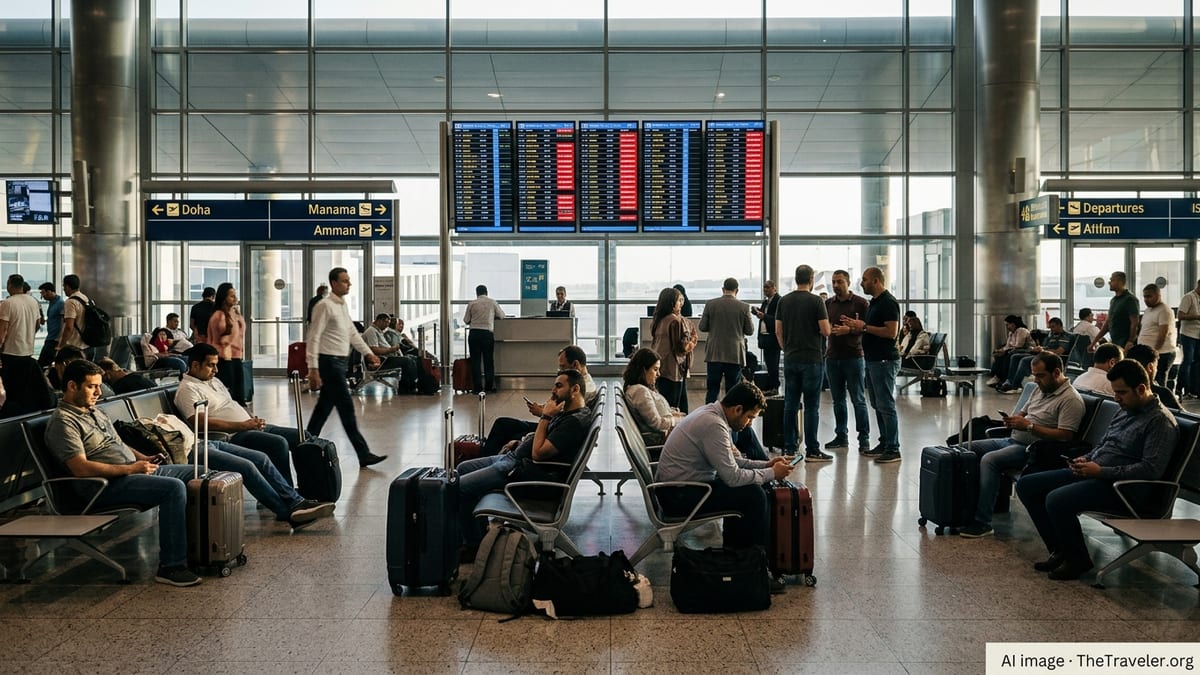
Wave of Cancellations Hits Gulf and Levant Hubs
Published coverage and live schedule data indicate that the latest round of disruption is concentrated on services operating to and from Doha’s Hamad International Airport, Bahrain International Airport in Manama, and Amman’s Queen Alia International Airport. The three national carriers are reported to have scrubbed dozens of departures and arrivals in a short window, with additional services operating under significant delay.
The 45 cancellations and 20 delays span regional and long-haul routes, disrupting links between the Gulf and major markets in Europe and Asia. Connections involving London and Singapore are among those most affected, creating knock-on problems for onward journeys across airline alliances and codeshare networks.
Operational databases and timetable snapshots show gaps in previously scheduled rotations, with some aircraft remaining on the ground and others repositioned or rerouted. This pattern suggests a coordinated response to constrained airspace and capacity limits rather than isolated technical issues on individual flights.
The impact is magnified by the role of Doha, Manama, and Amman as transit gateways for passengers traveling between Europe, Asia, Africa, and Oceania. Even a relatively small number of cancellations relative to daily schedules can cascade into missed connections and extended journey times for travelers far beyond the region.
Doha Disruptions Undercut Qatar Airways’ Global Network
Doha, one of the world’s busiest long-haul hubs, remains central to the disruption. Publicly available information on interim schedules indicates that Qatar Airways has been operating a reduced and frequently adjusted timetable, with specific dates seeing concentrated cancellations and long delays on trunk routes to London, Singapore, and other high-demand cities.
Route updates circulating in industry channels point to fluctuating frequencies on key city pairs such as Doha to Singapore and Doha to London. In some cases, services have been consolidated onto fewer departures, while at other times individual flights have vanished from booking systems within days of departure, leaving passengers scrambling for alternatives.
Reports from travelers show that even when flights continue to operate, extended layovers and last-minute retimings are common. In several instances, itineraries that originally involved moderate connection times through Doha have been rebooked onto new services with lengthy overnight stays, stretching total journey times by many hours.
These ongoing adjustments underscore the fragility of hub-and-spoke operations in constrained airspace conditions. With most long-haul passengers relying on smooth connections at Doha, the cancellation of a single feeder or onward leg can render an entire itinerary unworkable, prompting rebooking, refunds, or complete trip abandonment.
Gulf Air and Bahrain Feel the Strain of Regional Volatility
In Bahrain, Gulf Air’s operations are also under pressure. Regional aviation trackers and recent travel advisories describe a pattern of short-notice cancellations and retimed flights, particularly on routes linking Manama with other Gulf states and key destinations in the Middle East and Europe.
While Gulf Air’s network is smaller than that of Qatar Airways, the airline plays a vital role in connecting Bahrain with major business and expatriate markets. The cancellation of multiple rotations in a single day can have a disproportionate effect on local travelers, who depend on limited daily options to reach regional hubs or connect onward.
For some passengers, the disruption has meant re-routing through alternative airports such as Dammam in Saudi Arabia or via competing Gulf carriers where seats are available. However, capacity constraints and overlapping disruption across the wider region have limited these fallback options, leaving certain travelers facing extended waits or forced changes of travel dates.
Publicly available timetables suggest that Gulf Air is continuously revisiting its schedule as conditions evolve, restoring selected flights while withdrawing others. This dynamic environment has made it challenging for travelers to plan with confidence, even when bookings were made well in advance.
Royal Jordanian Adjusts Schedules as Amman Connections Falter
Royal Jordanian, based in Amman, has also trimmed and reshaped its operations in response to the same regional pressures. Sector data and media coverage show the carrier cancelling and delaying services on a mix of regional and long-haul routes, including flights that feed into European destinations such as London.
Amman functions as a key connection point between the Levant, the Gulf, and Europe, and disruptions there reverberate across multiple corridors. Canceled or heavily delayed flights from Gulf cities into Amman can cause passengers to miss onward European departures, forcing overnight stays or complete itinerary changes.
Royal Jordanian’s recent schedule adjustments come on top of a broader network reshaping that has been underway in response to changing demand and operational constraints. The latest series of cancellations has further reduced flexibility for passengers, particularly those seeking to avoid transiting other Gulf hubs while still reaching major cities such as London or Singapore via multi-stop journeys.
Travelers with upcoming tickets routed through Amman are being advised by travel agents and online booking platforms to verify their flight status repeatedly in the days leading up to departure, as additional changes and rolling delays remain possible.
Passengers Face Missed Connections, Refund Delays, and Limited Alternatives
The immediate consequence for passengers is uncertainty. Social media posts and traveler forums are filled with accounts of flights disappearing from apps, itineraries showing one segment confirmed while another is marked as canceled, and long waits to reach call centers for clarification.
Many affected travelers report being offered rebooking within a limited window, sometimes only a few days before or after their original travel date. For those with fixed commitments or onward tickets on separate carriers, these options can be impractical, pushing them toward refunds or entirely new bookings on different airlines at higher prices.
Refund processing times have become a major point of frustration. While airline policies referenced in public documents provide for refunds on canceled flights, travelers describe waiting days or weeks for confirmation that claims have been accepted, especially when tickets were purchased through third-party agencies or with frequent-flyer miles.
Alternative routings are available in some cases via other Middle Eastern or European hubs, but capacity is limited and demand is elevated. This has led to sharply higher fares on remaining seats and, for some passengers, the difficult choice between paying substantially more to travel as planned or postponing trips indefinitely.
What Travelers Should Do Before Heading to the Airport
Given the fluid situation, travel industry advisories consistently recommend that passengers monitor their bookings closely rather than relying on original confirmation emails. Airline websites and mobile apps are generally updated first when cancellations or delays occur, though these channels have occasionally lagged behind internal schedule changes.
Experts also suggest building additional buffer time into any itinerary involving Doha, Manama, or Amman, particularly when connecting to separate tickets or time-sensitive events. Even flights that appear to be operating on schedule may be subject to last-minute retiming as carriers adjust to evolving airspace and operational constraints.
Travelers who have not yet departed are encouraged by consumer advocates and travel agents to review fare rules and disruption policies. In many cases, flexible rebooking or refund options are available once a flight is officially canceled, but these may not apply to voluntary changes made before any schedule adjustment is recorded.
With regional conditions still unsettled and airlines revising timetables at short notice, industry observers expect intermittent disruptions to continue in the coming weeks. For now, anyone planning to travel through Doha, Manama, or Amman, or to destinations such as Singapore and London on the affected carriers, is likely to face a more complex and uncertain journey than usual.