

More news on this day
Qatar Airways has joined Emirates, flydubai, Etihad Airways and Air Arabia in cautiously resuming flights across the Middle East, as parts of the region’s airspace reopen following unprecedented closures triggered by the widening Iran–US–Israel conflict.
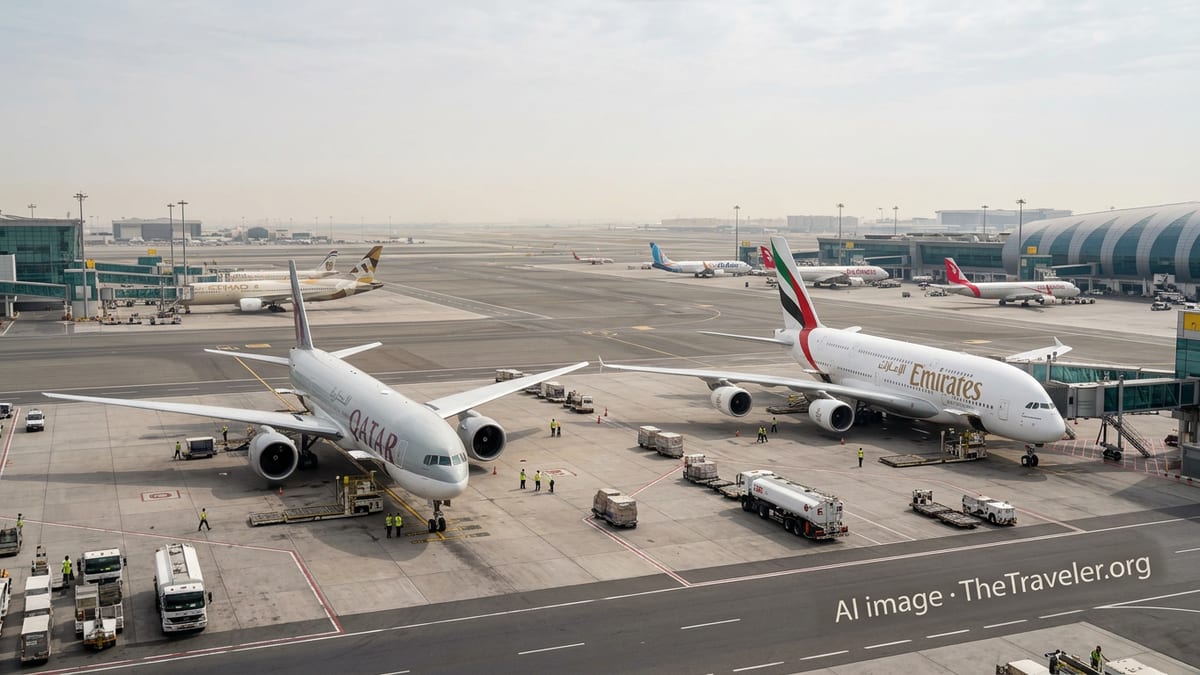
Gulf Hubs Edge Back to Life After Sweeping Closures
After more than a week of severe disruption that shut down some of the world’s busiest hubs, Gulf airlines are beginning to restore a patchwork of services linking the United Arab Emirates, Qatar, Saudi Arabia, Bahrain and other Middle Eastern destinations. Emirates and Etihad restarted reduced operations from Dubai and Abu Dhabi on March 6, operating well below their usual capacity while they assess the security situation and available routings across still-fragmented airspace.
Regional low-cost carriers flydubai and Air Arabia have similarly brought back limited schedules from Dubai World Central, Dubai International and Sharjah, focusing on short- and medium-haul routes judged to carry lower risk and that can be flown via safe corridors. Industry estimates suggest these carriers are collectively operating between a quarter and two-thirds of their normal networks, with many frequencies trimmed and some destinations temporarily removed.
Saudi airports, including Riyadh’s King Khalid and Jeddah’s King Abdulaziz, have seen a gradual return of services operated by Gulf and regional carriers, reconnecting key business and religious travel markets. However, with airspace over Iran, Iraq and Israel remaining heavily restricted or closed to most civilian traffic, airlines are rebuilding their schedules on the basis of what is operationally possible rather than what is commercially optimal.
Behind the cautious reopening is a complex patchwork of national restrictions, conflict-zone advisories and insurance constraints that airlines must navigate in real time. Aviation analysts say the Gulf’s role as a global connecting hub is temporarily constrained, with routes between Europe, Africa and Asia forced into longer detours or multiple stops, elongating journey times even as flights resume.
Qatar Airways Returns Under Tight Constraints
The most closely watched development came in Doha, where Qatar Airways has restarted limited operations from Hamad International Airport after the Qatar Civil Aviation Authority partially reopened national airspace on March 7. The carrier is initially focusing on essential passenger movements and cargo flights, while standard commercial frequencies remain significantly curtailed.
Qatari regulators have been explicit that safety and security assessments will determine the pace of any further expansion. Authorities have authorised controlled corridors for evacuation, humanitarian and priority commercial services, but full-scale scheduled operations are withheld pending what they describe as “verifiable and sustainable” improvements in the regional security picture.
For Qatar Airways, the staggered return presents both operational and reputational challenges. The airline must reposition aircraft and crew stranded outside the country, realign its global banked hub schedule and manage hundreds of thousands of disrupted itineraries, all while adhering to conservative risk thresholds. Travel agents in Doha report that seats on the first wave of outbound services are being allocated primarily to passengers whose journeys were cancelled during the initial closure period.
Even once full commercial flying resumes, route structures out of Doha are expected to be reshaped by ongoing risk assessments. Flights that traditionally overflew Iran, Iraq or Israel are likely to continue detouring over the Arabian Sea or via the eastern Mediterranean, adding hours to some long-haul journeys and pushing up fuel burn and operating costs.
Safety First: How Airlines Are Managing Airspace Risk
Across the region, airlines are foregrounding safety and security messaging to reassure travellers unsettled by missile attacks, drone activity and sudden airport shutdowns. Executives from Emirates, Etihad and Qatar Airways have all emphasised that decisions about where and when to fly are being guided by real-time intelligence briefings from national authorities, global regulators and defence partners rather than by commercial pressures.
Carriers are making extensive use of dynamic rerouting tools that allow flight planners to design paths around active conflict zones, restricted airspace and missile trajectories identified by military tracking systems. Dispatch teams are updating flight plans hour by hour as new Notices to Air Missions are issued, often favouring longer southern or northern corridors that keep aircraft well clear of potential flashpoints despite the extra fuel and crew time required.
Insurers and international aviation bodies are playing a pivotal role in setting the boundaries of what is considered acceptable risk. Conflict-zone bulletins from European and global regulators, combined with war-risk insurance requirements, effectively draw invisible no-go lines on the map. Gulf carriers that built their business models around optimised, straight-line routings are now operating within these constraints, accepting reduced payloads and tighter schedule buffers in exchange for wider safety margins.
On the ground, airports in Dubai, Abu Dhabi and Doha have activated emergency and contingency plans calibrated after earlier regional crises. These include reinforced terminal screening, the use of remote stands to keep aircraft away from crowded concourses where necessary, and pre-designated shelters and secure zones for passengers and staff should an incident occur during operating hours.
What the Reopenings Mean for Travellers
For travellers, the gradual resumption of flights brings relief but also continued uncertainty. Schedules are changing frequently, with short-notice cancellations and re-timings as airlines respond to evolving airspace conditions. Passenger advocates are urging anyone flying via the Gulf to monitor airline apps closely, avoid same-day connections when possible and ensure that contact details in bookings are up to date.
Flexible rebooking policies remain in place at most major Gulf carriers for tickets issued before the latest wave of closures, allowing passengers to shift travel dates or reroute without additional fees. However, with capacity still constrained and certain routes entirely suspended, securing seats on alternative flights can be challenging, particularly for those travelling between Europe and Asia or between the Indian subcontinent and North America.
Travel patterns are also being reshaped as some passengers opt to avoid the region altogether, at least in the short term. European and Asian airlines have bolstered non-stop services that bypass the Gulf, while Turkish and Central Asian hubs are absorbing traffic that would normally connect through Dubai or Doha. Industry experts note that once stability returns, the geographic advantages of the Gulf are likely to reassert themselves, but rebuilding passenger confidence will take time.
Despite the disruption, consumer demand for travel across the Middle East and beyond remains strong, driven by family visits, labour migration and pent-up tourism. Airlines are betting that a transparent emphasis on safety, clear communication and generous flexibility will persuade nervous travellers to keep flying as the region edges toward a new, more cautious normal.
Longer Routes, Higher Costs and a New Operating Reality
The operational compromises required to keep flights away from high-risk airspace are reshaping the economics of Gulf aviation. Detours around closed or restricted flight information regions can add hundreds of nautical miles to a journey, increasing fuel consumption, crew hours and maintenance needs. For carriers already grappling with volatile oil prices, the cost of maintaining safe but circuitous routes is significant.
Airlines are responding by temporarily trimming frequencies on some long-haul routes, upgauging aircraft where demand is strongest and, in some cases, prioritising markets with higher-yield traffic that can better absorb increased operating costs. Analysts expect fares on certain Europe–Asia and Africa–Asia city pairs to remain elevated as long as the current airspace restrictions persist and capacity remains constrained.
The latest crisis also underscores the vulnerability of the Gulf’s hub-and-spoke model to geopolitical shocks. While Emirates, Qatar Airways, Etihad, flydubai and Air Arabia have all invested heavily in resilience measures over the past decade, the near-simultaneous closure of multiple key airspaces has highlighted the limits of operational flexibility when surrounded by conflict zones. Industry observers say carriers are now accelerating work on diversified networks, deeper partnerships and contingency planning that assume more frequent, longer-lasting disruptions.
For now, the message from Gulf airlines is consistent: flights will only ramp up in lockstep with verifiable improvements in the regional security climate. Qatar Airways’ decision to join its UAE peers in cautiously resuming services frames the current phase as one of controlled recovery rather than a return to business as usual, with safety and security firmly at the centre of every operational choice.