

More news on this day
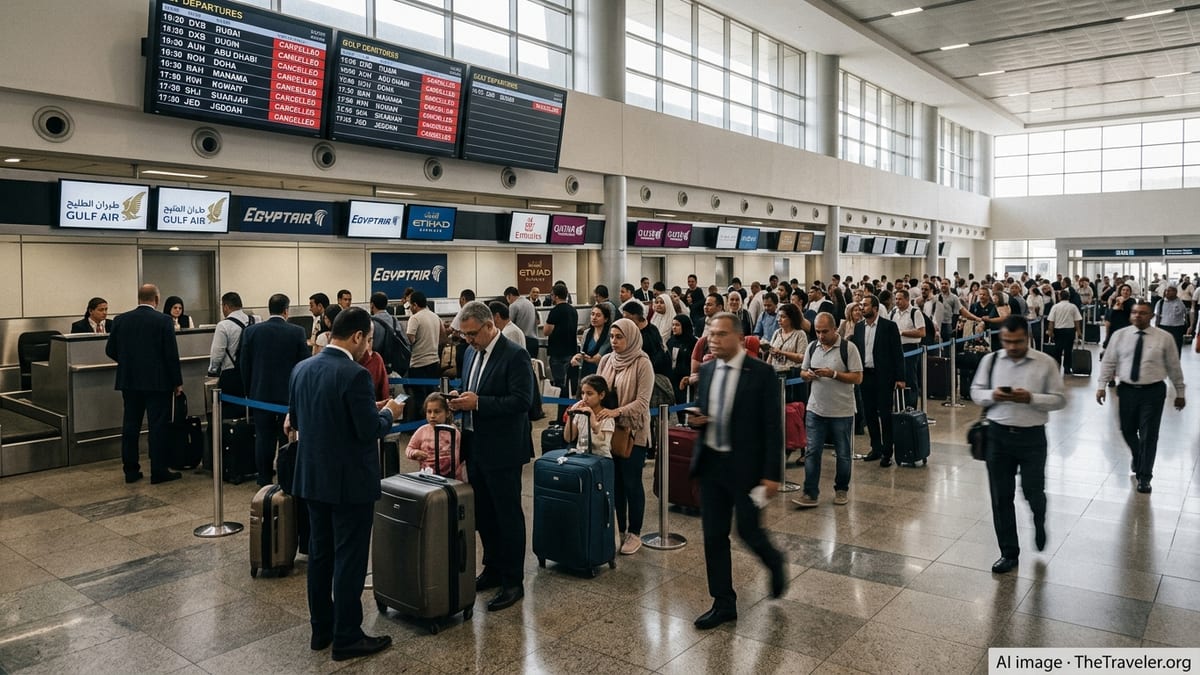
Air travel across Egypt has been thrown into fresh turmoil as Gulf Air, EgyptAir, major UAE-based carriers, and Qatar Airways cancel more than 50 flights, disrupting links from Cairo and other Egyptian airports to key hubs including Dubai, Abu Dhabi, Doha, Manama, Kuwait City, Sharjah, Jeddah, Port Sudan and additional regional gateways, according to publicly available schedules and travel-industry advisories.
Get the latest news straight to your inbox!
Wider Middle East Airspace Crisis Ripples Into Egypt
The latest wave of cancellations affecting flights between Egypt and the Gulf comes against the backdrop of a broader Middle East airspace crisis triggered in late February 2026. Regional media, government advisories, and corporate travel bulletins describe a pattern of intermittent airspace restrictions and missile-related security concerns stretching across the Gulf and Levant, with the United Arab Emirates, Qatar, Bahrain, Kuwait, Israel, Iran and Iraq among the most heavily impacted.
While Egyptian airspace and its main gateways, including Cairo International Airport, remain technically open, reports indicate that Egypt’s connectivity with Gulf hubs has been sharply curtailed. EgyptAir has already suspended multiple routes to Middle Eastern cities as a precaution, while foreign carriers serving Egypt are cutting or consolidating services as they navigate closed or restricted corridors in neighboring states.
The result is that Egypt, typically a stable transit and tourism hub between Africa, the Gulf and Europe, is now feeling the knock-on effects of disruptions centered outside its borders. Cancellations by Gulf Air, Qatar Airways and leading UAE-based airlines are particularly significant because these carriers normally provide dense schedules linking Egyptian cities with the wider Gulf, South Asia and East Asia.
Key Routes Hit: Dubai, Abu Dhabi, Doha, Manama and Beyond
Travel-industry updates and airline schedule data show cancellations concentrated on high-frequency routes between Egypt and major Gulf hubs. Flights between Cairo and Dubai, as well as services from Egyptian cities to Abu Dhabi and Sharjah, have seen repeated cancellations or downgrades to irregular, ad hoc operations. This has left many travelers relying on last-minute rebookings via third countries or alternative Gulf gateways.
Connections to Doha have been among the most affected. Qatar Airways, which typically operates a significant number of daily services to and from Egypt, is maintaining only a limited schedule while standard commercial operations through Hamad International Airport remain constrained. Passengers booked on Cairo–Doha or Alexandria–Doha rotations report cancellations extending over multiple days, with some itineraries shifted onto partner airlines or routed via Istanbul, European gateways or the Red Sea corridor when seats are available.
Bahrain’s Gulf Air has implemented its own set of cancellations on Egypt-linked sectors as Bahrain’s airspace and neighboring routes come under periodic restrictions. Flights linking Cairo with Manama, as well as onward connections to Kuwait City and Jeddah, have been thinned out or temporarily suspended, further reducing options for travelers attempting to reach the northern Gulf or the western shores of the Arabian Peninsula.
The disruption also stretches southward. Services toward Port Sudan and other Red Sea points have faced additional operational complexity as carriers adjust routings to avoid closed or high-risk airspace segments, further limiting Egypt’s traditional role as a flexible connecting point between the Gulf and East Africa.
UAE Airlines Adjust Schedules as Hubs Gradually Reopen
UAE-based airlines have been forced into rapid schedule overhauls as Dubai and Abu Dhabi, normally among the world’s busiest international hubs, work through intermittent restrictions and security reviews. Advisory notices from corporate travel managers describe periods when Emirates temporarily halted all departures from Dubai before progressively restoring a limited number of flights, subject to operational and safety clearance.
Etihad Airways and other carriers based in the UAE have implemented similar step-by-step resumptions from Abu Dhabi, with passenger services prioritized on carefully selected routes and timings. For Egyptian travelers and foreign visitors transiting through Egypt, this has translated into sudden cancellations on routes such as Cairo–Abu Dhabi, Cairo–Dubai and Alexandria–Dubai, even as some long-haul services from the UAE to Europe and Asia cautiously return.
Sharjah and secondary UAE airports, often used by low-cost and regional carriers, have also seen their Egypt services curtailed. Publicly available flight-status information shows that airlines are frequently consolidating multiple daily rotations into fewer departures, or swapping widebody aircraft for smaller jets when demand can be accommodated on a reduced schedule.
Industry observers note that while there are clear signs of a gradual reopening across parts of UAE and Qatari airspace, the situation remains fluid. For travelers relying on tightly timed connections through the Gulf, even small last-minute alterations in flight permissions can cascade into missed onward flights, overnight delays and unplanned stays in Cairo or other Egyptian cities.
Stranded Passengers and Mounting Pressure on Rebooking Systems
The cancellation tally of more than 50 flights involving Gulf Air, EgyptAir, UAE airlines and Qatar Airways is only part of the story, as each affected departure typically carries hundreds of passengers with onward connections. Social media posts, airline app updates and travel-forum discussions describe travelers stranded in Cairo, Hurghada and Sharm El Sheikh after their onward Gulf connections were repeatedly cancelled or rescheduled.
Travel-management firms have warned clients that call centers and online support channels are heavily congested, with some passengers reporting waits of several hours to secure rebookings. Publicly available guidance from major airlines currently recommends that travellers avoid heading to the airport until they have received confirmed new itineraries, a departure from the usual advice to arrive early and queue at service desks.
In many cases, rebookings involve substantial rerouting. Some travelers originally bound for Dubai or Doha from Egypt are being placed on flights to European or Asian hubs instead, where they can reconnect with long-haul services operated by alliance partners or interline carriers. Others are being advised to accept full refunds and make entirely new arrangements, especially when travel dates fall inside specific eligibility windows set out in updated airline policies.
The strain is particularly acute for passengers with complex multi-leg journeys, such as labor migrants connecting from Egypt to the Gulf and onward to South or Southeast Asia, or long-haul leisure travelers using Cairo as a gateway between Europe and the Indian Ocean. For these groups, a single cancellation between Egypt and a Gulf hub can unravel several subsequent flights and prepaid hotel or tour bookings.
What Travelers Through Egypt Should Do Now
With cancellations still being announced at short notice, publicly available information from airlines and travel-management companies stresses the importance of active monitoring. Passengers holding tickets on Gulf Air, EgyptAir, major UAE carriers or Qatar Airways for travel between Egypt and Gulf destinations in March and early April are being urged to check their booking status frequently via airline websites or mobile applications.
Advisories also highlight the evolving nature of airline waiver and refund policies. Several Gulf carriers have expanded their eligibility windows for fee-free date changes or refunds, particularly for travel dates framed between late February and late March, and in some cases into April. Travelers whose flights remain scheduled but who are uncomfortable with the current uncertainty are often permitted to shift departures forward by a limited number of weeks without penalty, depending on fare rules.
Given the tight capacity on remaining services, travellers are being encouraged to confirm any rebooked itinerary before cancelling existing accommodation or onward transport. For journeys that are time-sensitive or involve critical commitments, such as business trips or medical travel, industry specialists suggest exploring alternative routings that bypass the most heavily affected hubs, even if this involves longer flying times or additional stops.
For now, Egypt’s airports continue to operate, but their role as reliable connectors to Gulf hubs has been temporarily undermined. Until airspace restrictions in neighboring states are fully lifted and carriers restore regular schedules, travelers heading to or from Egypt via Dubai, Abu Dhabi, Doha, Manama, Kuwait City, Sharjah, Jeddah and Port Sudan are likely to face a continued risk of last-minute disruption.