

More news on this day
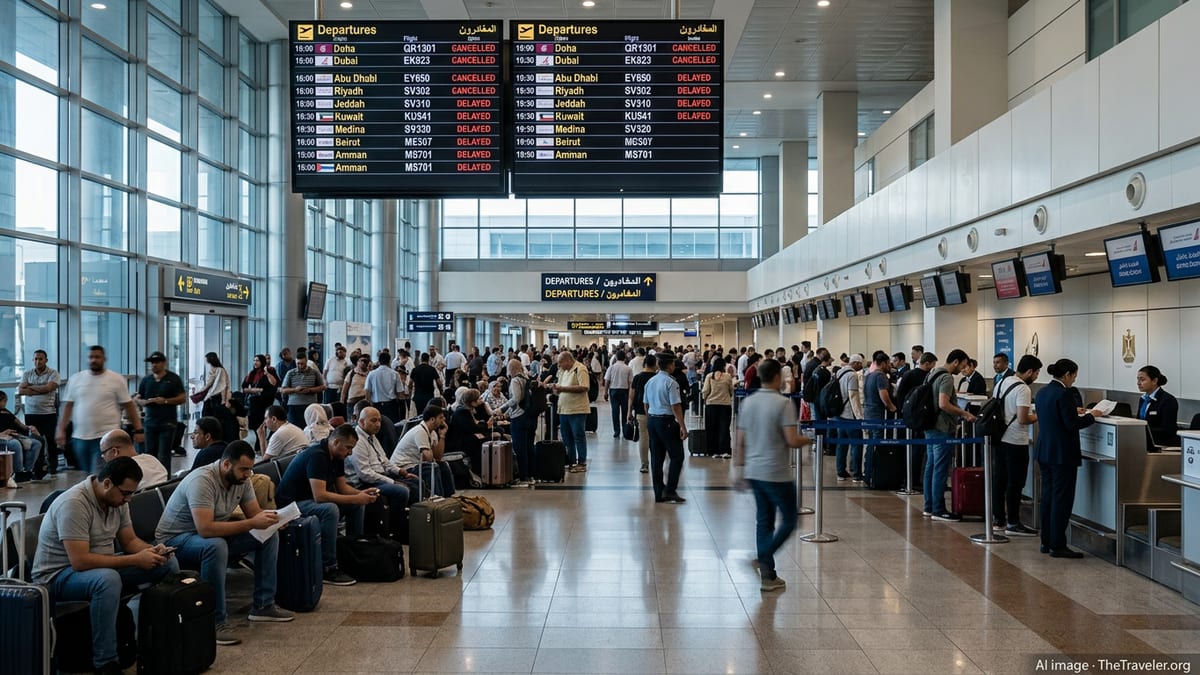
More than 50 flights linking Egypt with key Gulf hubs have been cancelled this week, as Gulf Air, EgyptAir, major United Arab Emirates carriers and Qatar Airways continue to adjust schedules in response to the volatile airspace situation across the Middle East.
Get the latest news straight to your inbox!
Wave of Cancellations Hits Egypt–Gulf Flight Network
Publicly available airline schedules and industry advisories indicate that flight cancellations from Egypt to major Gulf hubs have intensified through mid-March 2026. Services involving Bahrain-based Gulf Air, EgyptAir, several UAE-based airlines, and Qatar Airways have all been affected, leading to disruption on routes that usually carry large volumes of business and leisure travelers.
The latest schedule changes show more than 50 Egypt–Gulf flights scrubbed or temporarily suspended over recent days, covering departures from Cairo and other Egyptian airports to Dubai, Abu Dhabi, Bahrain, Kuwait City, Doha, Sharjah, Jeddah, Port Sudan and additional points across the region. Many of the affected sectors are high-frequency corridors that normally support dense connecting traffic to Asia, Europe and North America.
Travel management bulletins and aviation risk reports describe the disruption as an extension of wider Middle East airspace restrictions that began in late February 2026 and have continued to ripple through airline operations. While Egyptian airspace remains broadly open, the knock-on effect of closures and operational caps in neighboring states has forced carriers to thin out schedules and cancel departures at short notice.
For passengers in Egypt, the result has been crowded airport departure halls, longer rebooking queues and a spike in demand for the remaining seats on unaffected carriers and routes. Travelers are being urged by travel advisories to monitor flight status up to the time of departure and to allow additional time at airports in case of last-minute changes.
Gulf Air and EgyptAir Scale Back Regional Links
Network data and corporate travel alerts show Bahrain’s Gulf Air among the hardest hit, with its operations constrained by the prolonged closure of Bahraini airspace. The carrier’s Egypt services typically funnel passengers through Bahrain to destinations across the Gulf and onward to Asia, but the current restrictions have led to widespread cancellations and diversions.
EgyptAir, which maintains an extensive Middle East network from Cairo, has also significantly trimmed operations to regional cities in recent weeks. According to specialist aviation and consulting updates, the airline has suspended or reduced flights from Egypt to multiple Gulf destinations as a precautionary response to the evolving security landscape and reduced airspace options.
The combined effect for travelers departing Egypt is a sharp reduction in one-stop connectivity via Bahrain and selected EgyptAir Gulf gateways. Some passengers have reported being rerouted via alternative hubs outside the most affected air corridors, often adding extra flight segments and journey time.
Industry observers note that EgyptAir’s long-haul schedule has so far been less disrupted than its regional network, reflecting a strategic decision to prioritize intercontinental connectivity while selectively suspending higher-risk or operationally constrained short- and medium-haul sectors.
UAE Airlines and Qatar Airways Adjust Schedules Around Airspace Constraints
Separate advisories from corporate travel managers and global mobility firms highlight that UAE-based airlines serving Egypt, as well as Qatar Airways, continue to operate with varying degrees of constraint. Earlier this month, carriers in Dubai and Abu Dhabi briefly halted or sharply reduced flights while authorities and operators assessed missile and drone risks around key hubs. Subsequent partial resumptions have restored some capacity, but Egypt–UAE routes are still experiencing cancellations and late-notice retimings.
Qatar Airways’ network has also been reshaped by temporary airspace closures and limited-capacity contingency routes around Doha. Publicly available information and passenger reports suggest that many flights to and from Doha remain cancelled or consolidated, including some links touching Egypt and neighboring Red Sea and Gulf markets.
On Egypt–UAE routes, services connecting Cairo and other Egyptian cities with Dubai, Abu Dhabi and Sharjah have been among those affected. While certain flights have resumed on a reduced schedule, operational updates posted by travel intermediaries show that cancellations continue to occur, particularly on off-peak departures or flights that require complex rerouting.
For Egypt–Qatar traffic, the disruption has been most visible in altered or cancelled flights to Doha, a key transfer hub for journeys between Africa, Asia and Europe. Even as limited services resume along designated safe corridors, passengers transiting from Egypt through Doha are being advised to verify connection integrity and minimum connection times due to the risk of rolling schedule changes.
Key Destinations Impacted: From Gulf Hubs to Red Sea Gateways
The cancellations affecting Egypt span a wide geographic footprint, from major Gulf financial centers to busy pilgrimage and labor-migration corridors. Routes from Egypt to Dubai, Abu Dhabi, Doha and Bahrain account for a large share of suspended or thinned-out frequencies, given their importance as global transit hubs and the intensity of recent airspace restrictions around them.
Additional pressure is evident on links to Sharjah and Kuwait City, which typically act as secondary hubs for low-cost and full-service carriers connecting Egypt with South Asia and the wider Gulf. Industry data and routing maps suggest that some of these services are harder to re-accommodate because viable alternative routings are limited when multiple neighboring airspaces are constrained at the same time.
Services between Egypt and Jeddah, a critical gateway for religious travel and labor flows to Saudi Arabia, have also seen intermittent disruption as airlines adjust routings and schedules in response to shifting risk assessments. Meanwhile, flights touching Port Sudan and other Red Sea points have been subject to cascading delays and cancellations as regional traffic flows are reshaped.
Collectively, the cancellations at these destinations are having a measurable impact on trade, tourism and labor mobility between Egypt and the Gulf. Travel analysts caution that even modest schedule cuts on such high-volume corridors can quickly translate into higher fares on remaining flights and reduced flexibility for short-notice business trips and family visits.
What Travelers in Egypt Should Expect in the Coming Days
With regional conditions still fluid as of late March 2026, industry commentary suggests that further short-notice changes are likely across Egypt’s Gulf-connected routes. Airlines are updating schedules in small increments rather than publishing long-term cuts, a strategy that allows rapid restoration of capacity if airspace restrictions ease but leaves passengers facing persistent uncertainty.
Travel agencies and corporate mobility teams are advising Egypt-based passengers to plan for potential last-minute cancellations, even when flights appear confirmed. Recommendations include booking earlier departures where possible, building longer layovers into itineraries that rely on Gulf hubs, and maintaining flexible accommodation and ground transport arrangements at both ends of the journey.
For those whose flights are cancelled, publicly available airline policies generally offer rebooking on the next available service, travel vouchers or refunds, depending on fare rules and the duration of disruption. However, limited seat availability on alternative routes and the sheer volume of affected travelers mean that same-day or next-day re-accommodation cannot be guaranteed, particularly on peak Egypt–Gulf sectors.
Analysts tracking the situation note that a sustained improvement will depend on a consistent reduction in regional security risks and a clear timetable for fully reopening key airspaces. Until then, Egypt’s air links with Dubai, Abu Dhabi, Bahrain, Kuwait, Doha, Sharjah, Jeddah, Port Sudan and other regional hubs are expected to remain vulnerable to further schedule changes and cancellations.