

More news on this day
Flight operations across the Gulf have been severely disrupted as at least 60 services are grounded and more than 40 delayed by Gulf Air, Qatar Airways, and Saudia, leaving passengers stranded in Bahrain, Saudi Arabia, Qatar, and the United Arab Emirates amid heightened regional tensions and shifting airspace restrictions.
Get the latest news straight to your inbox!
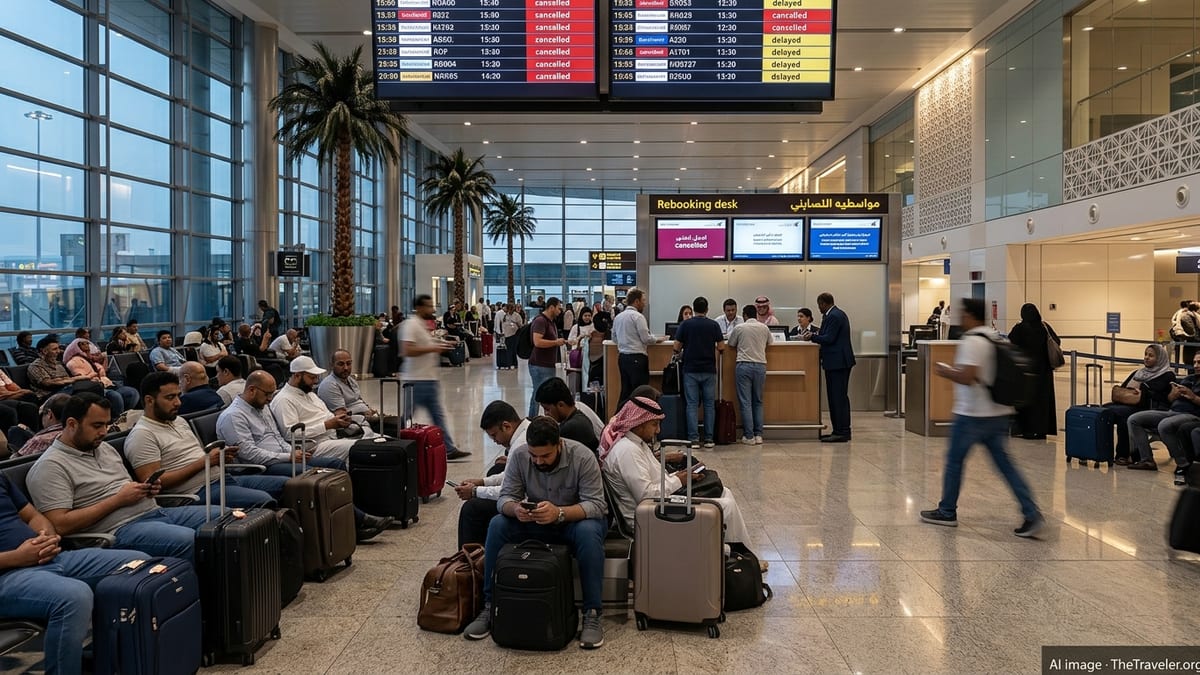
Regional Tensions Translate Into Grounded Jets
Recent escalation in the wider Middle East conflict has spilled into commercial aviation, with airlines in the Gulf region forced to cut or reroute flights as airspace rules tighten and security concerns grow. Publicly available aviation advisories and news coverage indicate that multiple Gulf countries have implemented partial or temporary airspace closures since late February 2026, affecting traffic over key hubs in Bahrain, Saudi Arabia, Qatar, and the United Arab Emirates.
Within this volatile backdrop, Gulf Air, Qatar Airways, and Saudia have each taken aircraft out of rotation, grounding dozens of services and triggering knock-on delays across their networks. The current disruption described by regional monitoring reports and traveler accounts points to around 60 flights cancelled or grounded and at least 43 delayed across the three carriers in recent days, particularly on routes touching Bahrain, Riyadh, Jeddah, Doha, Dubai, and Abu Dhabi.
Analysts note that these numbers are likely to fluctuate day by day as security assessments and air navigation restrictions evolve. Schedules are being revised at short notice, and airlines are prioritizing limited corridors judged to be operable, including selective long-haul services and repatriation-style flights where permissions allow.
The result for travelers is a patchwork of cancellations, rolling delays, and sudden schedule changes that can affect journeys even when departure and arrival airports remain open. Passengers connecting through regional hubs operated by the three carriers are bearing the brunt of these operational decisions.
How Gulf Air, Qatar Airways, and Saudia Are Adjusting Schedules
Gulf Air, the flag carrier based in Bahrain, has been contending with one of the most challenging operating environments in the region. Maritime and port advisories referencing Bahrain describe temporary suspensions of some local operations and broader airspace constraints, which have in turn limited the carrier’s ability to run its usual regional shuttle pattern between Bahrain and neighboring Gulf cities. Flights to and from destinations whose airspace is restricted or intermittently closed have been especially vulnerable to cancellation.
Qatar Airways’ Doha hub has been at the center of the turmoil since Qatar’s airspace was closed or heavily curtailed for periods following regional missile and drone activity. According to open flight tracking data summaries and travel advisories, standard commercial services have been reduced, with the airline instead mounting a limited number of relief or repatriation flights along approved corridors when permitted by regulators. This has contributed significantly to the tally of grounded flights, even as a smaller number of long-haul services continue under special arrangements.
In Saudi Arabia, Saudia’s network is adjusting to both direct and indirect effects of the crisis. Security briefings focused on Riyadh and other Saudi cities describe intermittent disruptions at major airports, including reduced schedules at King Khalid International Airport. Saudia has suspended or curtailed some services to neighboring states where airspace remains restricted, while also facing operational challenges on domestic segments when routes intersect with sensitive zones or require diversions.
Airlines are using a mix of cancellations, consolidations, and equipment swaps to cope. Some flights are being merged, with passengers rebooked onto a smaller set of departures, while others are switched to alternative routings that avoid high-risk air corridors. These measures can keep certain long-haul links open, but often at the cost of sizeable delays and long layovers for travelers.
Impact on Passengers in Bahrain, Saudi Arabia, Qatar, and the UAE
For passengers on the ground, the operational details translate into long queues, crowded terminals, and changing plans. Airports in Bahrain and Qatar have seen waves of travelers seeking information, refunds, or new itineraries after last-minute cancellations. Social media and passenger forums describe families attempting to piece together alternative routes via secondary hubs such as Muscat or European gateways when direct connections through Doha or Bahrain are no longer available.
In Saudi Arabia, travelers at Riyadh and Jeddah report a mix of partial operations and patchy connectivity. Some flights run as scheduled, particularly on routes that avoid the most affected corridors, while other services face multi-hour delays as aircraft and crew are repositioned. Public advisories referencing Riyadh highlight limited but ongoing operations, prompting airlines and airports to caution that schedules remain subject to change at short notice.
The United Arab Emirates, home to major international hubs in Dubai and Abu Dhabi, is also experiencing operational ripples even where airports remain largely functional. Security briefings and regional risk assessments note that air defense activity in the vicinity of key airports can lead to temporary ground stops, diversions, or rerouting of overflying traffic. Passengers connecting from Gulf Air, Qatar Airways, or Saudia onto other international carriers in the UAE can therefore encounter disrupted onward journeys, even if their final destinations lie far from the Gulf.
Demand for alternative routings that bypass the most heavily restricted airspace has risen sharply, placing pressure on remaining capacity and driving up fares on some Europe Asia and Asia Africa corridors. Travelers able to rebook via non-Gulf hubs are frequently finding that options exist, but at higher prices and with longer travel times.
What Travelers Need to Know Before Flying
Publicly available guidance from aviation risk consultancies and airline communications emphasizes that the current situation is fluid, with airlines responding to a combination of security assessments, regulatory decisions, and operational constraints. Schedules that appear confirmed several days in advance may still be altered closer to departure as carriers reassess risks or as authorities update airspace notices.
Passengers scheduled to fly with Gulf Air, Qatar Airways, or Saudia through Bahrain, Saudi Arabia, Qatar, or the UAE are being advised by travel industry bulletins to monitor their bookings frequently using airline apps or booking management tools. Where airlines have introduced flexible disruption policies, affected customers may be able to accept refunds, rebook without additional fare differences, or convert tickets to travel credits, depending on the fare rules and the dates of travel.
Travel advisories also stress the importance of allowing extra time at the airport, carrying essential items in hand luggage in case of unexpected overnight stays, and keeping documentation, including visas for potential transit countries, up to date. With some flights rerouted via alternative hubs, passengers may find themselves passing through countries not listed on their original itineraries, which can affect entry and transit requirements.
For those planning future trips, risk analysts suggest considering itineraries that offer more than one routing option and choosing fares that allow reasonable flexibility. While it remains possible to travel to and through the Gulf, the combination of grounded flights, extended delays, and evolving airspace restrictions means that journeys that once felt routine now demand closer attention, backup plans, and a higher tolerance for uncertainty.