

More news on this day
Middle Eastern airlines are accelerating a quiet revolution in accessible travel, with Emirates, Flynas and Qatar Airways rolling out autism-friendly initiatives that aim to turn one of the most stressful parts of family life into a calmer, more predictable journey for neurodiverse passengers.
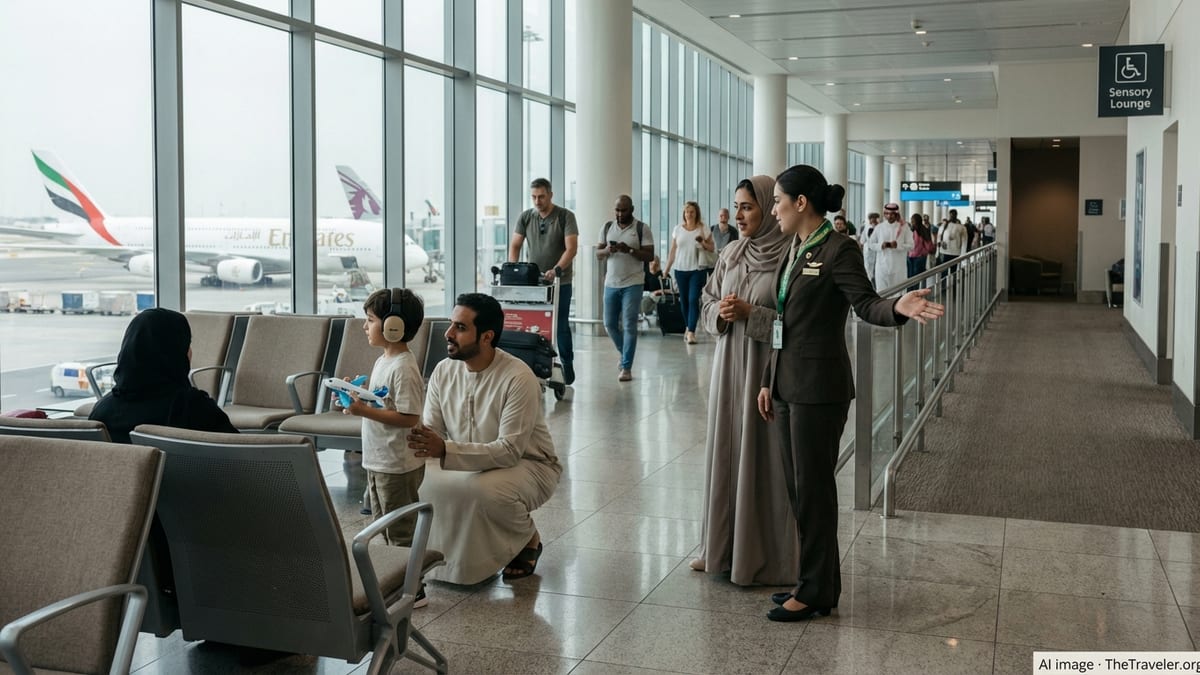
Emirates Becomes the First Autism Certified Airline
Emirates has positioned itself at the forefront of inclusive aviation by securing recognition as the world’s first Autism Certified Airline, marking a milestone in efforts to support passengers with hidden disabilities. The designation, announced in April 2025, builds on earlier accreditation as a Certified Autism Center and underscores a systemwide push to embed neurodiversity awareness into the carrier’s operations.
According to the airline, more than 30,000 cabin crew and ground staff have now completed training on autism and hidden disabilities, expanding from an initial 29,000 staff members who undertook the online course after its launch in 2022. The curriculum covers how to recognise signs of sensory overload, communicate calmly and clearly, and adapt service to support passengers who may struggle with crowds, noise or unexpected changes. For families who have often avoided air travel altogether, this investment in staff skills is intended to offer reassurance before they even reach the airport.
Emirates executives describe accessible travel as a core part of the carrier’s operational strategy rather than a peripheral initiative. In public statements, the airline has framed autism certification as both a social responsibility and a commercial imperative, arguing that millions of would-be passengers are currently deterred from flying by environments that can be overwhelming for neurodivergent travelers. The new designation is meant to signal that the airline is ready to welcome those customers with tailored support.
The certification was awarded by the International Board of Credentialing and Continuing Education Standards, which has also worked with airports and visitor attractions around the world. Industry surveys cited by the group suggest that only a small minority of families with autistic children currently take vacations by air, but that many would do so if there were more autism-aware options. Emirates is betting that formal recognition and visible changes to the travel experience can help close that gap.
Travel Rehearsals and Sensory Support Calm Pre-Flight Anxiety
One of Emirates’ most distinctive innovations is its travel rehearsal program, designed specifically for children with autism and related sensory needs. First introduced in Dubai in 2024 as an Autism Familiarisation Flight for around 30 families, the program has grown into a global initiative spanning 17 cities including Dubai, Barcelona, Brisbane, Manchester, Montreal and Manila. The goal is to let children experience check-in, security, boarding and a short flight in a controlled, low-pressure environment before they face a real family trip.
During these rehearsal events, families are guided through an “Autism Friendly Route” at Dubai International Airport, including access to priority lanes at check-in, passport control, security and boarding. Specially trained staff are on hand throughout to explain each step, answer questions and adjust the pace as needed. The experience culminates in a short flight sector that simulates the sounds, announcements and sensations of take-off and landing without the pressure of a full journey or tight connections.
Parents who have taken part describe the rehearsals as a powerful way to reduce uncertainty and identify potential triggers ahead of time. For some children, simply hearing the engine roar or feeling the cabin door close can be a major source of anxiety. By rehearsing these moments, caregivers and crew can work together on coping strategies, such as noise-cancelling headphones, clear visual cues or alternative seating arrangements.
Emirates is also extending sensory support into the cabin. The airline has announced new sensory products and fidget toys that will be available on all flights from late 2025, including tactile stress relievers shaped like aircraft, fidget cubes and rubber “poppers.” These items, recognised for helping neurodivergent passengers self-regulate, will be offered to children and adults who indicate they are struggling, as well as to nervous flyers who might benefit from a simple, discreet way to release tension.
From Seat Selection to Information Hubs: Designing Predictable Journeys
Beyond headline programs, Emirates and its regional peers are reshaping the small but critical details that determine how predictable a journey feels for neurodiverse travelers. For many autistic passengers, the ability to plan every step in advance and avoid unexpected changes is as important as any physical accommodation. Airlines are increasingly responding by overhauling how they share information and manage special requests.
Emirates has introduced an Accessible and Inclusive Travel Hub on its main website, gathering information about assistance options, medical documentation, mobility support and family travel in a single, more navigable space. The hub is designed around accessibility principles so that passengers with varying needs can quickly find guidance and plan their trip according to personal triggers, whether that means avoiding certain seating locations or understanding security screening procedures in detail.
The carrier has also refined its seat allocation policies for passengers who declare hidden disabilities, including autism. Families can request bulkhead seats or locations away from high-traffic galleys and restrooms, with the aim of reducing sensory overload from noise, light and movement. These requests typically go through local Emirates offices or special assistance teams, who are trained to weigh safety, operational constraints and the specific needs of each traveler.
Industry bodies such as the International Air Transport Association have issued guidance encouraging airlines to streamline how they collect and store information about passengers with disabilities, including the use of standard codes that signal assistance needs in booking systems. Gulf carriers are aligning with this direction, integrating special service requests more tightly into reservation workflows so that airport and cabin staff are informed of needs well before departure. For neurodiverse families, this can mean fewer last-minute explanations at crowded counters and a more coherent support experience along the journey.
Qatar Airways Builds Sensory Havens at Its Global Hub
While Emirates has focused on certification and rehearsals, Qatar Airways has reimagined its home hub as a calmer, more accommodating space for autistic travelers. At Hamad International Airport in Doha, the flagship Muzn Lounge operates as a dedicated sensory room for children aged between two and twelve with autism or other disabilities. Located between departure gates and open around the clock, the lounge offers bubble tubes, soft lighting, interactive projections and soothing sounds that allow children to decompress away from the busy terminal.
The facility is the product of a multi-year collaboration between Qatar Airways, the Shafallah Centre for Persons with Disabilities and Qatar’s Ministry of Social Development and Family. Designed as a multi-sensory environment rather than a conventional playroom, the lounge includes spaces tailored for children with limited communication skills and electronic mats that encourage movement and positive use of energy. Parents can request access at check-in or through pre-booking, and are guided to the lounge by airport staff familiar with the needs of neurodivergent passengers.
Airport authorities say the space serves two key functions: it helps regulate children who are overwhelmed during their time at the airport, and it gently acclimatises them to elements of the travel experience they may find challenging. Ambient sounds, seating similar to aircraft cabins and visual simulations of flight-related stimuli are used to reduce the shock of boarding and take-off. For many families, a quiet session in the lounge before a long-haul flight can be the difference between a manageable journey and an exhausting ordeal.
Hamad International Airport’s accessibility work has been recognised with an Accessibility Enhancement Accreditation from Airports Council International, reflecting its investment in facilities for passengers with reduced mobility and hidden disabilities. Airport managers frame the Muzn Lounge as part of a broader effort to make Doha one of the world’s most inclusive hubs, aligning with Qatar Airways’ own push to offer a more predictable, dignified experience for travelers with autism at every stage of their journey.
Hidden Disabilities Sunflower Signals Quietly Expand Support
Qatar’s accessibility drive took a further step forward in February 2026, when Hamad International Airport joined the global Hidden Disabilities Sunflower program. The initiative allows passengers to wear a discreet lanyard or other Sunflower-branded item to indicate that they have a non-visible disability and may need extra time, clearer communication or flexible processes.
The program is being integrated across key touchpoints at the airport, from check-in and security to retail and boarding gates. Qatar Airways Group staff and other stakeholders have received training to recognise the Sunflower symbol and respond with appropriate support, such as guiding passengers to quieter spaces, offering simplified explanations or allowing additional time to process instructions. For neurodivergent travelers who may find it difficult to explain their needs verbally in a stressful environment, the visual cue offers an alternative way to ask for help without drawing unwanted attention.
Airport executives say the scheme is grounded in principles of autonomy and dignity, with participation entirely voluntary and no requirement to disclose specific diagnoses. The emphasis is on creating a culture of awareness among frontline employees so that they can interpret the symbol as a prompt to listen carefully and adapt their approach. For example, a Sunflower wearer might benefit from a slower pace at security screening or reassurance about loud noises and queues.
As one of the region’s leading hubs to adopt the Sunflower program formally, Hamad International Airport is likely to influence peer airports in the Gulf and beyond. For Qatar Airways, the move dovetails with in-house autism awareness campaigns, including employee workshops and partnerships with local organisations that support people on the spectrum. Together, these efforts position Doha as a test bed for combining physical infrastructure, staff training and subtle communication tools into a more coherent model of autism-friendly air travel.
Flynas and Regional Carriers Embrace Autism-Friendly Standards
Saudi low-cost carrier Flynas has been steadily building its reputation as an early adopter of accessibility initiatives in the budget segment, a space where passengers with disabilities have traditionally struggled to find consistent support. While its programs are less publicised than those of the major Gulf network airlines, Flynas has moved to align with international best practices by training staff on hidden disabilities and working with airport partners to smooth the journey for autistic travelers.
Industry observers note that Flynas has participated in regional discussions about the Hidden Disabilities Sunflower scheme and has explored partnerships to standardise how special assistance is flagged within bookings. The carrier’s ground handling teams in Saudi Arabia’s main airports increasingly coordinate with airport authorities to provide quieter waiting areas, assist families through security and boarding, and reduce last-minute gate changes that can be particularly distressing for neurodivergent passengers.
For low-cost airlines, the challenge is to embed accessibility into a model built on quick turnarounds and minimal frills. Flynas’ approach has focused on staff awareness, clear communication and flexibility around seating, rather than dedicated lounges or specialist spaces. In practice, that can mean allowing neurodivergent passengers to board early, seating families together where possible, and ensuring that cabin crew understand how to respond if a child experiences a sensory overload during the flight.
These efforts place Flynas within a broader wave of Middle Eastern carriers that are trying to bring autism-friendly principles into every tier of the market. While full-service airlines can invest heavily in bespoke infrastructure, low-cost operators are demonstrating that meaningful changes can be made through training and procedural tweaks alone, widening the range of affordable options for families who previously felt excluded from air travel.
Global Standards and the Push for Truly Inclusive Skies
The moves by Emirates, Qatar Airways and Flynas are unfolding against a backdrop of evolving global standards for passengers with disabilities. In recent years, international aviation bodies have released guidance urging airlines and airports to treat accessibility as an integral part of customer experience, rather than a specialised add-on. Autism and other neurodevelopmental conditions have been a particular focus, as awareness grows about the sensory challenges embedded in modern air travel.
Guidelines highlight the importance of clear, centralised information online, simple pathways to request assistance during booking, and staff training that goes beyond basic compliance to cover empathy and nuanced communication. For families traveling with an autistic child, the availability of a dedicated accessibility page, the option to flag needs through established codes, and the assurance that staff recognise these markers can be as reassuring as any physical facility.
Middle Eastern hubs are increasingly seen as test beds for these ideas. Dubai and Doha, in particular, have invested heavily in airport infrastructure and digital systems that can be adapted to support inclusive design, from quieter check-in zones and sensory rooms to more flexible boarding procedures. The experiences of carriers like Emirates and Qatar Airways are being closely watched by airlines elsewhere that are under pressure from regulators and disability advocates to improve.
Advocacy groups caution, however, that progress remains uneven and that formal certifications or new programs do not always translate into consistent experiences on the ground. Families continue to report variability in how well staff understand neurodiversity, both within and between airlines. The challenge now is to ensure that promising pilot schemes and high-profile announcements harden into everyday practice across entire networks, including outstations and partner airports.
A Calmer Future for Neurodiverse Travel
For many neurodivergent travelers and their families, the promise of autism-friendly air travel is not about special treatment, but about a baseline of predictability, respect and choice. Initiatives such as Emirates’ travel rehearsals, Qatar’s Muzn Lounge and the region’s adoption of the Hidden Disabilities Sunflower are all designed to give passengers more control over how they move through a highly structured environment.
In practical terms, that might mean rehearsing a trip months in advance, knowing that a quiet room will be available between flights, or trusting that a discreet lanyard will be recognised by staff without the need for repeated explanations. For parents who have long weighed the potential benefits of travel against the risk of public meltdowns or misunderstanding, these reassurances can open the door to journeys that were previously unthinkable.
The economic case is also becoming clearer. By making it easier for neurodiverse passengers to fly, airlines are tapping into a market segment that has been under-served but is eager to travel when barriers are removed. As more carriers compete on accessibility and inclusivity, families affected by autism may find themselves with a growing range of routes and price points tailored to their needs.
While significant work lies ahead to ensure that every part of the journey reflects these ambitions, Emirates, Flynas and Qatar Airways are emerging as standard-bearers for a new era in air travel. Their experiments in training, infrastructure and quiet communication are reshaping expectations of what flying can feel like for neurodiverse travelers, and hint at a future in which the skies are not only open to all, but welcoming in ways that once seemed out of reach.