

More news on this day
More than 60 flights operated by Qatar Airways, Gulf Air, Malaysia Airlines and other carriers have been cancelled or heavily disrupted across Qatar in recent days, affecting links to Bahrain, Indian cities such as Ahmedabad and Amritsar, and major long-haul routes to Manchester, Tokyo, Beijing, Singapore, Bali, Sydney, Melbourne and additional global hubs, according to published operational updates and flight-tracking data.
Get the latest news straight to your inbox!
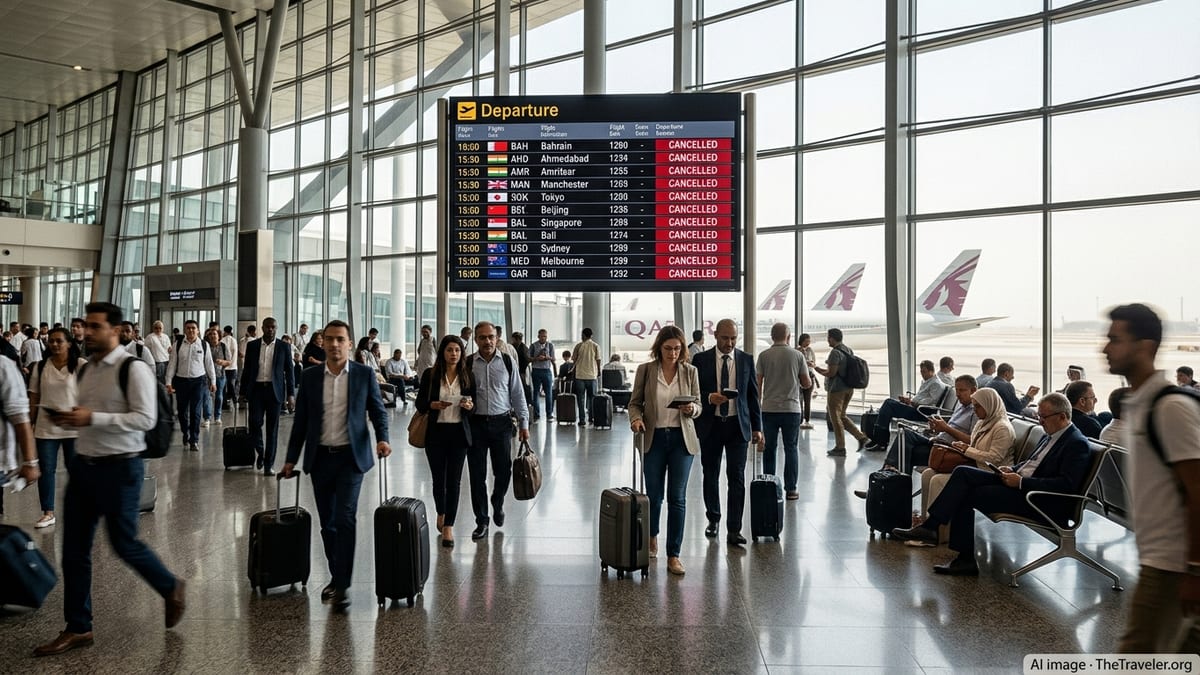
Regional Tensions and Airspace Constraints Ripple Through Qatar
Publicly available information indicates that the latest wave of cancellations is closely tied to ongoing security concerns and partial Gulf airspace restrictions following recent missile strikes and military activity in the region. Qatar’s Hamad International Airport has been operating under constrained conditions since late February 2026, with the country’s civil aviation authorities initially closing national airspace and since allowing only limited emergency and evacuation traffic.
These constraints have forced Qatar Airways and partner airlines that rely on Doha as a key transit hub to repeatedly redraw schedules. Reports indicate that while some emergency and special services have been operating on select days, standard commercial frequencies remain significantly reduced, leading to short-notice cancellations on a rolling basis.
The impact is not confined to Qatar’s flag carrier. Published coverage of the broader conflict and its aviation fallout shows that multiple Gulf states, including Bahrain and the United Arab Emirates, have also enacted temporary restrictions at various points, shrinking available routings through the region and making it harder for airlines to reroute passengers quickly when flights to or from Doha are withdrawn.
Industry analysts note that the combination of airspace closures, congested alternative corridors and heightened risk assessments has created a fragile operating environment. Airlines appear to be adopting conservative scheduling strategies, cancelling or consolidating services days in advance while they wait for clearer guidance from aviation authorities and defense agencies.
Qatar Airways Cuts Deep Into Network From Doha
Qatar Airways has been at the center of the disruption, as its hub-and-spoke model is highly dependent on undisrupted access to Doha. Flight-tracking snapshots and traveler reports show a pattern of cancellations affecting short-haul Gulf services, India routes and long-haul connections to Europe and Asia-Pacific.
Among the most affected links are services between Doha and Bahrain, routes that ordinarily operate multiple times daily. The suspension or thinning of these flights has reduced connectivity for passengers shuttling between the two countries and disrupted onward itineraries that depend on rapid Doha transfers.
Indian markets have also been hit. Publicly available schedules and passenger accounts indicate cancellations on popular corridors from Doha to Ahmedabad and Amritsar, routes frequently used by workers and families connecting between the Gulf and western or northern India. Many travelers report receiving cancellation notices only a few days before departure, leaving limited time to secure alternatives at reasonable fares.
Long-haul routes have not been spared. Reports from Europe and Australia show instances of Doha to Manchester flights being scrubbed, while itineraries linking Doha with Sydney and Melbourne have been repeatedly altered or replaced with complex re-routings on partner airlines via alternative hubs. These changes have extended journey times and, in some cases, stranded passengers in intermediate cities while new options are arranged.
Gulf Air, Malaysia Airlines and Partner Carriers Adjust Operations
While Qatar Airways is absorbing the largest share of the disruption, other regional and partner airlines that feed traffic into or through Qatar have also moved to trim or suspend services. Publicly posted notices and schedule changes show that Gulf Air has adjusted its Bahrain-based network, including flights touching Doha, as it navigates the same constrained airspace and security assessments.
Malaysia Airlines, which has historically linked Kuala Lumpur with destinations such as Doha and major Australian cities including Sydney and Melbourne, has also seen its operations affected by the evolving situation. According to updated booking displays and timetable revisions, some services in and out of the Gulf have been cancelled outright, while others have been retimed or rerouted to avoid restricted corridors.
Other partner and codeshare airlines that rely on Doha as a connecting point for traffic from Asia, Europe and Africa are making similar moves. Publicly available information from airline trade portals and traveler forums indicates that carriers are increasingly shifting passengers onto non-Gulf routings via Southeast Asia or Europe where possible, often at short notice and subject to seat availability during an already capacity-constrained period.
This cascade effect means that even travelers not originally booked on Qatar Airways may experience disruption if any portion of their itinerary involves Doha or other Gulf hubs currently affected by airspace and security measures.
Key Routes Impacted From Asia to Europe and Australia
The list of disrupted routes connected to Qatar extends across multiple regions, underscoring the hub’s global importance. In Asia, publicly available flight data points to interruptions on links from Doha to Tokyo and Beijing, affecting both business travelers and tourists at the tail end of the northern winter season. Connections to Singapore and Bali have also been hit, with some passengers reporting reroutings via other Southeast Asian hubs rather than transiting through the Gulf.
In Europe, cancellations on Doha to Manchester services have drawn particular attention, given Manchester’s role as a major gateway for northern England. Travelers connecting onwards to destinations across the United Kingdom and continental Europe are facing longer itineraries and, in some cases, overnight stops when transferred to alternative routings.
Australia is seeing some of the longest and most complicated disruptions. Published traveler accounts describe cancelled or rescheduled flights linking Doha with Sydney and Melbourne, with replacement arrangements often involving lengthy detours via Asian or European cities. These extended routings can add many hours to already long journeys, creating additional challenges for families and time-sensitive business travelers.
Although more than 60 flights related to Qatar operations have been cancelled in the current wave, aviation observers suggest that the knock-on impact is far wider once missed connections, downline segment changes and aircraft repositioning are factored in. The resulting strain on alternative hubs and carriers is likely to continue as long as uncertainty over Gulf airspace persists.
What Affected Travelers Are Being Offered
As cancellations mount, airlines linked to Qatar are updating their disruption and rebooking policies. Publicly accessible Qatar Airways trade portal guidance and traveler-shared documentation outline an expanded framework that allows eligible passengers on cancelled flights within specified dates to request full refunds, free date changes or re-routing on partner airlines, subject to available seats and fare conditions.
Reports from passengers indicate that the carrier has introduced tiered options distinguishing between preferred partner airlines and other interline partners, with specific booking windows for free re-routing after a cancellation is posted. Some travelers have successfully been moved onto flights operated by alternative carriers via non-Gulf hubs, while others report difficulty finding available seats during peak travel days.
Other affected airlines, including Gulf Air and Malaysia Airlines, have published their own advisories and “travel waiver” policies, generally waiving change fees and offering refunds for flights touching Doha or neighboring airspace during the disruption period. The precise options vary by airline and ticket type, and in many cases by the date a flight is officially marked as cancelled in reservation systems.
Consumer advocates advise that passengers monitor their booking status frequently and document all communications, as many cancellations appear in apps and online accounts only a few days before departure. With call centers and airport desks under heavy pressure, publicly available guidance suggests that travelers use official digital channels where possible, and consider backup routings through unaffected regions if their plans are time-critical.