

More news on this day
Rapidly escalating conflict around the Strait of Hormuz has triggered an unprecedented shutdown of Gulf airspace, slashing visitor numbers, grounding marquee carriers such as Qatar Airways, Emirates, Etihad and Flydubai, and wiping tens of billions of dollars off a tourism sector that only months ago was celebrating record growth.
Get the latest news straight to your inbox!
From Record Tourism Highs to Sudden Freefall
Until late February 2026, Gulf tourism indicators pointed firmly upward. Industry reports on 2024 and 2025 performance highlighted Qatar’s emergence as one of the fastest growing destinations in the region, with tourism contributing around 8 percent of national GDP and hotel revenues rising on the back of major events and an expanding calendar of festivals and conferences. Forecasts for 2026 anticipated further gains driven by strong demand for Doha, Dubai, Abu Dhabi and Riyadh.
Across the wider Gulf Cooperation Council, visitor arrivals and tourism receipts were on track to exceed pre pandemic benchmarks. Analysts described the bloc as a rare bright spot in global travel, benefiting from improved connectivity, visa reforms and heavy investment in hospitality infrastructure. Saudi Arabia and Bahrain in particular had been banking on new resorts, conference centers and sports events to fill an expanding hotel pipeline.
That trajectory reversed dramatically as the Iran war intensified and the Strait of Hormuz crisis unfolded. Within days of the first missile and drone strikes in late February, multiple Gulf states imposed sweeping airspace restrictions, cutting off key corridors that underpin the region’s hub and spoke aviation model. Airlines that had helped drive tourism growth found themselves at the center of a cascading shutdown.
Gulf Airspace Closures Cripple Qatar Airways and Regional Hubs
Publicly available aviation data and media coverage show that airspace closures and conflict related damage have produced one of the most severe disruptions in Gulf aviation history. Airspace over parts of the United Arab Emirates, Qatar, Bahrain and Kuwait has been periodically closed or heavily restricted, forcing mass cancellations and diversions. Dubai International and Abu Dhabi airports, normally among the world’s busiest, have operated at a fraction of capacity amid security concerns and infrastructure damage.
Emirates, Qatar Airways, Etihad and Flydubai, which rely on open skies and dense transfer traffic across the Gulf, have each reported hundreds of cancellations in the space of days. Industry trackers indicate that Emirates has axed the large majority of scheduled services, while Qatar Airways, Etihad and Flydubai have also seen more than half of their networks curtailed at points as flight paths through contested airspace became unviable or were formally prohibited.
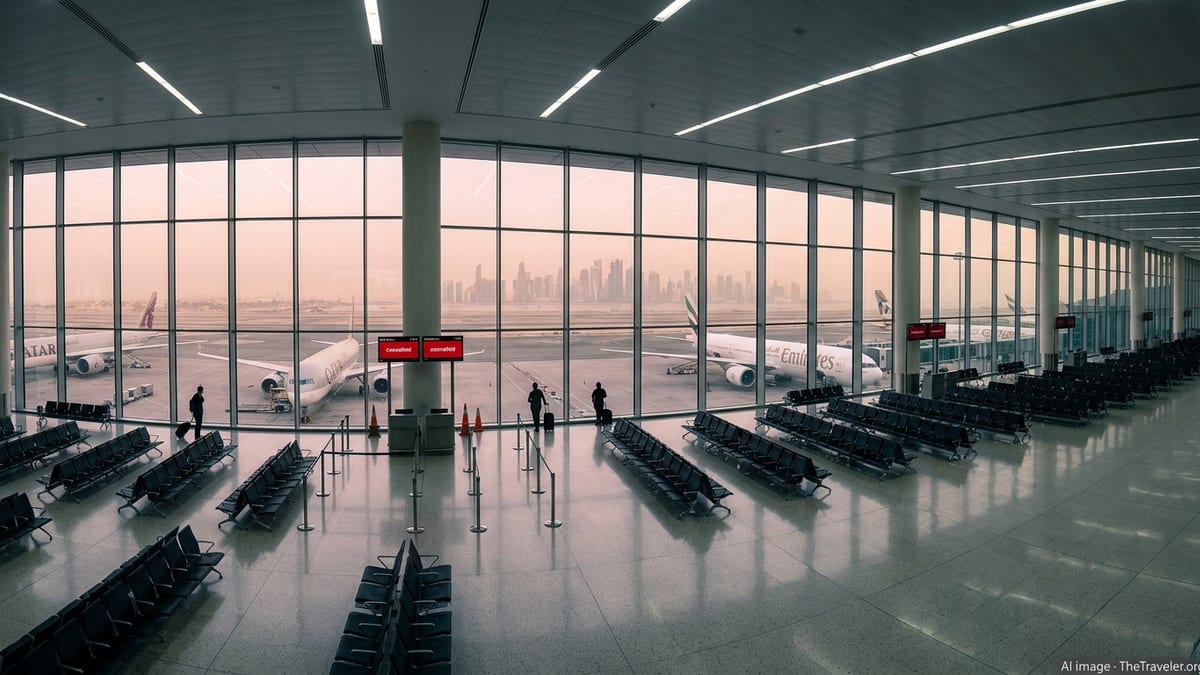
Qatar’s Hamad International Airport, which only recently completed major expansion works and was positioning itself for another year of record throughput, has been reduced to handling limited evacuation and emergency flights under temporary arrangements. Rerouted long haul services shoulder higher fuel and crew costs, while many point to point and regional connections have simply been suspended, disconnecting tourism markets that had grown accustomed to seamless links.
Aviation analysts note that the scale of the interruption rivals or exceeds the early months of the COVID 19 pandemic for the Gulf’s flagship carriers, with knock on effects for ground handling, duty free, airport real estate and the broader ecosystem of travel services clustered around major hubs.
Hotels in Riyadh and Bahrain Sit Empty Amid Security Fears
The shockwave from grounded aircraft has been felt most immediately in the hotel sectors of Saudi Arabia and Bahrain, where occupancy rates have collapsed in key business and leisure districts. Travel advisories from major source markets, coupled with images of missile strikes and intercepted drones, have chilled demand in cities that had been marketing themselves aggressively as safe, modern visitor destinations.
In Bahrain, where several hotels lie close to sensitive military and diplomatic sites, published reports and eyewitness accounts describe evacuated properties, damaged buildings and entire blocks of once busy waterfront accommodations now dark at night. Conference and event bookings have been cancelled en masse, tour groups redirected or repatriated, and local hospitality workers placed on unpaid leave as management attempts to conserve cash.
Riyadh faces similar pressures. High profile investment summits, entertainment festivals and sports fixtures that were central to the kingdom’s tourism push have been postponed or moved, leaving newly opened hotels with sharply lower than expected occupancy. Inbound corporate travel has almost halted as companies adopt risk averse policies and shift meetings to Europe or Asia, while regional weekend leisure trips, an important part of the Gulf hotel mix, have dwindled with cross border flying severely curtailed.
Tourism researchers warn that even short lived security incidents can have long tail effects on traveler perception, meaning that Riyadh and Manama hotels may struggle with weak forward bookings long after airspace technically reopens.
Qatar’s Tourism Engine Stalls, with Losses Estimated in the Tens of Billions
The reversal is particularly stark in Qatar, where tourism had been promoted as a flagship pillar of economic diversification. Prior to the current crisis, official and industry assessments suggested that inbound visitor spending and associated economic activity could approach or exceed the equivalent of 20 to 25 billion US dollars annually in the medium term, supported by a steady rise in arrivals and sustained growth in hotel revenue.
The sudden collapse in air connectivity and the suspension of normal commercial operations have effectively frozen that trajectory. A combination of canceled events, empty hotel rooms, shuttered attractions and stranded travelers has prompted early scenario modeling by sector analysts. Some estimates suggest that if the present shutdown of key Gulf air corridors were to persist for much of 2026, the cumulative hit to Qatar’s wider tourism value chain, including aviation, accommodation, retail, food and beverage, and events, could be counted in the tens of billions of dollars compared with pre crisis projections.
Talk of a 56 billion US dollar gap reflects not a single year loss but the potential erosion of several years of forecast tourism and travel related revenue if confidence proves slow to return. That figure captures foregone visitor spending, stalled investment plans, reduced ancillary income across industries such as transport and entertainment, and the broader drag on gross domestic product from a sector that had been delivering compounded double digit growth.
While precise numbers will depend on the duration and intensity of the conflict, interim data already point to a collapse in forward bookings and a sharp fall in online search interest for Gulf leisure travel, suggesting that Qatar’s tourism engine, like those of its neighbors, is operating far below the levels assumed in recent national development strategies.
Uncertain Road to Recovery for Gulf Aviation and Tourism
For the region’s big four carriers, the immediate priority has been operational survival. Schedules have been trimmed to a skeletal network of safer routes, widebody aircraft grounded or repositioned, and staff rosters reworked around rapidly changing security assessments. The carriers entered this crisis from a position of relative financial strength after several profitable years, but prolonged shutdowns will test liquidity, particularly for airlines with large order books and ongoing fleet renewal commitments.
Hotels, tour operators and destination management companies across Qatar, the United Arab Emirates, Saudi Arabia and Bahrain face their own balancing act between retaining skilled staff and stemming cash burn. Industry bodies are openly discussing the need for temporary tax relief, fee waivers and targeted financing to prevent widespread closures, even as governments weigh competing fiscal pressures related to defense and social support.
Recovery scenarios hinge above all on security developments and the speed at which airspace restrictions can safely be lifted. Even once skies reopen, it may take months for airlines to rebuild complex schedules, for insurers to fully restore coverage, and for travelers to regain confidence in transiting through a region that has become synonymous with headlines about missile strikes and evacuations.
Yet the structural factors that propelled Gulf tourism growth before the crisis have not disappeared. Modern infrastructure, globally connected airlines, year round events and ambitious destination branding campaigns remain in place. The question now confronting policymakers in Doha, Dubai, Abu Dhabi, Riyadh and Manama is how much economic damage will be sustained before those strengths can again be translated into full planes and busy hotel lobbies.