

More news on this day
Major Gulf and European airlines are cancelling and rerouting hundreds of flights as the United Arab Emirates struggles with storm-related disruption while US–Iran hostilities trigger widespread airspace closures across the Middle East.
Get the latest news straight to your inbox!
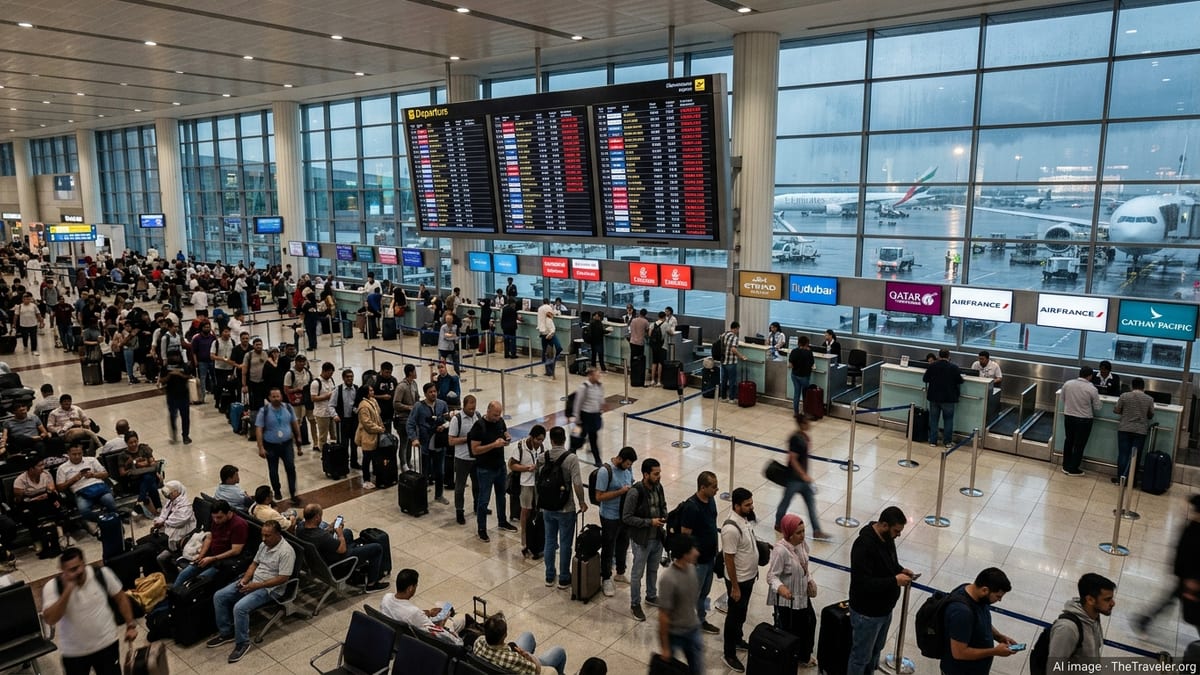
UAE Airports Strain Under Dual Pressure of Weather and War
Air travel in and out of the United Arab Emirates has entered one of its most turbulent periods in recent memory, with airports in Dubai and Abu Dhabi contending with both extreme weather and regional security risks. Recent reports describe periods of heavy rain and localized flooding around key hubs that have compounded existing operational stress caused by missile and drone activity linked to the ongoing US–Iran conflict.
Publicly available information indicates that Dubai International Airport and Abu Dhabi’s main airport have faced temporary suspensions of operations following security incidents near aviation fuel facilities, alongside intermittent storm-related constraints on ground handling. These overlapping pressures have sharply reduced runway capacity at times, forcing airlines to cut rotations, consolidate services, and extend connection times for passengers transiting through the UAE.
Travel advisories from aviation regulators and industry bodies describe a patchwork of emergency schedules at Gulf hubs, with air traffic control prioritizing limited commercial services, evacuation flights, and essential cargo movements. This has left airlines struggling to maintain predictable timetables, particularly on long-haul routes linking Europe, Asia, and Australasia via the Gulf.
Analysts note that the UAE’s position at the crossroads of global east–west traffic magnifies the impact of any disruption. Even short suspensions or weather-related slowdowns at Dubai or Abu Dhabi ripple quickly through global networks, leading to rolling delays and cancellations far beyond the region.
Emirates, Etihad and flydubai Trim Schedules and Consolidate Routes
Emirates, Etihad Airways and flydubai, the three largest UAE-based passenger carriers, have implemented sweeping capacity adjustments as conditions around their home hubs remain volatile. Operational updates show waves of cancellations and schedule reductions on high-frequency routes to Europe, South Asia and the broader Middle East, with select long-haul services combined onto larger aircraft to move the greatest number of passengers on fewer flight movements.
Reports from passengers and aviation trackers indicate that Emirates has periodically paused or limited departures from Dubai during security incidents and intense storm cells, later restarting operations on a reduced timetable as conditions stabilize. Some flights have been retimed to off-peak hours to ease congestion on constrained runways and at immigration and baggage facilities already under pressure from earlier disruptions.
Etihad Airways, based in Abu Dhabi, has followed a similar pattern, suspending portions of its network during periods of airspace closure and then restoring a subset of services under exceptional operating procedures. Public guidance notes that many Etihad flights are operating with extended flying times due to rerouting around conflict-affected corridors, increasing crew and aircraft utilization and limiting spare capacity for irregular operations.
Flydubai, which typically underpins connectivity between Dubai and regional secondary cities, has been running a patchwork of limited services. Industry updates describe selective cancellations to conflict-adjacent destinations, with some passengers rebooked onto Emirates codeshare services where operationally feasible. Travelers are being urged to monitor booking systems closely, as same-day changes remain common.
Qatar Airways, Air France and Cathay Pacific Cut Middle East Exposure
Beyond the UAE, the wider Middle East and international aviation community are reacting to evolving conflict dynamics involving Iran and US-led forces. Airspace closures over Iran and parts of the Gulf have forced airlines to either cancel services outright or adopt longer, more fuel-intensive routings, particularly on Europe–Asia corridors that once relied heavily on direct paths across the region.
Qatar Airways has scaled back regular passenger services as Doha’s Hamad International Airport adjusts to restricted air navigation conditions and intermittent regional closures. Publicly available notices emphasize that priority is being given to limited emergency, repatriation and cargo operations, with many standard commercial flights cancelled or temporarily suspended.
In Europe, Air France has trimmed schedules to conflict-exposed destinations, with cancellations affecting selected flights into the broader Middle East as carriers evaluate risk profiles for overflight and arrival. Airline statements and tracking data show that certain routes that once used Gulf airspace are now being rerouted over alternative corridors via Central Asia, Africa or the eastern Mediterranean, often adding significant time to journeys.
In Asia, Cathay Pacific has curtailed some services into Gulf markets and adjacent regions while also warning of higher operating costs tied to extended routings and jet fuel price volatility linked to the conflict. Public coverage points to a combination of outright cancellations on specific Middle Eastern sectors and capacity reductions through smaller schedules or aircraft swaps on affected days.
Global Networks Feel the Shockwaves of Middle East Airspace Closures
The combined effect of UAE storm disruption and Middle East airspace restrictions has been felt far beyond the region’s borders. International aviation assessments suggest that closures over Iran and several neighboring states have removed a key corridor that supported a substantial share of global east–west connectivity, forcing airlines to redesign network flows in real time.
Analysts report that thousands of flights per day have been cancelled or rerouted since the onset of the current crisis, with particularly acute impacts at mega-hubs such as Dubai, Abu Dhabi and Doha. When these airports shift to emergency or limited operations, knock-on effects quickly propagate through alliance partners and codeshare arrangements, creating bottlenecks in Europe, South Asia, and Southeast Asia.
Carriers such as Emirates, Etihad, Qatar Airways, Air France and Cathay Pacific are also confronting higher fuel burn from detours that skirt closed or high-risk airspace. These additional costs are emerging at a time when demand on many long-haul markets remains strong, leaving airlines with difficult choices between raising fares, reducing frequencies, or absorbing some of the financial hit in the short term.
For travelers, the practical result is an environment in which confirmed itineraries can change with little notice. Travel forums and industry advisories highlight cases of passengers being rerouted via secondary hubs, accommodated on partner airlines, or offered refunds when no viable alternative routing exists within a reasonable time frame.
Passengers Face Delays, Rerouting and Rising Travel Uncertainty
For passengers with itineraries touching the Gulf, the immediate reality is one of uncertainty and frequent last-minute adjustments. Many travelers connecting through Dubai, Abu Dhabi, Doha or other regional hubs have reported extended layovers and involuntary overnight stays as airlines juggle aircraft positioning and crew duty limits amid rolling cancellations.
Travel advisories from civil aviation authorities and corporate travel managers consistently recommend that passengers check flight status repeatedly in the 24 hours before departure, keep contact details updated with airlines, and consider flexible tickets where possible. Some guidance also encourages allowing additional buffer time between connections, especially on itineraries that depend on Gulf hubs or overfly areas adjacent to the conflict zone.
Corporate travel programs and tour operators are reassessing routing strategies for staff and customers, with some temporarily steering new bookings away from the most affected hubs in favor of alternative connections through less impacted regions. This shift may further reshape demand patterns on key long-haul corridors if disruptions persist.
While airlines and airports in the UAE and neighboring states continue to restore capacity whenever conditions allow, industry observers caution that the combination of severe weather vulnerability and regional geopolitical tension is likely to keep the operating environment fragile. Travelers planning journeys through the Gulf in the coming weeks are being advised to expect continued schedule changes and to build flexibility into their plans.