

More news on this day
Travel between Egypt and the Gulf faced a new wave of disruption this week as EgyptAir, Emirates, Gulf Air and Qatar Airways collectively canceled more than 30 flights on key routes linking Cairo and other Egyptian cities with Dubai, Doha, Bahrain, Kuwait, Abu Dhabi, Riyadh, Jeddah, Baghdad, Hurghada, Port Sudan, Sayun and additional regional destinations.
Get the latest news straight to your inbox!
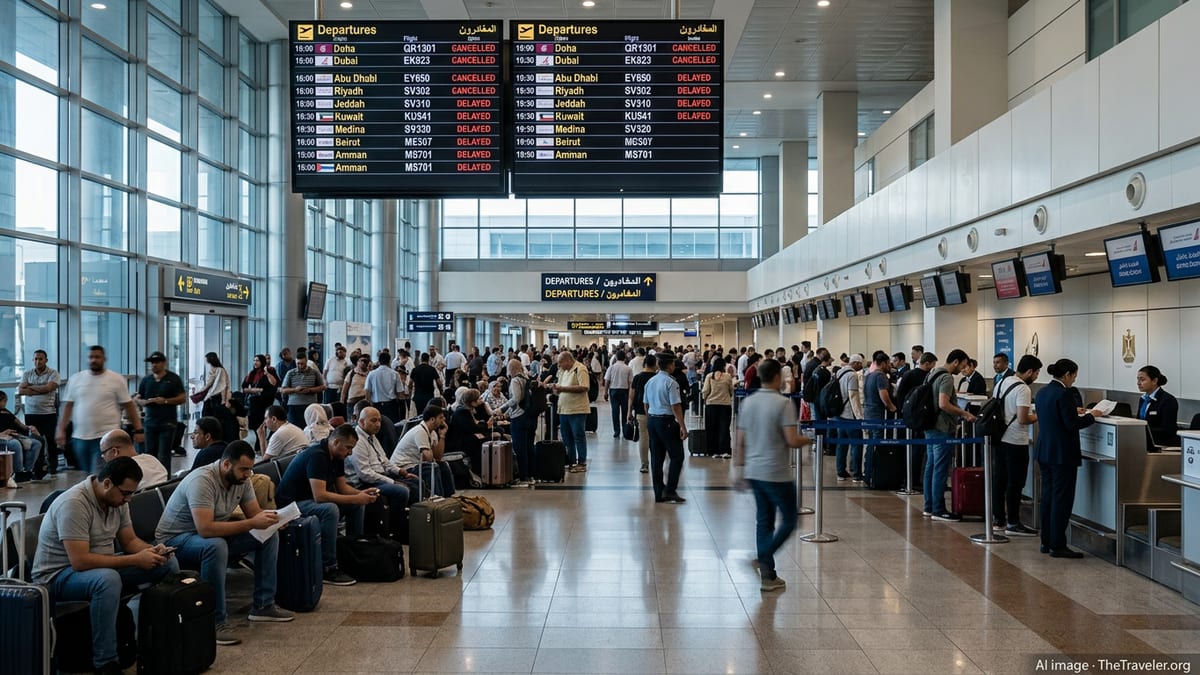
Regional Airspace Crisis Ripples Into Egypt
Published advisories and operational updates from airlines and travel-management firms in March 2026 describe a broad airspace crisis across the Middle East, triggered by heightened military tensions and resulting in partial or full closures above several Gulf states. This regional disruption has now translated into a concentrated burst of cancellations on Egypt-linked routes, particularly those connecting Cairo and coastal gateways with major Gulf hubs.
While Egyptian airspace itself remains open according to recent corporate and advisory bulletins, carriers are being forced to rework or withdraw services that traverse restricted skies or rely on airports facing temporary shutdowns. This has left Egypt-based travelers heavily exposed, given the country’s reliance on Gulf connections for business, labour traffic, religious travel and onward long-haul links to Asia, Europe and North America.
The latest cancellation round includes services involving not only Cairo but also secondary and leisure-oriented gateways such as Hurghada and Port Sudan, as well as connections to conflict-adjacent cities including Baghdad and Sayun. The pattern reflects both direct operational constraints and precautionary rerouting decisions as airlines seek to minimize exposure to volatile air corridors.
Industry tracking of schedules and passenger reports indicates that the cumulative total of scrubbed flights over recent days has already surpassed 30 for the group of EgyptAir, Emirates, Gulf Air and Qatar Airways alone, with short-notice adjustments continuing as conditions evolve.
EgyptAir Scales Back Middle East Network
According to recent corporate travel alerts summarizing airline responses, EgyptAir has suspended or curtailed flights to more than a dozen Middle Eastern cities as part of its crisis response. Routes most affected include services from Cairo to Gulf capitals and key regional centers such as Dubai, Doha, Kuwait City, Riyadh, Jeddah, Bahrain and Baghdad, where either airspace restrictions or operational uncertainty make regular operations difficult.
Network data published in early March still lists a wide portfolio of EgyptAir destinations around the Gulf, underscoring how abrupt the current reductions are compared with the carrier’s typical schedule. The suspension of multiple city pairs across a compact time frame has amplified the impact on Egyptian travelers, many of whom rely on these flights for employment-related commutes and religious visits.
Egypt-focused leisure routes are also being caught in the fallout. Flights serving resort and Red Sea markets, including links through Hurghada and Port Sudan that connect via Gulf hubs, have seen cancellations or significant timetable changes. In some cases, aircraft are being reassigned to more resilient corridors in Europe and Africa where overflight conditions are comparatively stable.
Publicly available information suggests that EgyptAir is prioritizing core domestic services and select long-haul operations while keeping its Middle East schedules under rolling review. Passengers are being encouraged through public advisories and airline channels to monitor booking tools closely and remain prepared for last-minute changes.
Emirates, Gulf Air and Qatar Airways Cut Back Egypt Links
The disruption is being compounded by decisions taken in the home markets of major Gulf carriers. Recent travel-industry alerts indicate that Emirates has faced broad suspensions from its Dubai hub during key phases of the crisis, limiting its ability to sustain normal frequencies to Cairo and other Egyptian points. Even as some services from Dubai gradually return, the schedule remains thinner and more volatile than usual, with cancellations affecting Egypt-bound departures on specific days.
Gulf Air has been hit even more severely. A detailed March update on Bahrain operations describes the airline as effectively grounded while Bahrain’s airspace remains restricted, severing a long-standing bridge between Egypt and the wider Gulf. Historic reliance on Gulf Air’s Bahrain hub for two-step connections from Egypt to Saudi Arabia, the wider Levant and parts of South Asia has thus been sharply curtailed.
Qatar Airways, operating from Doha, has been managing its own rolling adjustments, with interim schedules repeatedly revised during March. Limited resumptions on select routes to Riyadh and Jeddah have been reported, but overall capacity into and out of Doha is still markedly below normal. As a result, Egypt–Doha flights are experiencing cancellations and downgauging, squeezing one of the most important transfer flows for Egyptian travelers heading to Asia-Pacific and beyond.
Collectively, the schedule cuts by these three Gulf carriers remove a significant share of daily seats that would typically connect Egypt with Dubai, Abu Dhabi, Doha, Bahrain and Kuwait. This has left passengers with fewer alternatives, longer journey times via secondary hubs, and a greater likelihood of same-day disruption at short notice.
Passengers Face Missed Connections and Limited Alternatives
The immediate impact for travelers has been felt in missed connections, extended layovers and, in many cases, complete trip cancellations. Posts and discussions on passenger forums over the past three weeks describe repeated changes to itineraries involving Egypt and the Gulf, including late-night notifications of scrapped flights and rebookings routed through less-affected airports in Saudi Arabia or outside the region.
Reports indicate that some passengers have opted to purchase fully refundable backup tickets on alternative carriers, especially where essential travel such as medical appointments, work start dates or family obligations is at stake. Others have chosen to postpone journeys entirely until the situation becomes more predictable, citing difficulties reaching airline call centers and uncertainty over future schedule stability.
With Egypt’s own airspace still open, a number of travelers are attempting to piece together overland and multi-stop solutions. This can involve flying from Egypt to a still-operational hub, then connecting onward on non-Gulf carriers that are able to route around restricted zones. However, such workarounds often come with increased costs, longer travel times and heightened stress, particularly for families and older passengers.
Travel-management companies and corporate mobility teams are advising clients, through publicly accessible advisories, to check live flight-status tools frequently, avoid tight connection windows, and ensure that any new bookings come with flexible change or refund conditions. The same guidance is being echoed in informal traveler communities, where recent experience has shown that even confirmed flights can be altered with little warning.
Uncertain Timeline for Normal Operations
Analysts and industry observers tracking the situation note that the outlook for a rapid return to normal operations remains unclear. The underlying driver of the current airspace restrictions is a broader regional security crisis, and many countries whose airspace is central to Egypt–Gulf traffic flows are still enforcing partial or complete closures.
For EgyptAir and its Gulf counterparts, this creates planning challenges beyond the usual seasonal adjustments. Scheduling teams are having to design short-term timetables that may quickly be overtaken by new developments, requiring rolling cancellations and last-minute aircraft redeployments. This dynamic is especially visible on routes to cities such as Riyadh, Jeddah, Baghdad and Sayun, where both demand and risk factors are high.
Travelers looking ahead to late March and April face a landscape in which official timetables may not fully reflect the operational reality until days before departure. Published coverage suggests that airlines are issuing travel-flexibility policies and extended rebooking windows on an incremental basis, rather than committing to long-term waivers that might outlast the current phase of the crisis.
For now, Egypt’s role as a connecting point between Africa, Europe and the Middle East remains constrained by developments largely beyond its own borders. Until airspace over key Gulf and neighboring states reopens to a degree that allows stable scheduling, EgyptAir, Emirates, Gulf Air and Qatar Airways are likely to continue adjusting their operations, with Egypt’s travelers and tourism sector absorbing much of the disruption.