

More news on this day
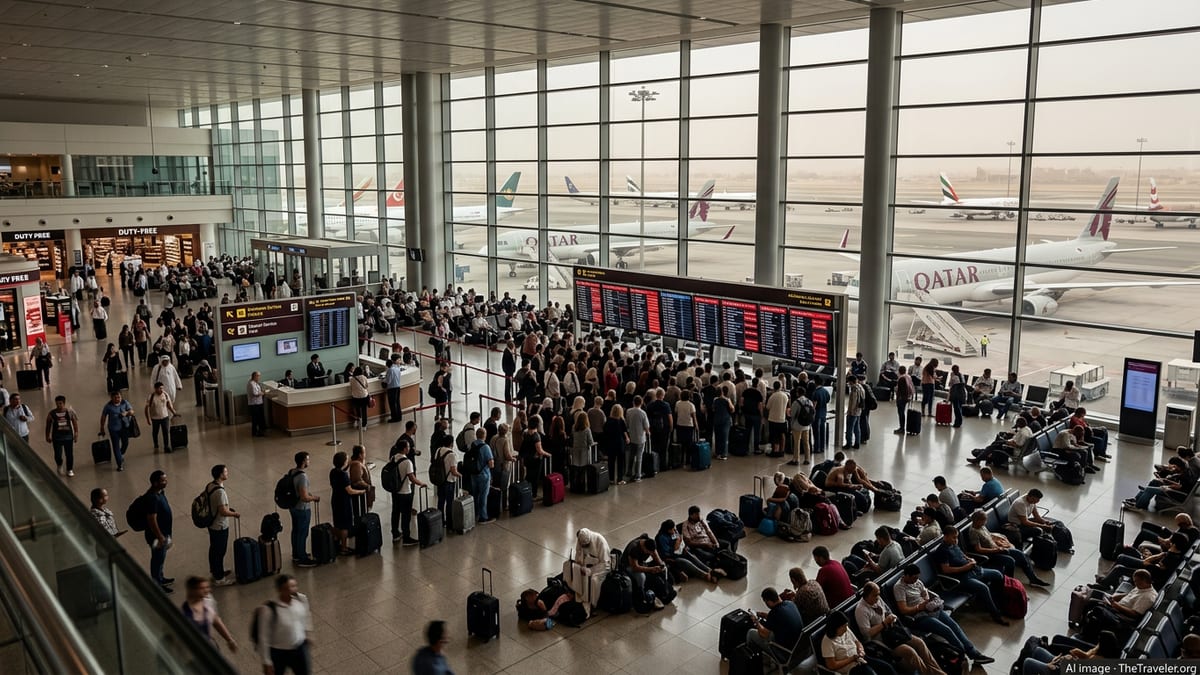
Escalating conflict centered on Iran is rapidly reshaping air travel across the Gulf, with Qatar, Bahrain, and Saudi Arabia experiencing major disruptions as Qatar Airways and Gulf Air suspend or sharply reduce operations, forcing global passengers into longer, more complex journeys.
Get the latest news straight to your inbox!
Regional Conflict Shuts Key Airspace and Hubs
Publicly available aviation notices and security advisories show that airspace over Qatar and Bahrain has been closed or heavily restricted since late February, following missile and drone strikes linked to the 2026 Iran war. Bahrain’s airspace closure has been extended "until further notice," while Qatar has shifted between full and partial closures focused on protecting Hamad International Airport in Doha.
Operational updates compiled by travel risk and logistics firms indicate that Saudi Arabia has kept its main airports open but with significant restrictions on Gulf-facing airspace. Saudi-controlled corridors have instead become the primary east–west bypass for flights that must avoid high-risk skies over the central Gulf, Iran, Iraq, and parts of Kuwait.
Industry briefings describe an unprecedented reshaping of flight paths, with carriers diverting through the Red Sea, the eastern Mediterranean, Central Asia, or Africa. These reroutings add hours to some long-haul journeys, increase fuel burn at a time of sharply higher oil prices, and reduce the number of flights airlines can operate with available aircraft and crews.
The wider backdrop is a fast-moving regional war that has also disrupted shipping through the Strait of Hormuz and damaged energy infrastructure in Qatar and Saudi Arabia. Analysts note that aviation is now at the center of a broader economic shock affecting trade, tourism, and logistics across the Gulf.
Qatar Airways Scales Back Hub Operations and Shifts to Relief Flying
Qatar Airways, which relies on Doha as a single mega-hub, has been among the hardest hit. Travel advisories and press coverage describe a near-total suspension of regular hub operations after airspace closures over Qatar and neighboring states, leaving the airline temporarily operating at a fraction of its usual capacity.
According to airline circulars shared via trade portals and summarized in travel forums, Qatar Airways has pivoted to a limited program of relief and repatriation services. With special authorizations from regulators, the carrier has been running selected long-haul flights from Doha to major European gateways such as London, Paris, Madrid, Rome, and Frankfurt, primarily to evacuate stranded passengers and reposition aircraft.
These services operate along narrow, pre-cleared corridors designed to avoid active conflict zones, often with last-minute scheduling changes. Travelers report diversions to alternative hubs such as Muscat when Qatar’s airspace has been abruptly closed, sometimes resulting in multi-day delays and lengthy waits for onward connections.
The airline has also introduced temporary rebooking policies that broaden options for affected customers. Publicly available guidance indicates that passengers on disrupted itineraries can request refunds, date changes, or rerouting via partner carriers and, in some cases, via non-partner airlines within specified time windows, although reaching call centers and securing seats has proved challenging during peak disruption periods.
Bahrain’s Gulf Air Confronts Extended Hub Disruption
Bahrain-based Gulf Air has likewise faced sustained turbulence as Manama’s airspace remains formally closed. Passenger accounts and booking notices describe multiple cancellations on itineraries routing through Bahrain, with some travelers forced to abandon Gulf Air connections entirely and rebook via carriers using alternative hubs.
Information shared by the airline and disseminated in advisory bulletins shows that Gulf Air has issued a flexible waiver policy covering travel over a defined disruption period. Eligible passengers have been allowed to rebook their journeys without additional change fees, push their travel dates into later months, or request refunds when flights are canceled.
However, closed airspace over Bahrain has sharply limited Gulf Air’s ability to operate even skeleton services. With its primary hub constrained, the airline has had fewer options than larger regional rivals that can fall back on multiple hubs or domestic networks. Reports from travel communities describe complex workarounds involving surface travel to Saudi Arabia or Oman, followed by onward flights on other carriers.
The situation in Bahrain highlights how quickly a small hub can be sidelined in a regional security crisis. With insurers tightening war-risk cover and aviation authorities maintaining strict restrictions, the pace at which Gulf Air can restore a reliable schedule remains uncertain and heavily dependent on the security outlook.
Saudi Arabia Emerges as a Critical Detour Corridor
While Saudi Arabia has also come under attack in the current conflict, its geographic position and diversified infrastructure have given it a pivotal role in keeping some global traffic moving. Consulting and corporate travel advisories describe Saudi airspace, particularly westward corridors anchored on Red Sea gateways, as the primary open east–west bridge across the broader region.
Riyadh, Jeddah, and other Saudi airports have seen rising importance as detour points, even as Gulf-facing sectors of Saudi airspace remain restricted. Some travelers are reaching Saudi cities by road from Qatar or Bahrain, then boarding long-haul flights that avoid the most sensitive areas and connect onward to Europe, Asia, or Africa.
At the same time, airlines based in Saudi Arabia have curtailed services to directly affected neighbors, suspending flights to Doha, Manama, Kuwait City, and key United Arab Emirates hubs early in the crisis. This combination of reduced regional connectivity and increased strategic importance for long-haul flows has created a two-speed aviation role for Saudi Arabia: constrained as a Gulf shuttle operator but vital as a global transit corridor.
Economic analyses suggest that Saudi Arabia’s ability to reroute both energy exports and airline traffic via the Red Sea has cushioned some of the blow from the conflict. Nonetheless, higher operating costs, war-risk insurance premiums, and volatile demand are expected to weigh on aviation earnings and broader tourism targets in the kingdom for the remainder of 2026.
What Global Passengers Can Expect in the Weeks Ahead
For travelers with tickets touching Qatar, Bahrain, or Saudi Arabia, the immediate reality is continued uncertainty. Open-source flight tracking, airline advisories, and airport notices collectively point to reduced frequencies, rolling cancellations, and last-minute reroutings across much of the Gulf network.
International carriers that once relied on Qatar Airways and Gulf Air for one-stop access to destinations across Asia and Africa are recalibrating. Many are shifting capacity to alternative hubs in Europe, Turkey, and South Asia, or relying more heavily on carriers based outside the conflict-affected zone. This has led to tighter seat availability and, in some markets, higher fares, especially in premium cabins and on key business routes.
Travel management firms are advising clients to build extra buffer time into itineraries, avoid tight connections in the broader Middle East, and monitor airline waiver policies closely. Passengers are being encouraged to confirm that contact details are up to date in bookings, enabling carriers to push schedule changes and rebooking options more quickly when disruptions occur.
Looking ahead, analysts expect that a prolonged conflict will accelerate a structural shift in global routing patterns. Some traffic that once flowed through Doha or Manama may permanently gravitate toward alternative hubs considered less exposed to Gulf security risks. Yet the central geographic position of the region, and the scale of its aviation investments, mean that once the security situation stabilizes, carriers such as Qatar Airways and Gulf Air are likely to mount an aggressive push to reclaim their roles in global connectivity.