

More news on this day
Heightened military tensions around the Strait of Hormuz have abruptly paralysed Middle East cruise itineraries, leaving thousands of tourists marooned on vessels and in ports across Dubai, Doha and the wider Arabian Gulf, as governments and cruise lines scramble to find safe corridors out of the region.
Strait of Hormuz Crisis Ripples Into Luxury Cruise Sector
The cruise disruption stems directly from the fast‑escalating security emergency in and around the Strait of Hormuz, the narrow sea lane that connects the Arabian Gulf to the Gulf of Oman and the Indian Ocean. Since joint United States and Israeli strikes on Iranian targets on February 28 2026, the waterway has effectively been treated as impassable by much of the commercial fleet amid repeated threats from Tehran against ships attempting to transit.
Iran’s Revolutionary Guards have claimed what they describe as complete control over the strait, while Western navies and maritime security agencies have raised threat levels to their highest bands, warning that all civilian shipping in the area faces a high risk of attack. International shipping trackers show a collapse in transits through the chokepoint, with hundreds of vessels of all types now anchored in sheltered waters across the northern Gulf rather than risk the passage.
For the cruise industry, which has spent the past decade cultivating the Gulf as a winter-sun playground featuring short sailings between Dubai, Doha, Abu Dhabi and ports in Oman, the sudden operational freeze has been devastating. Ships that would normally reposition to the Mediterranean or Asia via the Strait of Hormuz at the end of the season can no longer leave, trapping both vessels and guests in a volatile theatre of conflict.
Analysts note that while war risk has long been priced into tanker and container trades through the region, the scale and speed of the current shutdown is unprecedented for passenger shipping. Cruise executives privately acknowledge they have limited playbooks for a scenario in which both sea lanes and key regional airports are simultaneously constrained by military activity.
Thousands of Tourists Stuck in Dubai, Doha and Gulf Ports
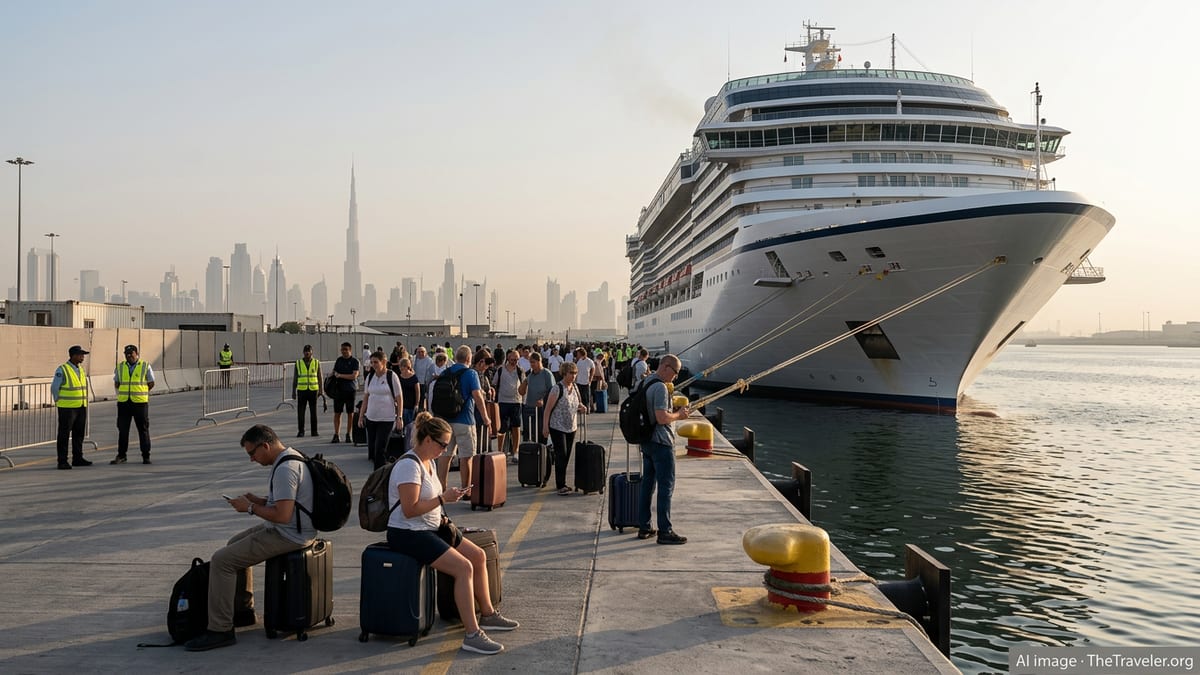
According to figures shared by the United Nations’ International Maritime Organization and maritime labour groups, around 15,000 cruise passengers are currently stranded on multiple large vessels confined to Gulf ports or anchorages, alongside some 20,000 commercial seafarers on cargo and tanker ships. Dubai’s Port Rashid and nearby cruise terminals are hosting some of the largest ships, with additional passenger vessels idle off Doha and in other UAE harbours.
Operators including European, Gulf and Greek cruise brands have confirmed that scheduled sailings in early and mid March have been cancelled, with ships instead remaining alongside as floating hotels. In Dubai, iconic vessels such as the MSC Euribia and the Saudi-owned Aroya Manara are among those photographed at anchor or berthed without clear departure dates, while smaller ships serving niche itineraries are scattered across the northern Gulf waiting for instructions.
For holidaymakers, many of whom had booked week-long Arabian Gulf loops or repositioning voyages back to Europe, the disruption has turned dream vacations into an open-ended ordeal. Passengers report initial attempts to continue port calls being abandoned as nearby waters were subject to missile alerts or drone interceptions, forcing captains to return to harbour and suspend shore operations on safety grounds.
In both Dubai and Doha, hotel capacity and airport operations are under strain from wider regional travel disruption linked to the Iran conflict, limiting options for cruise guests seeking to fly home. Some well-heeled travellers have reportedly turned to private charters and business jets, paying six-figure sums to secure routes via secondary airports seen as less exposed to potential strikes.
Cruise Lines Freeze Gulf Seasons and Reroute Fleets
Major international cruise lines have moved quickly to halt new departures in the Middle East, announcing the suspension of sailings from Dubai, Doha and Abu Dhabi through at least late March while they reassess security conditions. A series of high-profile voyages, including spring departures to or from Qatar and the United Arab Emirates, have been cancelled outright, with booked guests offered refunds or future cruise credits.
Industry trade publications report that ships which were due to operate extended Gulf seasons into May are instead being held in place while corporate crisis teams weigh whether and how to reposition them without using the Strait of Hormuz. Some operators are examining complex alternative routings that could involve empty re-positioning via the Red Sea and around Africa at a later date, if maritime advisories in those waters allow, but emphasise that no such moves are imminent.
Travel agents across Europe and Asia say they have been inundated with calls from customers concerned about Middle East itineraries scheduled for the coming months. Several cruise brands have proactively pulled their entire regional programmes for the remainder of 2026, citing a combination of navigational hazards, war risk insurance premiums and uncertainty over when Hormuz might be deemed safe again by naval coalitions.
The sudden collapse of the Gulf cruise season is a blow for regional tourism authorities that had invested heavily in new terminals, marketing campaigns and visa facilitation to attract ships. Ports in Dubai, Doha and Abu Dhabi had touted record passenger projections for this winter and next, banking on the sector as a pillar of diversification away from hydrocarbons at precisely the moment the oil trade itself is being reshaped by the crisis.
Safety, Welfare and Legal Headaches for Stranded Guests
As the days stretch on, the immediate focus for cruise lines has shifted from salvaging itineraries to managing the welfare of thousands of guests and crew effectively stuck at sea or in port. Executives insist that passenger safety is paramount and stress that ships are maintaining full hotel operations, medical facilities and security patrols while they remain docked or at anchor.
However, the unusual circumstances raise complex legal and logistical questions. Contracts of carriage typically allow cruise operators broad latitude to alter routes due to force majeure, but consumer advocates argue that companies still have a duty to provide reasonable onward travel or accommodation. With commercial flights from key Gulf hubs curtailed or oversubscribed due to the broader conflict, arranging that onward travel has become a formidable challenge.
Crew welfare is another mounting concern. Many seafarers have now found themselves in a high-risk zone far beyond what they anticipated when signing on, with limited clarity on when they will be able to disembark or rotate off their contracts. Unions warn of growing fatigue, anxiety and financial strain on multinational crews who must support families at home while working in a conflict-adjacent environment.
Insurance implications are also significant. The sudden reclassification of the Strait of Hormuz and much of the surrounding region as an extreme war risk area has sent premiums soaring for any vessel contemplating movement. Cruise ships remaining alongside in ports are somewhat shielded from those costs, but any eventual mass exodus once conditions ease could trigger a scramble for cover and sharply higher operating expenses.
Uncertain Timeline as Diplomats and Navies Seek a Way Out
For now, there is no clear timetable for when stranded cruise passengers will be able to leave the region by sea. United States officials have signalled a willingness to organise naval escorts for key commercial convoys through the Strait of Hormuz, but no large-scale corridor specifically tailored to passenger ships has been announced. Regional governments, meanwhile, are focused on air defence and the protection of energy exports, with tourism evacuations a secondary priority.
Diplomatic efforts at the United Nations and in regional capitals are intensifying in a bid to reduce the risk of further escalation and to reopen at least limited merchant traffic through the chokepoint. Maritime experts caution that even if a ceasefire or de-escalation is agreed in the coming weeks, it could take much longer for insurers, navies and shipowners to regain the confidence needed to resume routine cruise itineraries in the Gulf.
In the meantime, the Middle East cruise crisis is forcing a broader industry rethink about exposure to geopolitical flashpoints. Operators that had once promoted the Gulf as a safe, modern alternative to more politically fraught regions are recalibrating their deployment strategies, with some hinting that future growth will be concentrated in less contested waters such as Northern Europe, North America and parts of Asia.
For the thousands of tourists currently confined to ships in Dubai, Doha and neighbouring ports, the strategic recalculations feel distant compared with the immediate reality of missed connections, extended leaves from work and the daily thrum of military activity nearby. Their predicament has become one of the most visible human faces of a fast-moving maritime crisis that began in the oil and security domains but has now swept up the world of leisure travel as well.