

More news on this day
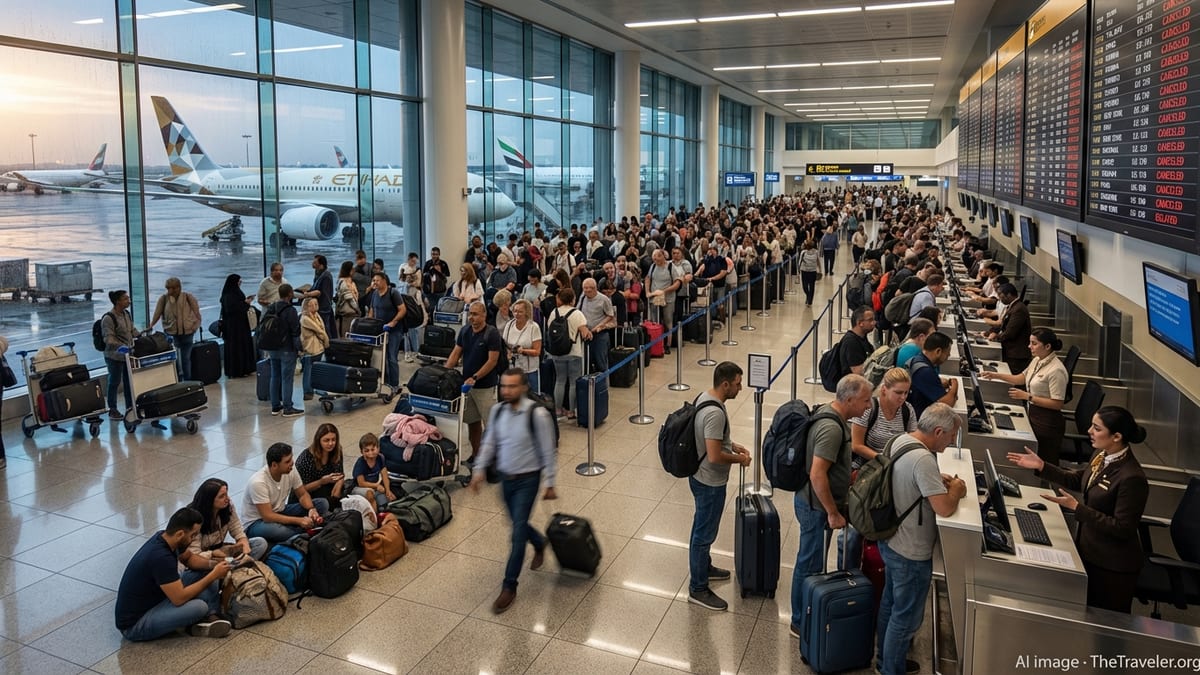
Europe is heading into one of its most chaotic spring travel periods in years as expanding airspace restrictions and flight suspensions across the Gulf region derail April 2026 itineraries for thousands of passengers from Denmark, Germany, the United Kingdom, Italy, France, Ireland, Portugal, Turkey and other European countries.
Get the latest news straight to your inbox!
Middle East Conflict Ripples Into Europe’s Spring Travel Season
The disruption stems from the conflict that erupted after late February strikes on Iran, which prompted widespread closures or severe restrictions of airspace across much of the Middle East. Aviation safety bulletins and conflict-monitoring platforms indicate that operators have been advised to avoid or strictly limit flights in the skies of Bahrain, Qatar, the United Arab Emirates, Kuwait and several neighboring states, effectively shutting down the main Gulf corridor that links Europe with Asia and Oceania.
Key hubs such as Dubai, Abu Dhabi and Doha, usually among the world’s busiest transit points, have shifted to limited or heavily controlled operations. Industry reporting shows that many foreign carriers are no longer able to use these airports as through-routes and are instead diverting, delaying or cancelling services that once relied on fast Gulf connections between Europe and destinations in Southeast Asia, Australia and East Africa.
Analysts tracking global schedules estimate that tens of thousands of flights have already been affected since late February, with more than 14,000 cancellations on Europe to Asia corridors alone in the weeks immediately following the escalation. As April begins, those timetable shocks are filtering into European holiday plans, business trips and family visits booked months in advance around school breaks and religious holidays.
European travelers who once saw Gulf carriers and hubs as reliable shortcuts between continents now face multi-leg routings through congested airports in Europe, Central Asia or North Africa, often at significantly higher fares and with very limited last-minute availability.
Denmark and Other European States Escalate Travel Alerts
Against this backdrop, several European governments have stepped up advisories for citizens transiting the Gulf, with Denmark emerging in early April as the latest country to flag the situation as a major travel emergency. Public guidance from Nordic and wider European foreign ministries has shifted from generic “exercise caution” language to much more explicit warnings about the likelihood of cancellations, diversions and protracted airport stays for anyone relying on connections through Bahrain, Qatar, the UAE and nearby states.
Travel-risk briefings issued this week highlight that European passengers are being stranded not only by outright airport closures but also by short-notice airspace shutdowns that force pilots to divert mid-flight or return to their point of origin. This creates cascading operational problems once the aircraft and crew are out of position, affecting routes across Germany, the UK, France, Italy, Ireland, Portugal and Turkey even when those flights do not enter Middle Eastern airspace.
Recent compilations of disruption data and passenger claims suggest that March and early April have already produced some of the heaviest concentrations of long-haul cancellations that Europe has seen since the pandemic. Consumer-rights platforms are reporting a spike in EU261 and UK261 compensation inquiries on services operated by European and Gulf airlines alike, although eligibility varies widely depending on the routing and whether safety-related airspace closures are deemed extraordinary circumstances.
For Denmark, a country whose travelers frequently connect to Asia and Africa via Dubai, Doha or Abu Dhabi, the sudden unreliability of those hubs is particularly acute. Advisories now urge Danes to build in substantial buffer time, avoid tight connections and consider itineraries that remain within European and North American carriers’ networks where possible, even if those options are slower and more expensive.
From Germany to Ireland, Thousands Face Disrupted April Holidays
The timing of the Gulf restrictions is especially damaging because it collides with peak spring getaway traffic from major European outbound markets. Germany, the UK, France, Italy, Ireland and Portugal all see sharp rises in leisure travel around early April, driven by Easter holidays and school breaks that many families plan around months in advance.
Reports from flight-tracking services and traveler forums point to a familiar pattern. Passengers set to fly from European cities such as Frankfurt, Munich, London, Paris, Rome, Dublin, Lisbon and Istanbul to long-haul destinations in Asia or the Indian Ocean via Gulf hubs are receiving last-minute notifications that their segments through Doha, Dubai, Abu Dhabi, Manama or Kuwait City are cancelled or rerouted. In some cases, airlines are attempting to rebook travelers on alternative routings via European hubs, but seat availability is tightening and rebooking windows often stretch several days.
Travelers already in transit are among the hardest hit. Social media accounts and traveler communities are filled with stories of Europeans stranded for days in Gulf airports while waiting for scarce rescue flights or charter options to open up. Some airlines have introduced limited special services to Europe, but operational updates indicate that capacity remains far below normal levels and priority is often given to those whose original travel dates fell closest to the initial wave of cancellations.
The knock-on effects reach beyond long-haul holidaymakers. Business travelers connecting to conferences in Asia, expatriates returning from work assignments and students heading back to European universities all face uncertainty. Denmark’s inclusion among the growing list of European countries calling the situation a major travel emergency underscores that the issue no longer affects just a handful of high-volume markets but is now systemic across the continent.
Gulf Flight Restrictions Complicate Routing and Spike Fares
The collapse of the traditional Gulf corridor is forcing airlines to redraw route maps in real time. With Russian airspace still largely closed to many Western carriers, options for flying between Europe and East Asia are already constrained. The loss or severe curtailment of airspace over Bahrain, Qatar, the UAE and neighboring areas adds another major barrier, leaving carriers to thread much longer paths through Central Asia, the Caucasus or parts of Africa where capacity and infrastructure are limited.
Industry-focused publications tracking airfares report that prices on many Europe to Asia routes have risen sharply since late February, in some cases by more than 20 to 25 percent compared with pre-crisis levels. Airlines are trying to spread constrained capacity as fairly as possible, but the twin pressures of longer flight times and reduced access to key hubs leave few immediate solutions. Cargo carriers are simultaneously contending with insurance restrictions and rerouting in the Red Sea and Gulf regions, which further tightens bellyhold capacity on passenger jets.
Major Gulf-based airlines, including those headquartered in the UAE and Qatar, have published rolling schedule updates indicating limited operations to select European cities up to at least the end of April. Travel agencies and advisory services note that some carriers have extended flexible rebooking and refund policies into late spring or early summer for tickets touching affected airports, yet these measures do not guarantee prompt alternative flights given the overall shortage of available seats.
For European travelers, the practical impact is clear. Routes that once involved a single smooth overnight connection through Doha or Dubai now require two or three separate legs, often with long daytime layovers in unfamiliar airports and higher total costs. In many cases, travelers are choosing to postpone or cancel trips altogether rather than navigate an unpredictable patchwork of restrictions and last-minute operational changes.
Emergency Visa Relief and Workarounds Offer Partial Relief
Amid the ongoing turmoil, some European and non-European states are attempting to ease the burden on stranded passengers. Switzerland recently announced that it is coordinating with partners including Germany, the UK, Spain, Italy, Austria and Portugal on emergency visa relief and expanded consular assistance for travelers stuck in Qatar, the UAE, Oman, Bahrain and Kuwait. Publicly available statements describe fast-track visa processing, special entry permissions and dedicated helplines for those who need to reroute through European territory on short notice.
These measures reflect a broader trend of ad hoc workarounds emerging to manage the human impact of the crisis. Regional observers report that certain embassies in the Gulf are arranging limited charter or repatriation flights, though places are scarce and eligibility criteria can be strict. In some cases, neighboring states with comparatively less affected airspace are allowing temporary overland entries so that travelers can access alternative airports and routes home.
Yet even with these initiatives, the reality for many European travelers in April 2026 is one of prolonged uncertainty. Relief schemes tend to focus on the most vulnerable or those who have been stranded for the longest periods, leaving a large cohort of ordinary holidaymakers and business passengers reliant on standard commercial rebooking channels. For them, the combination of shifting airspace restrictions, heavily disrupted Gulf hubs and already crowded European airports continues to make any travel involving the wider Middle East a high-risk proposition.
With advisories evolving daily and conflict dynamics still unresolved, travel experts recommend that Europeans with plans involving the Gulf in April monitor airline updates closely, consider routing entirely outside affected airspace where feasible, and prepare for the possibility that even confirmed itineraries may change with little warning.