

More news on this day
Hundreds of passengers remain stranded in Kuwait as widespread flight cancellations by Gulf Air and Kuwait Airways continue to disrupt long-haul travel links to New York, Amsterdam, Barcelona, Cairo, and other major destinations amid ongoing regional airspace turmoil.
Get the latest news straight to your inbox!
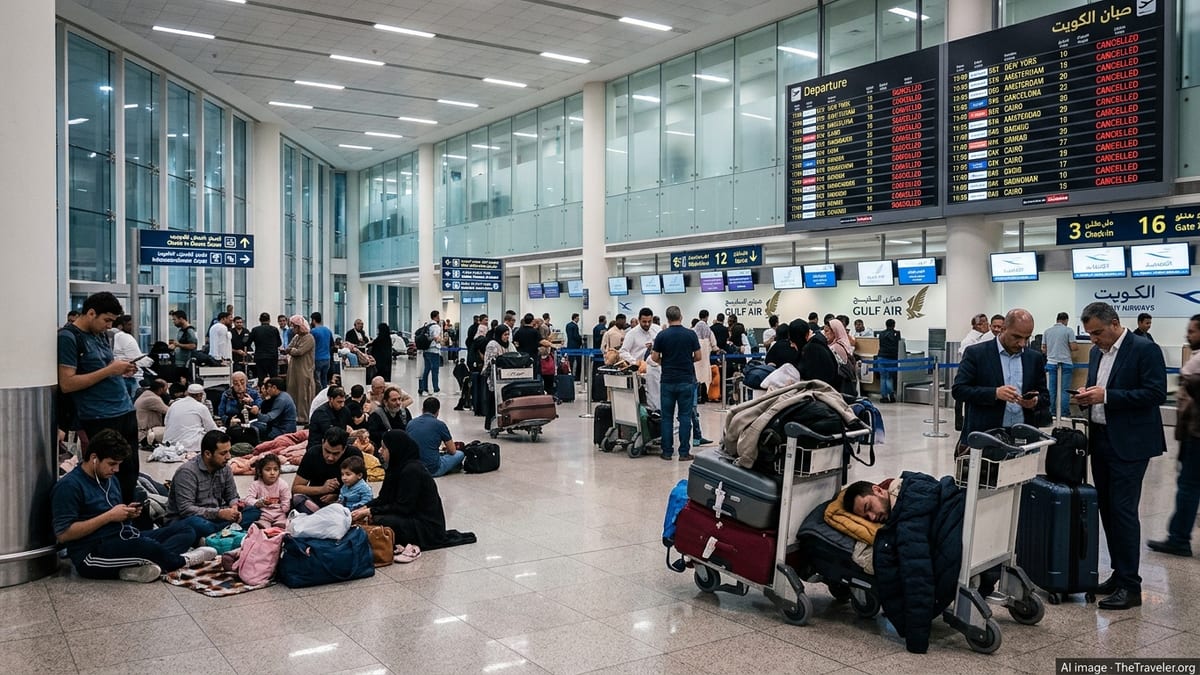
Long-Haul Routes From Kuwait Abruptly Severed
Recent days have seen a sharp escalation in disruption at Kuwait International Airport, where publicly available schedules and passenger reports indicate that more than a dozen departures operated by Gulf Air and Kuwait Airways have been canceled. The affected services include some of the country’s most important long-haul and regional connections, cutting direct links to hubs in North America, Europe, and the Middle East.
Routes to New York, Amsterdam, Barcelona, and Cairo feature prominently among the cancellations, alongside services to other European and Asian gateways. These links typically channel passengers onward to wider networks across the United States, the Schengen area, and Africa, magnifying the impact well beyond Kuwait’s borders. The interruption comes at a time of heightened sensitivity in global aviation, with airlines across the Gulf reassessing their exposure to regional airspace risks.
Flight-tracking data and updated timetables suggest that some Kuwait Airways services remain formally listed but are being scrubbed closer to departure, leaving travelers uncertain about whether their journeys will go ahead. Gulf Air’s adjustments, while more visible in advance, have nonetheless removed key frequencies that many passengers rely on for business, family visits, and transit travel.
The pattern of cancellations has effectively thinned Kuwait’s role as a connecting point between Europe, North America, and Asia, at least in the short term. For many travelers who had chosen itineraries via Kuwait to reach cities such as New York and Amsterdam, the abrupt schedule changes have translated into overnight stays in airport hotels, repeated rebookings, and a scramble for remaining seats on alternative carriers.
Passengers Face Uncertainty as Rebooking Options Narrow
For stranded passengers, the primary challenge has been a lack of predictability. According to publicly shared itineraries and posts on travel forums, some travelers received short-notice cancellation notifications for Kuwait Airways flights to Europe and onward to New York, while others arrived at the airport to find their departures removed from information screens. With multiple carriers adjusting schedules at the same time, options to rebook have quickly become constrained.
Travelers trying to reach Amsterdam, Barcelona, and Cairo report that alternative routings via other Gulf hubs or through European capitals are frequently full or significantly more expensive than their original tickets. In some cases, passengers are attempting to piece together journeys with separate one-way tickets on different airlines, introducing new risks if further disruptions occur.
Families and long-haul travelers are particularly affected, as many itineraries involve complex connections or nonrefundable arrangements such as hotel bookings and domestic onward flights. Publicly available accounts describe situations where travelers have remained in Kuwait for several extra days while waiting for confirmation of new departure dates, with some turning to social media and online communities to share information about which routes are still operating.
Information about refunds and waivers appears inconsistent from the passenger perspective. Some Kuwait Airways customers report being offered date changes without penalty under special conditions related to the current disruption, while others describe standard change and cancellation fees still being applied. For travelers attempting to leave Kuwait at short notice, the uncertainty around costs and timelines is compounding the stress of being stranded.
Regional Airspace Turmoil Ripples Through Gulf Carriers
The cancellations in Kuwait are unfolding against a broader backdrop of strain across Gulf aviation. According to recent published coverage and aviation data, airspace closures and conflict-related risk assessments have triggered thousands of daily flight cancellations across several states in the region, affecting both local carriers and international airlines that typically use Gulf hubs as transit points.
Carriers such as Gulf Air and Kuwait Airways are having to evaluate routing options, aircraft positioning, and crew logistics on an almost continuous basis. Adjusting or suspending certain long-haul routes from Kuwait, including services to New York and major European cities, appears to be part of a wider effort by airlines to navigate changing overflight permissions and operational constraints while maintaining safety standards.
Other major airlines in the wider Gulf region have responded by consolidating flights, operating special repatriation services, or rerouting aircraft via more southerly or westerly corridors. However, Kuwait’s specific exposure, including previous reports of damage to airport infrastructure and fluctuating airspace status, has made scheduling particularly difficult for its home carriers.
Industry analysts note that airlines in the region are balancing commercial pressures with rapidly evolving geopolitical realities. For Kuwait-based operations, the loss of even a handful of daily departures to high-yield destinations such as New York and Amsterdam can have a notable impact on revenue, while also weakening the country’s position as a competitive transit point between continents.
Knock-On Effects for Global Networks and Local Economy
The disruption at Kuwait International Airport is not limited to passengers holding tickets on affected flights. Travel industry reports indicate that tour operators, corporate travel planners, and regional businesses are having to reconfigure itineraries that previously relied on Kuwait as a convenient stopover between Europe, the Middle East, and Asia. Destinations such as Barcelona and Cairo, which often feature in multi-city leisure and business trips, are seeing itinerary changes ripple through booking systems.
Local hotels, transport providers, and airport concessionaires are also feeling the effects. Stranded passengers may generate short-term demand for accommodation and services, but prolonged uncertainty tends to deter new bookings and discourages travelers from planning itineraries through a hub perceived as unstable. Aviation specialists caution that if cancellations extend over weeks rather than days, the reputational impact on Kuwait as a transit hub could take longer to repair than the physical or logistical challenges.
For foreign visitors already in Kuwait, the lack of clarity around departure options is influencing decisions about future travel to the country. Some travelers sharing their experiences publicly state that they will avoid routings via Kuwait until schedules stabilize, preferring alternative hubs in the Gulf or direct services from European and Asian carriers where available.
On a broader scale, the thinning of long-haul services from Kuwait reduces choice in an already pressured global aviation system, where aircraft availability and crew resources remain tight. With routes to New York and key European cities curtailed, passengers worldwide may ultimately face higher fares and longer journey times, even if they are not directly traveling to or from Kuwait.
What Stranded Travelers Can Do Now
With conditions still fluid, travel experts recommend that passengers currently stranded in Kuwait or holding near-term tickets on Gulf Air or Kuwait Airways take a multi-pronged approach. Monitoring airline mobile applications and booking platforms can provide early notice of status changes, while cross-checking information with airport departure boards and independent flight-tracking services helps verify whether a flight is genuinely set to operate.
For those whose flights to destinations such as Amsterdam, Barcelona, New York, or Cairo have been canceled, investigating alternative routings via other regional hubs may be the fastest way out, even if it involves backtracking or overnight layovers. Passengers are also turning to their travel insurance policies, where disruption cover may help offset additional accommodation and rebooking costs, depending on policy wording and the specific cause of the cancellations.
Consumer advocates emphasize the importance of documenting all interactions with airlines and travel agents, including screenshots of schedules, cancellation notices, and any written offers of rebooking or refunds. This information can be valuable if travelers later need to escalate complaints through formal channels or seek compensation where regulations permit.
Until airlines restore predictable schedules from Kuwait to key international destinations, passengers are likely to face a patchwork of options. The experience of those currently stranded underscores how quickly a cluster of cancellations at a single Gulf hub can disrupt global travel flows, particularly when it affects heavily used corridors connecting the Middle East with North America and Europe.