

More news on this day
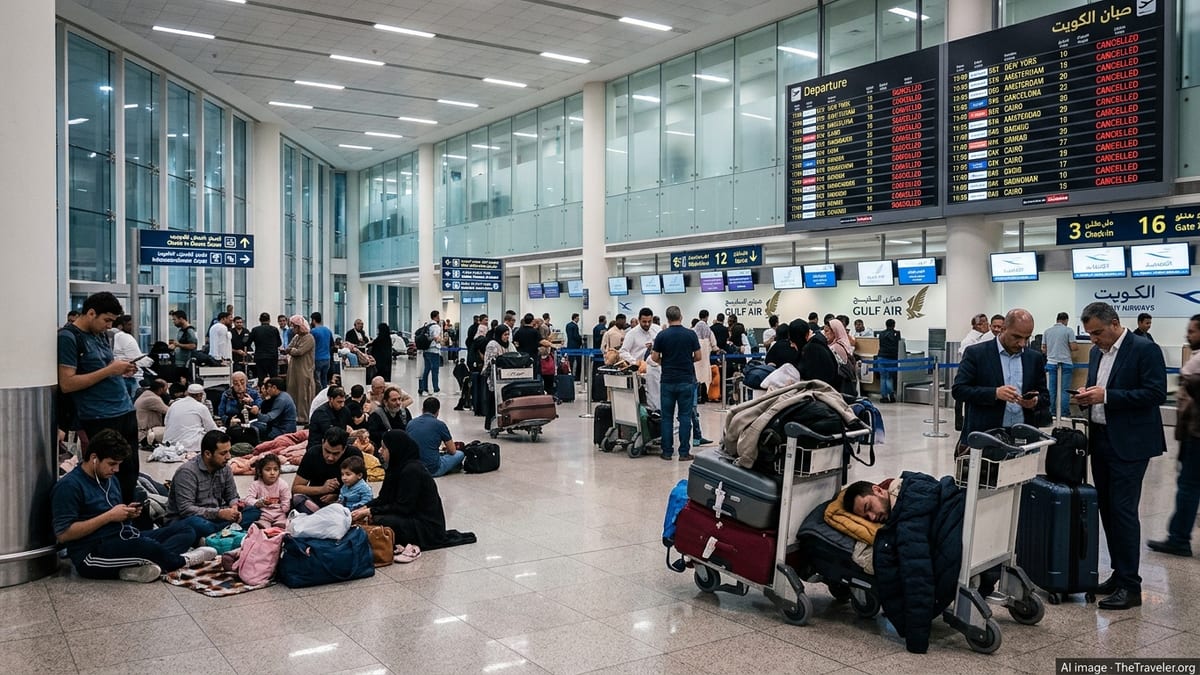
Thousands of travelers remain stranded in Kuwait as Gulf Air and Kuwait Airways cancel more than a dozen flights, sharply disrupting already fragile connections between the Gulf and major hubs including New York, Amsterdam, Barcelona, Cairo, and other key destinations.
Get the latest news straight to your inbox!
Security Crisis Cascades Into Major Flight Disruptions
Recent regional security tensions and attacks affecting airports and airspace across the Gulf have triggered an escalating wave of schedule changes, diversions, and cancellations. Publicly available information shows that Kuwait International Airport has faced repeated operational disruptions since late February 2026, following strikes linked to the wider Iran conflict. These disruptions have rippled outward through airline networks, hitting long-haul routes particularly hard.
According to published coverage of the regional aviation situation, airlines based in the Gulf have been forced to repeatedly reassess the safety and viability of operating over contested or intermittently closed airspace. Kuwait, which acts as both an origin and a key transit point for South Asia, the Middle East, Europe, and North America, has been especially exposed. As Kuwait’s airspace has been restricted and then partially reopened on a rolling basis, carriers have at times opted to cancel or consolidate flights rather than operate unpredictable skeleton schedules.
Within this context, Gulf Air and Kuwait Airways have each withdrawn multiple departures and arrivals on short notice. Flight-tracking data and passenger reports describe patterns of cancellations on routes linking Kuwait with major global gateways, including New York, Amsterdam, Barcelona, and Cairo, as carriers attempt to manage operational risk and comply with evolving safety directives.
Aviation analysts note that once long-haul connections are interrupted, the downstream effects can last for days, even after airspace formally reopens. Aircraft and crews end up out of position, transit flows break down, and airlines prioritize repatriation and essential segments over regular commercial frequencies, leaving many travelers in limbo.
Transit Passengers Caught Between Cancellations and Closed Airspace
The most severely affected travelers appear to be transit passengers who began journeys in Asia, Africa, or Europe with connections scheduled through Kuwait. Posts on passenger forums and social media describe cases in which travelers arrived in Kuwait only to find their onward flights to the United States and Europe canceled with limited advance notice.
One widely shared example involves a traveler flying with Kuwait Airways from India en route to the United States whose connecting leg from Kuwait to North America was canceled after arrival, leaving them temporarily stuck in Kuwait with no clear rebooking timeline. Other passengers on multi-stop itineraries have reported similar experiences, particularly on routes connecting through Kuwait to New York and other transatlantic gateways.
Additional reports indicate that the cancellations have also affected popular European leisure and business destinations such as Amsterdam and Barcelona, as well as regional routes to Cairo and other cities in the Middle East and North Africa. For many passengers, Kuwait was intended to be a brief transit stop of just a few hours, but the rolling adjustments to flight schedules have extended those stays indefinitely.
Some travelers have managed to secure alternative routings via relatively less affected hubs, including limited services from other Gulf and regional carriers. However, capacity on these substitute routes is constrained, and last-minute rebookings can involve complex itineraries and higher out-of-pocket costs, especially for those holding nonflexible economy tickets.
Confusion Over Refunds, Rebooking, and Passenger Rights
As the disruption drags on, frustration is growing over the handling of refunds, rebookings, and basic assistance. Discussions on consumer and travel forums focused on Kuwait highlight inconsistent information about eligibility for full refunds versus partial reimbursements, depending on whether part of a ticket has already been used.
Publicly shared communications attributed to Kuwait Airways describe evolving refund policies that initially covered cancellations between late February and late March, with eligibility criteria tied to whether a segment of the journey had been flown. Passengers report being told that accommodation and related ground expenses are at their own cost, even when they are stranded in Kuwait through no fault of their own. Some travelers say they have been offered only the option to cancel for a refund, with no comparable rebooking on other carriers, while others recount being asked to pay fare differences for alternative dates or destinations.
For transit passengers who never intended to enter Kuwait, this uncertainty is particularly acute. Without a confirmed onward flight, some have had to navigate visa policies, temporary accommodation, and local transport on short notice. Legal frameworks on passenger rights vary by jurisdiction, and many long-haul itineraries involving Gulf carriers are not covered by the more comprehensive consumer protections seen in some other regions, leaving travelers with limited recourse beyond airline goodwill and travel insurance.
Travel advisors recommend that passengers with upcoming bookings involving Kuwait or regional overflights carefully monitor airline notifications and booking platforms, maintain flexible plans where possible, and document all expenses in case partial reimbursement is later offered. However, the speed and scale of the cancellations have left many with little time to adjust.
Global Travel Networks Feel the Strain
The disruption in Kuwait is contributing to a broader reconfiguration of global flight paths as airlines seek to route around volatile airspace and damaged infrastructure elsewhere in the Gulf. Public reporting on the economic impact of the ongoing Iran conflict notes widespread interruptions to aviation across the region, including near-total shutdowns or severe restrictions at other major hubs when strikes or airspace closures occur.
With flights to New York, Amsterdam, Barcelona, and Cairo curtailed from Kuwait, traffic that once flowed smoothly through a network of Gulf and regional hubs is being redistributed. Some long-haul carriers are adding temporary frequencies via alternative waypoints, while others are consolidating services into a smaller number of reliable corridors. This can lengthen flight times and increase operating costs, ultimately feeding into higher ticket prices and reduced availability on certain routes.
For travelers, the practical effects are longer, more complex journeys and a higher risk of last-minute disruption. Airline schedules that appeared stable when tickets were purchased may no longer reflect operational reality, and rerouting options can be limited if neighboring countries impose their own restrictions or reach capacity. The result is a fragile patchwork of connections in which a single new security incident can cascade quickly through global networks.
Industry observers point out that even once the immediate security situation improves, it may take weeks or months for carriers serving Kuwait to fully restore pre-crisis schedules. Fleet and crew rotations will need to be rebuilt, passenger demand may shift in response to perceived risk, and regulatory approvals for updated routings must be secured.
What Stranded Passengers Can Expect in the Coming Days
For those still stuck in Kuwait, near-term prospects depend largely on how quickly airspace restrictions ease and whether airlines can restore a minimum level of long-haul connectivity. Flight-tracking platforms show a patchwork of limited operations and ongoing cancellations, suggesting that a full return to normal traffic remains some way off.
Passengers on canceled Gulf Air and Kuwait Airways flights may be offered options that include rebooking onto later services once they resume, rerouting via other hubs where capacity allows, or refunds in line with each carrier’s evolving policies. Travelers posting updates from Kuwait report that rebooking often happens in phases, with priority given to those who have already completed part of their journey or who face urgent travel needs.
In the meantime, stranded travelers are relying on a mix of airline information counters, call centers, and online tools to track developments. Publicly available guidance from regional aviation authorities stresses that safety remains the overriding factor in decisions to reopen airspace or authorize specific flights. Until a more stable operating environment is restored, passengers transiting through Kuwait may need to prepare for short-notice changes, extended layovers, or the possibility of seeking alternative routes entirely.
As the situation evolves, Kuwait’s role as a transit hub linking South Asia, the Middle East, Europe, and North America will remain under pressure. The experience of passengers currently stranded there is likely to shape perceptions of reliability and resilience in the wider Gulf aviation network long after the immediate crisis has passed.