

More news on this day
Hundreds of passengers traveling from Türkiye to Gulf hubs and North America are facing new disruption as Gulf Air, Kuwait Airways and other carriers cancel more than a dozen services linking Istanbul and other Turkish cities with Bahrain, Kuwait, Dubai, Detroit and additional long-haul destinations.
Get the latest news straight to your inbox!
Regional Tensions Ripple Into Turkish Airports
Flight disruption across the Gulf has intensified in recent weeks as the regional security situation deteriorates, and that turbulence is now being felt acutely in Türkiye’s main gateways. Airspace restrictions and operational constraints linked to the ongoing Iran conflict and retaliatory strikes on Bahrain, Kuwait and other states have prompted multiple carriers to trim or suspend flights on routes that rely on Gulf stopovers.
Publicly available information on route maps and live flight tracking shows that Bahrain and Kuwait, key hubs for Gulf Air and Kuwait Airways, sit directly in the corridor affected by recent missile and drone activity. In response, several Gulf and Turkish carriers have already reduced frequencies or cancelled flights outright on connections between Türkiye and Gulf cities, while also limiting onward traffic to destinations such as Detroit and other North American and Asian points.
What began as ad hoc cancellations has evolved into a more systematic reduction of services on certain days and routes. Passengers who once relied on Gulf hubs as convenient one-stop options from Türkiye to cities across the United States, South Asia and Africa are now encountering shrinking schedules, last-minute timetable changes and a greater risk of long layovers or missed connections.
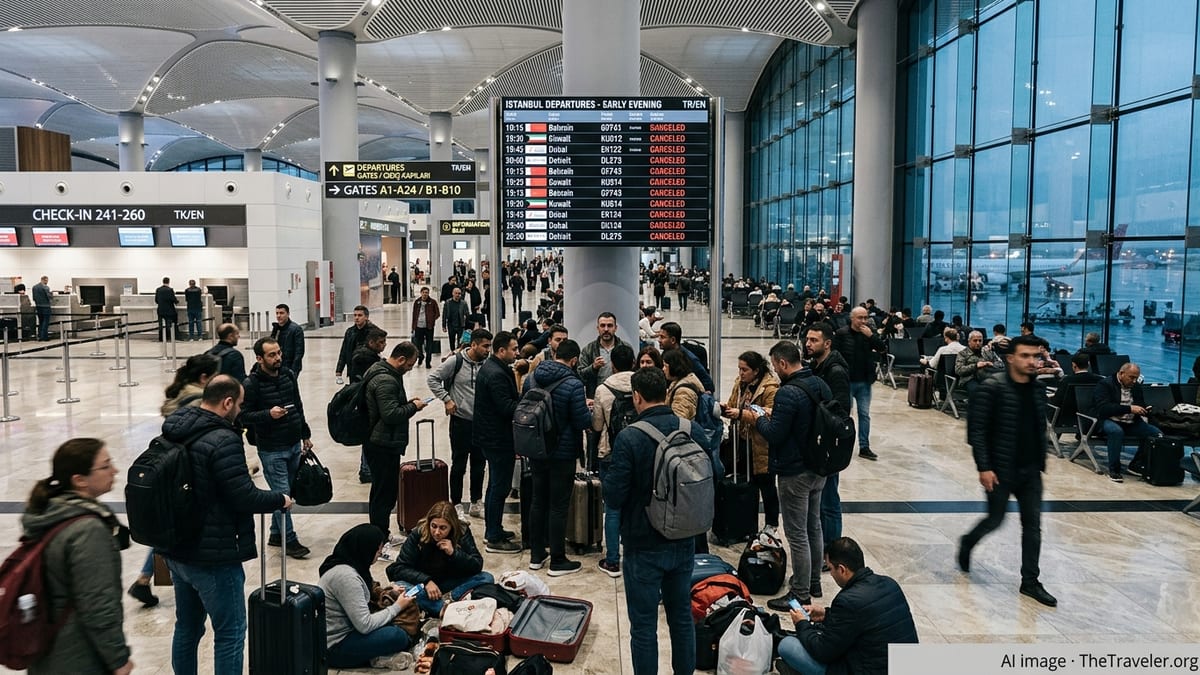
The impact is especially visible at Istanbul Airport, a major transfer point between Europe and the Middle East. Screens that once showed dense banks of departures to Bahrain, Kuwait and Dubai are now punctuated with blocks of cancellations and “check with airline” notices, underscoring the fragility of the current operating environment.
Gulf Air and Kuwait Airways Trim Türkiye Links
Gulf Air, Bahrain’s flag carrier, has been among the airlines most affected by the instability. Published schedules and passenger accounts on travel forums indicate that multiple Gulf Air flights linking Türkiye with Bahrain and onward destinations have been cancelled in recent days, with services on some dates from Istanbul either removed from sale or zeroed out close to departure.
Travelers booked on itineraries such as Istanbul to Bahrain to onward points in the Gulf and South Asia report receiving short-notice messages that their flights have been cancelled, often with limited guidance on rebooking options. Some passengers with March departures describe being told that free refunds or changes are available only within a defined window, creating further uncertainty for those with trips planned into April.
Kuwait Airways has also adjusted parts of its network as Kuwait faces heightened security concerns. According to recent coverage of the Iran conflict and its spillover effects, U.S. interests and allied facilities in Kuwait have been targeted, prompting tighter risk assessments and operational reviews. While Kuwait Airways continues to serve Türkiye on select days, travelers report patchy information on whether specific flights will operate, with some Istanbul services cancelled while others run as scheduled.
Other regional airlines are making similar moves. Reports from aviation observers show Turkish carriers suspending flights entirely to a cluster of Gulf destinations for defined periods, while certain foreign airlines that rely on Gulf stopovers are temporarily removing Türkiye segments from their schedules. This has the combined effect of concentrating demand onto the few remaining services, pushing up fares and reducing flexibility for last-minute changes.
Knock-On Effects for Routes to Dubai, Detroit and Beyond
The cancellations are not limited to point-to-point links between Türkiye and the Gulf. Because Bahrain and Kuwait act as connection hubs, every cancelled flight out of Türkiye can disrupt journeys onward to cities as varied as Dubai, Muscat, Doha or long-haul destinations such as Detroit and other North American gateways served via Gulf hubs.
Travel industry commentary notes that once a transit leg is removed, entire itineraries can unravel. A traveler booked from Istanbul to Bahrain and then onward to Detroit, for example, may find the first segment cancelled even if the long-haul leg technically remains scheduled. In practice, many airlines are choosing to cancel or re-accommodate full itineraries to avoid stranding passengers mid-journey in vulnerable transit points.
Major Gulf hubs such as Dubai have already experienced waves of disruption tied to the broader security crisis, creating a feedback loop. As carriers reconfigure schedules around airspace closures and slot constraints in the Gulf, feeder flights from Türkiye are often among the first to be cut or consolidated. The result is fewer daily options and a heavier dependence on a shrinking list of operating services on any given route.
These patterns also affect indirect itineraries from Türkiye to South Asia and East Africa that rely on Bahrain or Kuwait for connections. Some travelers are now being rebooked through alternative European or Anatolian hubs instead of traditional Gulf waypoints, often at the cost of longer travel times and less convenient departure hours.
Passengers in Türkiye Face Long Delays and Limited Support
For travelers on the ground in Türkiye, the immediate reality is queues at airline desks, crowded customer service lines and uncertain timelines. Accounts shared on aviation and travel discussion boards describe passengers stuck for days in Istanbul and other Turkish airports as they wait for new seats to open on alternative flights after their Gulf-bound services were cancelled.
Many travelers report difficulty accessing timely information from carriers such as Gulf Air and Kuwait Airways about whether upcoming flights will operate. In some cases, reservation systems still display active itineraries even after text messages advising of cancellations, forcing passengers to cross-check flight status repeatedly and seek clarification at airport counters.
Refunds and rebooking policies have emerged as another pain point. Based on recent passenger experiences posted online, some airlines are offering free changes or refunds for departures during specified periods, but implementation can be inconsistent. Travelers recount submitting multiple online requests without receiving prompt confirmation, or being advised that they must wait for the airline to proactively cancel in order to retain their right to a full refund.
This uncertainty is compounded by heavy call volumes and overloaded digital channels. With travel demand still elevated and many itineraries tied to once-in-a-lifetime events, exams or work commitments, stranded passengers in Türkiye are left weighing whether to purchase entirely new tickets on different airlines or wait in the hope that their original carrier will restore flights or process compensation.
What Travelers Should Watch in the Coming Days
Industry analysts and aviation specialists suggest that the current pattern of cancellations from Türkiye to Gulf hubs is closely linked to the trajectory of the regional security crisis. As long as missile and drone threats to Gulf states persist, airlines are expected to continue adjusting schedules at short notice, especially on routes passing near sensitive airspace or relying on airports that are hosting military operations.
Travelers with upcoming trips from Türkiye to Bahrain, Kuwait, Dubai or beyond are being advised by consumer advocates and travel media to monitor schedule updates daily and to stay alert for changes to both outbound and return legs. Because disruptions can cascade through multi-stop itineraries, a change to a single sector can affect subsequent flights, including long-haul connections to cities such as Detroit.
Publicly available advisories from several airlines in the region already extend flexible change and refund policies into late April for tickets issued before the escalation of tensions. However, the precise terms vary by carrier and by route, and passengers are encouraged to review the latest conditions of carriage, check the fine print on voluntary changes and keep records of all communication with their airline or booking platform.
With no clear timeline for a full restoration of normal schedules, Türkiye-based travelers heading to the Gulf or transiting through Gulf hubs may need to factor in additional contingency time and budget. For now, the combination of security concerns, airspace restrictions and operational complexity continues to leave many passengers in limbo, underscoring how quickly geopolitical shocks can reverberate through one of the world’s busiest aviation corridors.