

More news on this day
Travelers flying to and from Thailand are facing fresh disruption as Qatar Airways, Gulf Air, Etihad, Bangkok Airways and Flydubai cancel more than two dozen services, cutting key connections to Doha, Abu Dhabi, Tel Aviv, Dubai and other Middle East and European destinations.
Get the latest news straight to your inbox!
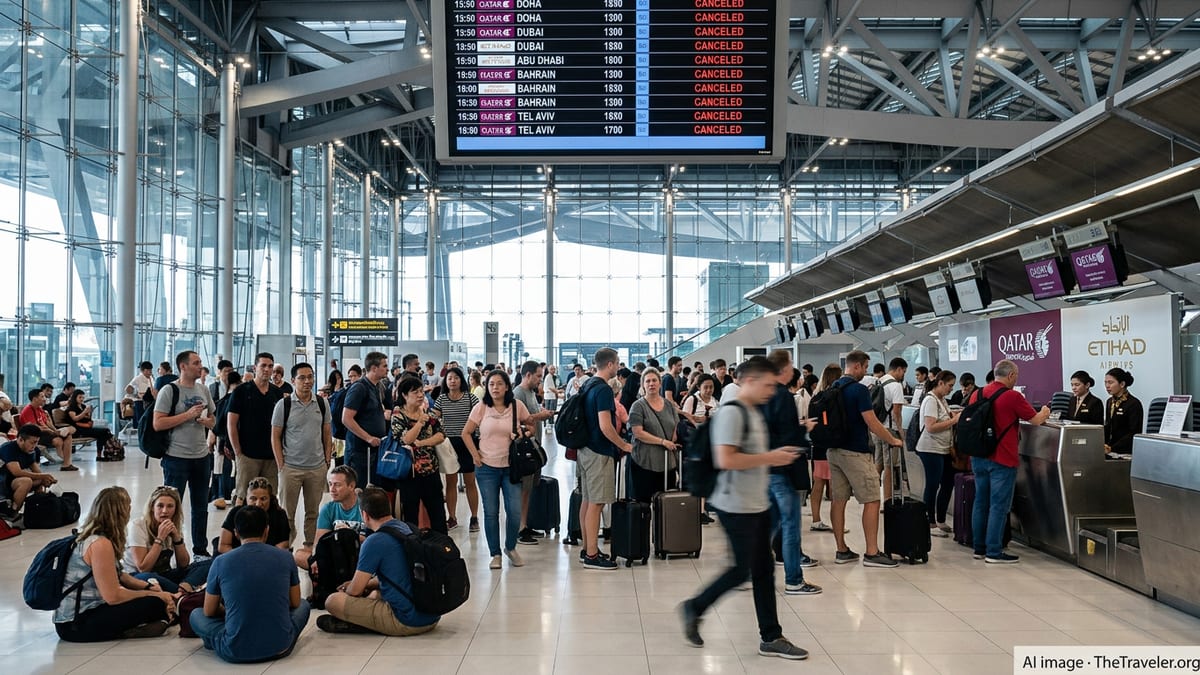
Wave of Cancellations Hits Thai Routes to Gulf Hubs
Airlines operating between Thailand and major Gulf hubs have confirmed a new round of cancellations, with more than 25 flights scrubbed over recent days. The affected services include nonstop links from Bangkok and Phuket to Doha, Abu Dhabi and Dubai, as well as codeshare and connecting itineraries onward to Tel Aviv and European cities that rely on these hubs for onward travel.
Qatar Airways has cut multiple Bangkok–Doha and Phuket–Doha rotations as it continues to operate under tight restrictions linked to ongoing airspace closures in parts of the Gulf region. Etihad is running a reduced schedule between Bangkok and Abu Dhabi, while Flydubai has pulled select services that normally connect Thai leisure travelers and European passengers transiting through Dubai to Thailand.
Regional carrier Bangkok Airways and Bahrain-based Gulf Air have also adjusted operations on routes feeding into Gulf and Levant destinations, adding to the sense of uncertainty for passengers trying to piece together multi-stop itineraries. While some flights continue to operate, capacity has been sharply reduced and schedules remain subject to last-minute changes.
The net effect is a patchwork of cancellations that has upended the normally dense web of connections between Thailand and Middle East hubs, leaving travelers with fewer options, higher fares on remaining services and longer, more circuitous routings via East Asia or Europe.
Middle East Airspace Restrictions Ripple Into Southeast Asia
The latest disruption stems from continued instability across parts of the Middle East, where security concerns have led to extended airspace closures and operational limits on key corridors. Airlines based in Qatar, the United Arab Emirates and Bahrain have been forced to re-route or temporarily suspend flights that would normally overfly affected regions, constraining their ability to maintain regular long-haul schedules.
For Thailand, which relies heavily on Gulf carriers to funnel tourists from Europe and the Americas and to connect Thai travelers to the Middle East and beyond, the impact is immediate. Flights between Bangkok or Phuket and Doha, Abu Dhabi and Dubai are not only point-to-point routes, but also critical links in global networks that serve Tel Aviv, major European capitals and secondary cities across the Mediterranean and North Africa.
Industry updates indicate that while some services are still operating on alternative routings, others have been cancelled outright where diversions would add too much time and cost or where destination airports remain under tight operational limits. This has particularly affected flights serving Tel Aviv and other high-risk destinations, which many carriers have either suspended or sharply reduced.
Travel management advisories circulated this week underscore that the situation remains fluid, with airline schedules being reviewed day by day in response to evolving security guidance and airspace availability. Passengers with itineraries touching Gulf hubs are being urged to monitor their bookings closely and be prepared for short-notice changes.
Stranded Passengers, Missed Connections and Rerouting Chaos
The knock-on effects for travelers in Thailand have been significant. Reports from Bangkok and Phuket highlight passengers stranded after last-minute cancellations of Qatar Airways and Etihad flights to Doha and Abu Dhabi, leaving them scrambling to secure alternative routes via other Asian hubs such as Singapore, Seoul or Hong Kong.
Many itineraries from Thailand to Europe and North America depend on single-ticket connections via Doha, Abu Dhabi or Dubai. When one leg is cancelled, the entire journey often collapses, triggering a complex rebooking effort as airlines attempt to find seats on already crowded alternative services. In several cases, travelers have found themselves rebooked days later or forced to purchase new tickets at high last-minute fares while they await refunds or travel credits.
Travel forums and social media posts describe repeated cancellations for the same passengers as airlines adjust schedules in real time. Some travelers who had already switched from one Gulf carrier to another after an earlier cancellation are now facing fresh disruption as the new airline also trims its operations. Others report long waits at airline counters and call centers as carriers prioritize customers with imminent departures.
For Thai tourism businesses, particularly hotels and tour operators catering to European and Middle Eastern visitors, the uncertainty is already feeding into cancellations of holiday packages and group tours. Industry representatives warn that if the disruptions persist, the crucial late high-season period for beach destinations such as Phuket, Krabi and Koh Samui could see a noticeable dip in arrivals.
What Affected Travelers in Thailand Should Do Now
Airlines involved in the cancellations have issued general guidance urging passengers to check the latest status of their flights before leaving for the airport and to ensure that contact details in their bookings are up to date. Many are offering fee-free date changes, rerouting where partners and seat availability allow, or full refunds for flights that fall within specified disruption windows.
Travel agents in Bangkok recommend that passengers with upcoming trips through Doha, Abu Dhabi or Dubai build in extra flexibility. That may mean accepting longer layovers, being open to rerouting via different hubs, or in some cases shifting travel dates by several days to secure a confirmed seat. Those with non-essential travel are being advised to consider postponing until schedules stabilize.
Passengers already in Thailand and trying to return to Europe or the Middle East are being encouraged to contact their airline or booking agent as early as possible, even if their flight is still technically scheduled, to explore backup options. In some instances, carriers have been able to move customers onto alternative routes via other alliance partners or to nearby regional hubs where operations are less constrained.
Travel insurers note that coverage varies widely by policy and by whether the disruption is classified as a security event, war-related exclusion or operational cancellation. Travelers are being urged to read the fine print of their policies and to document all communications with airlines and agents in case they need to lodge claims for additional accommodation, meals or replacement tickets.
Outlook for Thailand–Gulf Connectivity in the Coming Weeks
Aviation analysts caution that it may take several weeks before a more predictable pattern of flights between Thailand and Gulf hubs emerges. Even if airspace restrictions are gradually eased, airlines will likely restore capacity cautiously, prioritizing core trunk routes and repatriation needs before rebuilding full leisure and secondary-city networks.
For Qatar Airways, Etihad, Flydubai, Gulf Air and regional partners such as Bangkok Airways, the focus in the short term appears to be on maintaining a skeleton network that preserves essential connectivity while limiting exposure to further last-minute route changes. That means Thai travelers should brace for thinner schedules, fewer daily frequencies and the possibility that certain routes, especially to Tel Aviv and other high-risk destinations, remain suspended for longer.
Thai aviation officials and tourism authorities are monitoring the situation closely, aware that reliable Gulf connections are a key pillar of the country’s global accessibility. In parallel, other airlines in East and Southeast Asia are quietly assessing opportunities to add capacity on Europe–Thailand routes that bypass the Gulf entirely, offering alternative pathways for tourists and business travelers.
For now, the message from industry insiders is that patience and flexibility will be essential for anyone planning to travel between Thailand, the Middle East and Europe. With more than 25 flights already cancelled and schedules still in flux, travelers are being urged to stay informed, consider backup plans and avoid tight, same-day connections that rely on multiple at-risk hubs.