

More news on this day
Thousands of travelers across the Middle East and major global hubs are facing severe disruption today, as airspace restrictions and security concerns in Bahrain, the United Arab Emirates, Qatar, Oman, Kuwait and neighboring states have triggered a fresh wave of cancellations and delays affecting more than 350 flights.
Get the latest news straight to your inbox!
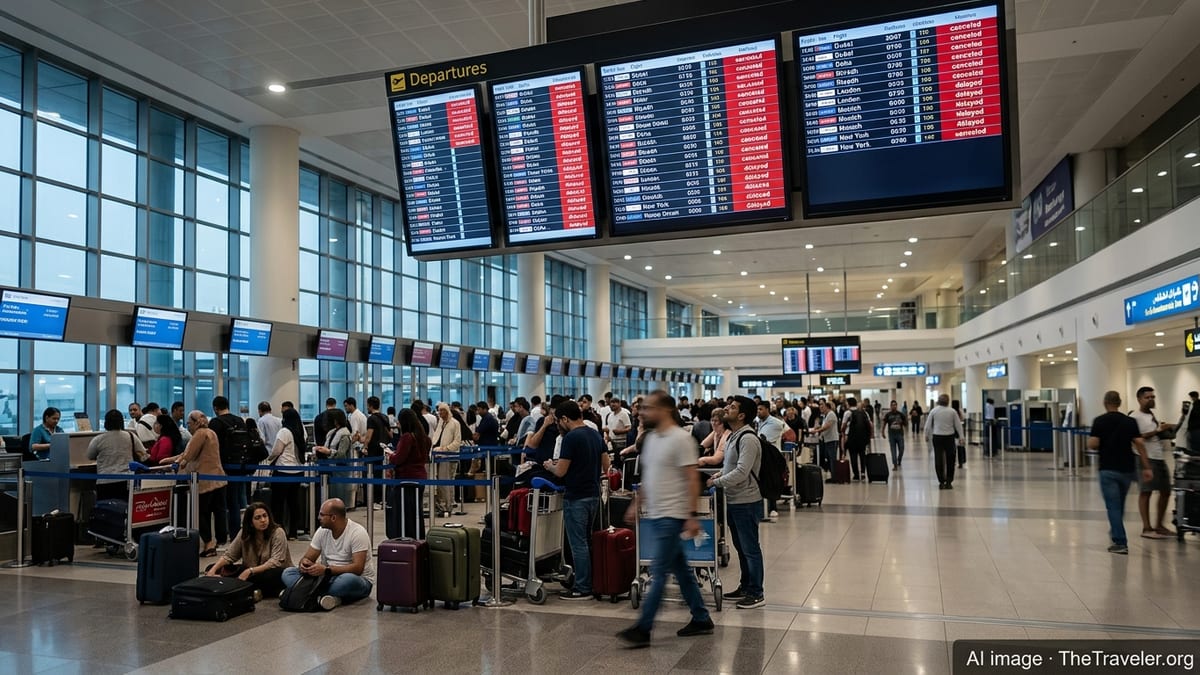
Regional Airspace Turmoil Ripples Across Global Networks
Publicly available information on March 23 indicates that much of the Gulf region remains heavily disrupted after weeks of missile and drone attacks linked to the wider 2026 Iran conflict, leading to sustained restrictions on civilian air traffic over Bahrain, the UAE, Qatar, Kuwait and Oman. Several Gulf airports, including Dubai and Abu Dhabi, have previously suspended or sharply curtailed operations, and airlines continue to adjust schedules as airspace closures shift and security assessments evolve.
Against this backdrop, industry tracking data and media coverage today point to at least 208 flights canceled and around 160 delayed on routes touching the affected Gulf states, compounding the impact of earlier multi-day shutdowns. While these figures represent only a fraction of the thousands of flights that have been scrubbed since late February, the renewed disruption underscores how fragile the regional aviation network remains.
The knock-on effects stretch far beyond the Middle East. European and North American hubs such as London, Munich and New York are recording additional cancellations, diversions and extended ground times as aircraft and crews are left out of position. For many passengers, this is the second or third time an itinerary has been altered, as airlines attempt to rebuild limited operations and then scale back again when security conditions deteriorate.
Travel and aviation analysts note that even partial airspace closures can force lengthy rerouting around the Gulf, adding hours to flight times and straining already tight schedules. The complex web of codeshares and connections centered on Gulf hubs has amplified the disruption, spreading delays across continents in ways that are still unfolding today.
Gulf Carriers Struggle to Restore Schedules
Flag carriers in the region remain at the heart of the turmoil. Gulf Air, Bahrain’s national airline, has been among the hardest hit due to the continued impact of Bahrain’s airspace restrictions, with reports earlier in March indicating that its regular passenger operations were effectively grounded for a prolonged period. Today’s cancellations add new strain for travelers who had rebooked via Bahrain after initial disruptions elsewhere in the Gulf.
Qatar Airways, which has been operating on an interim reduced schedule, has been gradually resuming selective routes from Doha, including limited services to London, Munich, New York and Riyadh. However, today’s data shows fresh cancellations and delays across parts of its long-haul network as Qatar’s airspace remains tightly managed and neighboring states adjust their own restrictions. Some flights are still operating via revised corridors, often adding time and complexity to journeys.
In the United Arab Emirates, Emirates continues to run a mix of curtailed and specially scheduled services after earlier periods when regular operations were largely suspended from Dubai. Recent days have seen more aircraft returning to the skies on key trunk routes, yet today’s wave of cancellations and delays highlights how quickly conditions can shift. Even a reduced schedule depends on stable overflight permissions and safe arrival and departure windows, which remain vulnerable to renewed security alerts.
Other regional carriers, including Oman Air and Kuwait Airways, are also contending with periodic suspensions and route changes. Public reports describe Oman Air canceling multiple routes earlier in March and Kuwait’s main airport experiencing significant constraints. Many of today’s disrupted services involve aircraft and crews still recovering from these earlier interruptions.
International Airlines Cut and Reroute Services
The turbulence in Gulf airspace has forced non‑regional airlines to redraw their route maps, with today bringing another round of schedule adjustments. European carriers such as KLM have continued to cancel or reroute flights to Dubai and other Gulf destinations on selected days, reflecting ongoing risk assessments and the challenge of navigating closed or restricted airspace corridors.
North American and Asian airlines have taken similar steps. Publicly available flight information and previous advisories show that major carriers including Air France, Lufthansa, British Airways, Delta, American Airlines, Singapore Airlines and others have reduced frequencies or temporarily suspended some services into the Gulf. Even when flights operate, they may be subject to diversions, extended routings and technical stops to avoid conflict zones.
Today’s tally of 208 cancellations and 160 delays is spread across both regional and international operators, with many flights touching key hubs such as Riyadh, Dubai, London, Munich and New York. Some aircraft are being repositioned through alternative gateways such as Riyadh or Muscat, while others remain on the ground awaiting more clarity on airspace status.
For passengers booked on multi‑segment itineraries involving Gulf connections, the practical effect is often a cascade of missed onward flights. With seat availability constrained by earlier waves of disruption, same‑day alternatives can be limited, leaving some travelers waiting days rather than hours for a viable rebooking option.
Passenger Strain at Major Hubs
Scenes at key airports across the region and beyond reflect the cumulative stress of weeks of disrupted operations. In Dubai, where normal traffic volumes routinely exceed a thousand flights a day, the combination of canceled services, sporadic resumptions and renewed groundings has created a stop‑start pattern that is difficult for travelers to navigate. Similar pressure is evident in Doha and other Gulf gateways, where reduced schedules are quickly overwhelmed when additional cancellations occur.
In Europe and North America, travelers connecting through the Gulf are finding themselves stranded far from their final destinations. London and Munich, both important links in the Gulf carriers’ global networks, have seen banks of departures to and from the Middle East disappear from departure boards, while New York–area airports are handling disrupted long‑haul traffic that previously relied on seamless transits through Dubai or Doha.
Travel forums and social media posts over recent days describe lengthy queues at transfer desks, limited hotel capacity for stranded passengers and uncertainty about when full schedules might resume. Many travelers have resorted to piecing together complex alternatives via secondary hubs, sometimes involving multiple airlines and overnight stays in cities such as Istanbul, Athens or Cairo.
With today’s additional wave of cancellations and delays, the number of people caught in this web of disruption is likely to grow further. Even travelers whose flights operate on time can face baggage issues and missed connections caused by upstream schedule changes elsewhere in the network.
What Travelers Can Expect in the Coming Days
Industry updates and security briefings suggest that aviation disruption across the Gulf is likely to remain significant in the short term. While some airlines have begun reinstating selected routes and frequencies, the broader regional environment remains volatile, and airspace closures or new restrictions can be introduced at short notice.
Travelers with bookings involving Bahrain, the UAE, Qatar, Oman or Kuwait in the coming days are being advised in public guidance to monitor airline apps and airport departure information closely, and to avoid traveling to the airport until a specific flight shows as operating. The pattern seen today, with hundreds of cancellations and delays, may continue intermittently as carriers test and then adjust limited schedules.
Observers also note that even once security conditions stabilize, it may take weeks for airlines to fully normalize their operations. Aircraft and crew rotations will need to be rebuilt, backlogs of displaced passengers cleared, and confidence restored among travelers who have faced repeated changes.
For now, the experience of passengers in Riyadh, Dubai, London, Munich and New York on March 23 illustrates how regional airspace decisions in the Gulf can rapidly cascade through the global aviation system, grounding aircraft and stranding thousands far from where the conflict itself is unfolding.