

More news on this day
Escalating conflict in and around Iran is rippling through global aviation, with major Gulf carriers sharply cutting or suspending services and thousands of Thailand-bound travelers now facing last-minute cancellations, chaotic rerouting and days-long delays.
Get the latest news straight to your inbox!
Explosive Regional Turmoil Spills Into the Skies
The latest phase of the 2026 Iran war has turned the Gulf’s usually seamless air hubs into choke points, disrupting one of the world’s busiest corridors between Europe, the Middle East and Southeast Asia. Missile and drone strikes on targets in the United Arab Emirates and Qatar, along with temporary airspace closures across multiple Gulf states, have forced airlines to ground or divert thousands of flights.
Publicly available data and advisories indicate that airspace restrictions in Iran, Iraq, Qatar, Bahrain and parts of the UAE have severely constrained the traditional west–east pathways used by long-haul carriers. Dubai, Abu Dhabi and Doha, normally the core transit points for passengers heading to Bangkok, Phuket and other Thai destinations, have all seen periods of partial shutdown or heavily reduced operations.
Industry analysis suggests that more than half of scheduled flights in the broader Middle East region have been canceled since the conflict escalated in late February, with several thousand flights a day affected. This has produced a cascading effect for travelers who never planned to set foot in the Gulf but were relying on one-stop connections between Europe or North America and Thailand via major Gulf hubs.
Travel-risk consultancies describe the disruption as the most significant shock to global aviation since the Covid-19 pandemic, with airline networks being redrawn in real time as conflict zones expand and regulators tighten safety restrictions.
Gulf Carriers Slash and Shuffle Thailand Services
Emirates, Qatar Airways and Etihad Airways, long marketed as reliable one-stop gateways to Southeast Asia, have all been forced to thin out their schedules to Thailand as the security situation has deteriorated. Publicly accessible airline notices and operational updates show waves of cancellations on routes linking Dubai, Abu Dhabi and Doha with Bangkok and Phuket over the first half of March.
Travelers report that some Emirates flights between Dubai and Bangkok operated only intermittently, while others were canceled at short notice when Dubai International Airport temporarily halted departures following drone and missile incidents. Etihad suspended most scheduled services to and from Abu Dhabi for several days, then restarted a limited roster that included Bangkok and Phuket, but stressed that all flights remained subject to last-minute operational approvals and airspace conditions.
Qatar Airways, heavily exposed to closures and restrictions around Doha, has issued repeated schedule revisions and operated only a reduced list of destinations for stretches of March. Community reports and airline advisories indicate that some Thailand services have been converted into irregular or consolidated operations, with passengers shifted between dates or downgraded from non-stop to multi-stop routings.
In many cases, Gulf carriers have attempted to move stranded Thailand-bound or Thailand-origin passengers onto partner airlines in Europe or Asia, routing them via Istanbul, Singapore, Kuala Lumpur or other still-operational hubs. However, capacity on those alternatives is limited, leaving many travelers facing multi-day waits or accepting complex itineraries with extended layovers.
Stranded Tourists, Skyrocketing Fares and Visa Worries
The human impact is most visible in Thailand, where Bangkok and Phuket serve as major gateways for European, Middle Eastern and Australasian visitors. Social media posts, travel forums and local media coverage are filled with accounts of tourists stuck in hotels with expired travel plans, unable to secure a confirmed seat home as Gulf connections evaporate.
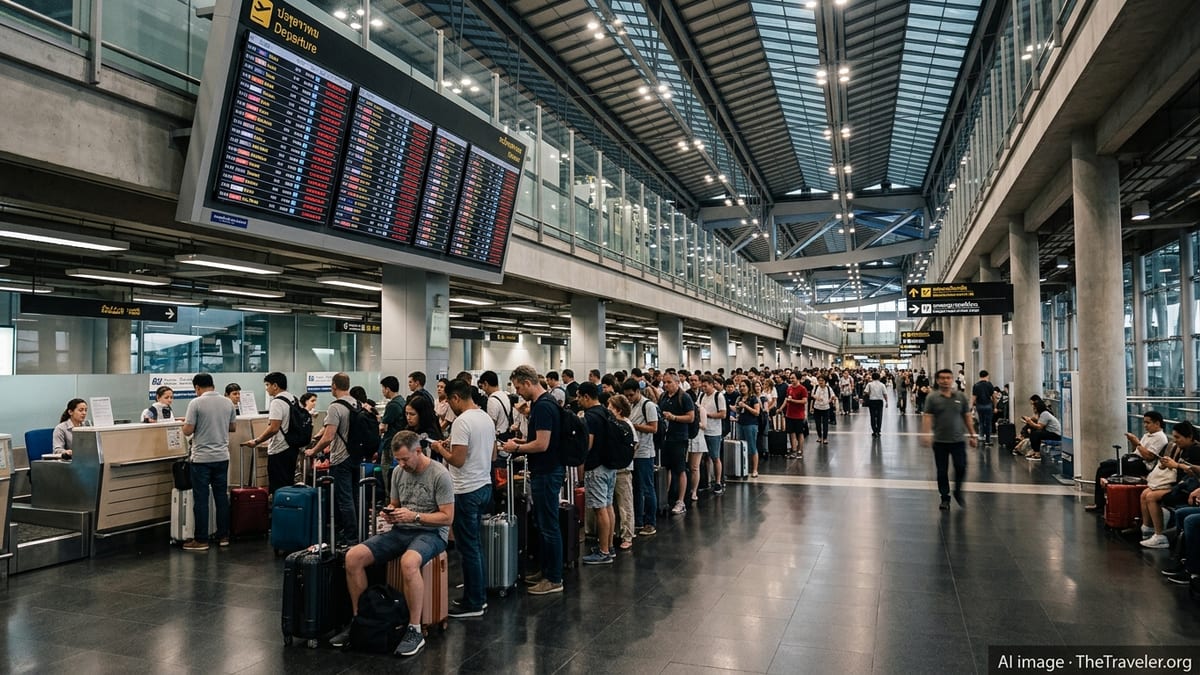
Reports from Bangkok describe passengers queuing at Gulf carrier ticket offices and airport counters for hours seeking rerouting or refunds. Some have been offered repatriation-style flights with unusual flight numbers or indirect routings, while others say they received only partial refunds or future travel credits when accepting cancellations. Travelers whose visas or permitted stays are approaching their limits are seeking advice from local immigration offices, with concerns about overstay penalties if flights are pushed back repeatedly.
At the same time, fares on remaining alternative routes have surged. With many airlines avoiding Gulf airspace entirely, capacity into and out of Thailand via East Asia and Europe has become tight. Published booking data and traveler anecdotes indicate that one-way economy tickets that would normally cost a modest premium are now being sold at several times their usual price on peak dates, particularly for those trying to replace a canceled Gulf connection at short notice.
Travelers with packaged itineraries face additional complications. Those who cancel proactively before an airline formally scraps a flight risk losing entitlement to full cash refunds or complimentary rerouting under many fare rules and agency contracts, leaving some stuck between waiting for a likely cancellation or paying heavily to secure a backup route.
What Travelers to and from Thailand Need to Know Now
For anyone with upcoming trips to Thailand routed through Dubai, Abu Dhabi or Doha, the situation remains fluid and often changes hour by hour. Airlines continue to adjust schedules as security assessments evolve, new advisories are issued and airspace corridors open or close. Even flights that appear confirmed in booking systems can be retimed, rerouted or withdrawn close to departure as operators respond to operational and safety constraints.
Travel advisories from risk-management firms and corporate travel providers are urging passengers to monitor their bookings closely, check flight status directly with operating airlines and avoid traveling to Gulf airports without confirmation that a specific flight is running. Some guidance also recommends building in additional flexibility, such as allowing longer connection times, being open to different routings and holding refundable or changeable backup tickets on non-Gulf carriers where financially feasible.
Travelers are also being reminded to review the conditions of carriage and fare rules on their tickets. In many cases, airlines are offering fee-free rebooking, vouchers or refunds only for journeys falling within specified travel windows or affected routing combinations. Passengers with later-dated trips to or from Thailand may find they are currently ineligible for waivers, even as they weigh whether to wait or rebook early.
Insurance considerations are critical. Many standard travel insurance policies treat war and armed conflict differently from ordinary disruptions, and coverage for cancellations, delays or extended hotel stays may be limited. Policy documents should be checked carefully to understand what assistance, if any, is available if Gulf transit points remain unstable.
How Long Could the Disruption Last?
The duration of the turmoil affecting Thailand-bound flights via the Gulf depends largely on the broader conflict trajectory in the Middle East. Analysts of the aviation and energy sectors note that the same missile and drone threats affecting airports and airspace are also hitting oil infrastructure and maritime routes, creating a combined shock that is unlikely to be resolved quickly without a broader de-escalation.
Even if missile activity subsides and airspace closures are gradually lifted, rebuilding full flight schedules is expected to take time. Airlines will need to reposition aircraft and crew, assess any damage to airport facilities and re-establish reliable corridors that comply with safety and insurance requirements. Carriers may prioritize key trunk routes first, with some secondary Thailand frequencies returning more slowly.
In the meantime, Saudi airspace and a handful of other corridors are acting as pressure valves for long-haul travel between Europe, Africa and Asia, but these alternatives are already heavily congested. Network planners may continue to favor routes that bypass the Gulf entirely, at least in the short to medium term, which could reshape how many travelers reach Thailand for months to come.
For would-be visitors and residents planning trips in the coming weeks, the most consistent advice from publicly available guidance is to remain flexible, stay informed and be prepared for late changes. The Gulf’s role as a convenient super-connector for Thailand and the wider region has been abruptly tested, and the path back to normality remains uncertain.