

More news on this day
Major Gulf and European airlines are operating skeleton schedules in and around the United Arab Emirates this week, as a fast-moving regional conflict shutters airspace, snarls hubs in Dubai and Abu Dhabi, and leaves Saudi, British and Russian tourists scrambling for scarce seats while VIPs quietly exit on privately chartered aircraft arranged by gaming and crypto platform 1win.
Flagship Carriers Slash Routes as UAE Hubs Struggle
Emirates and Etihad, the UAE’s dominant long haul operators, have cut back to reduced networks after days of full shutdown triggered by missile strikes and airspace closures over the Gulf. Both carriers have resumed only limited schedules from Dubai International and Abu Dhabi’s Zayed International Airport, with operations reportedly at a fraction of normal capacity and priority given to stranded passengers already holding tickets.
Industry data providers and regional media report that Dubai International is running well below normal throughput, even as outbound “rescue” flights ramp up. Emirates has publicly warned customers not to travel to the airport unless they have a confirmed rebooked itinerary, underscoring the extent of the bottlenecks at check in, security and immigration.
Etihad is following a similar playbook in Abu Dhabi, advising would be travelers that it will contact them directly when seats become available on curtailed routes. Analysts say the simultaneous disruption at both UAE hubs has effectively severed one of the world’s busiest East West corridors, pushing connecting traffic onto alternative routes through Europe and Asia or halting trips altogether.
Qatar Airways, usually a key rival to Emirates and Etihad for long haul transit passengers, has also been forced to drastically scale back operations. With Qatari and neighboring airspace affected by the conflict, the Doha based carrier has focused on a handful of repatriation and relief flights routed via Saudi Arabia and Oman, while its main hub remains subject to tight restrictions.
British Airways Cuts Gulf Operations as European Carriers Retreat
The turbulence is not confined to Gulf based airlines. British Airways has suspended or sharply reduced services to several destinations in the region, including Dubai and Abu Dhabi, as UK and European regulators tighten risk assessments for flights over or near conflict zones. The airline has introduced temporary flexible rebooking options for passengers due to fly between London Heathrow and hubs such as Dubai, Doha and Tel Aviv.
Schedule data reviewed by aviation analysts shows British Airways trimming frequencies, consolidating departures and, in some cases, funneling Gulf bound travelers onto partner or wet leased aircraft that can operate on safer, more circuitous routings. Yet the reduced capacity has left thousands of UK holidaymakers and business travelers either stranded in the Emirates and neighboring states or marooned mid journey in Europe and Asia.
Other European and North American carriers, including Lufthansa, Air France and major US airlines, have either paused Middle East services entirely or are operating only a handful of special flights. Combined with route cuts at Emirates, Etihad and Qatar Airways, the moves have triggered what one travel risk consultancy described as an unprecedented squeeze on long haul lift in and out of the Gulf.
For destination markets that rely heavily on Gulf connections, such as Southeast Asia and East Africa, the retrenchment has immediate knock on effects. Tourists from Britain, Saudi Arabia and Russia who would normally transit via Dubai or Abu Dhabi to beach resorts and safari lodges are now contending with blown itineraries, mounting costs and uncertain timelines for any return to normal flying.
Saudi, UK and Russian Tourists Face Airport Gridlock and Hotel Chaos
The greatest pain is being felt by ordinary leisure travelers, many of them Saudi, British and Russian nationals who flocked to Dubai and Abu Dhabi for winter sun, shopping and sporting events in the weeks before the escalation. With airspace closures taking hold, tens of thousands found themselves caught in a cascading series of cancellations as airlines pulled routes and consolidated operations.
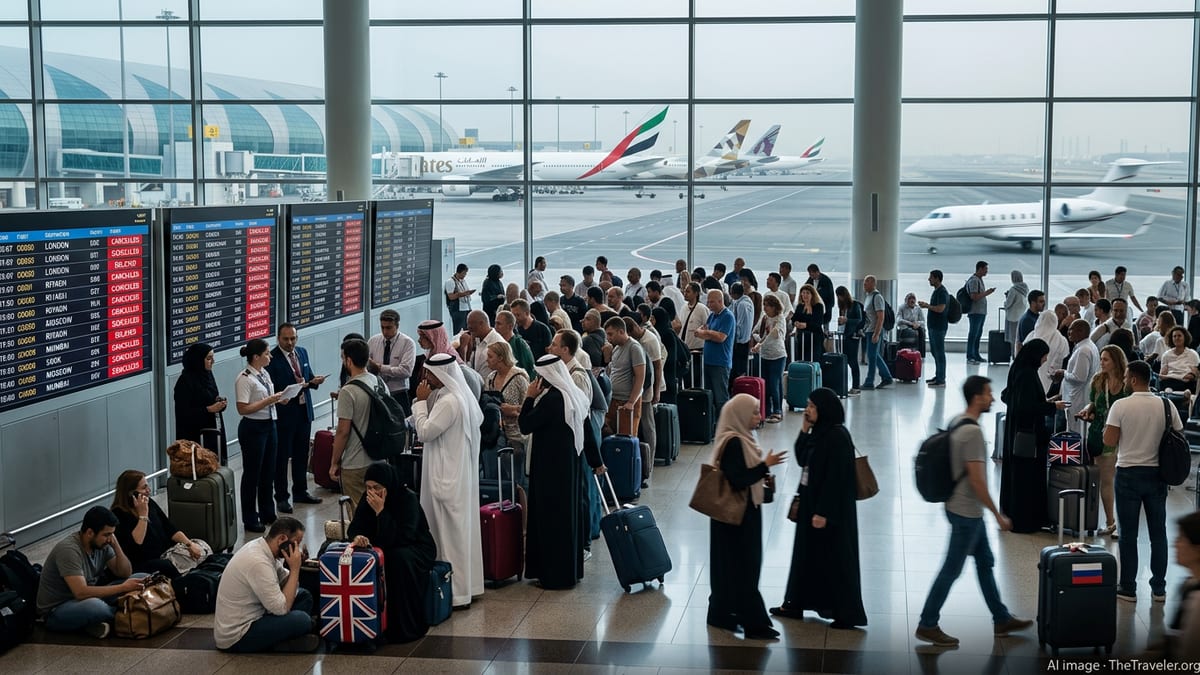
Travelers describe scenes of overcrowded terminals, snaking queues for rebooking desks and inconsistent information from overstretched airline staff. At Dubai International in particular, capacity constraints and intermittent security alerts have produced rolling delays that ripple across the day, with some passengers sleeping on terminal floors as they wait for a seat on the next available departure.
Hotel capacity in and around the main UAE cities has also come under intense strain. Some tourists report that their original stays, often booked at premium waterfront properties, have been repeatedly extended while they wait for confirmation of new flights, only to find that rooms are suddenly unavailable as group bookings for airline crews and government delegations take priority.
Saudi tourists attempting to drive or bus across borders to alternative gateways in Oman or within Saudi Arabia have encountered fresh bottlenecks at checkpoints and land crossings. Russian visitors, meanwhile, face the additional challenge of rapidly changing sanctions related restrictions on direct services between Russia and key Gulf airports, forcing them to rely on a patchwork of third country connections that may themselves be vulnerable to short notice suspension.
1win’s Private Charters Quietly Lift Out VIPs
Amid the wider turmoil, one corner of the market is booming. Global gaming and crypto platform 1win has confirmed that it has mounted an exclusive evacuation program for high spending customers stuck in the Emirates, chartering private jets to whisk VIPs out of Dubai and Abu Dhabi to safer hubs in Europe and Central Asia. The company has framed the flights as a loyalty benefit for elite tier clients whose commercial itineraries were wiped out by the crisis.
Aviation industry sources say demand for private charters out of the UAE has surged since the first missile strikes and drone incursions were reported near major airports, with hourly rates for long range business jets climbing steeply. 1win’s move taps directly into that trend, aggregating VIP demand into multi leg charter rotations that can be flexibly retimed and rerouted around sudden airspace closures.
While exact routings are being kept confidential for security reasons, brokers indicate that popular exit points include secondary airports in Saudi Arabia, as well as destinations in Turkey and the Caucasus, from which onward commercial or private links into Europe and Russia remain more readily available. Where possible, aircraft are being staged through less congested UAE facilities, such as Fujairah, to avoid gridlocked Dubai.
The optics of such bespoke evacuations are sensitive at a moment when tens of thousands of ordinary tourists remain stranded, but they underscore the growing role of nontraditional travel and financial companies in crisis logistics. With traditional airlines constrained by fleet, crew and regulatory limits, platforms like 1win have been quick to use cash reserves and flexible charter contracts to secure exit options that many state actors and travel agencies have struggled to match.
Charter Demand Redraws the Gulf’s Travel Map
The scramble for lift out of the Emirates and neighboring states is already reshaping regional travel patterns. Charter specialists report that airports in Oman and Saudi Arabia have taken on a new prominence as ad hoc hubs, with waves of narrowbody jets and business aircraft ferrying passengers away from the Gulf’s most affected cities before they transfer to long haul services on less exposed routings.
In the short term, this pivot adds cost and complexity for travelers and airlines alike, but it may also accelerate a broader diversification of transit options away from an almost exclusive reliance on Dubai and Doha super hubs. Governments in Muscat and Riyadh are seizing the opportunity to showcase their infrastructure and operational resilience, courting additional charter business and dangling incentives for airlines willing to establish temporary bases.
For now, however, the experience of stranded Saudi, British and Russian tourists in the UAE remains defined by uncertainty. As Emirates, Etihad, Qatar Airways and British Airways cautiously rebuild schedules from a heavily reduced base, and as private operators like 1win quietly shuttle VIPs to safety, the majority of visitors must navigate a patchwork of partial solutions, escalating prices and fast changing advisories, waiting for a clearer picture of when the Gulf’s crucial air bridges will fully reopen.