

More news on this day
Hundreds of thousands of travellers have been stranded across the Gulf as unprecedented airspace closures force Emirates, Etihad Airways, Qatar Airways and flydubai to cancel or delay nearly a thousand flights, grinding operations to a halt at key hubs in the United Arab Emirates, Saudi Arabia, Qatar and beyond.
Regional Airspace Shutdown Ripples Across Gulf Hubs
As of March 2, 2026, aviation authorities across the Middle East have kept large swathes of regional airspace closed in response to escalating conflict involving the United States, Israel and Iran, triggering one of the worst disruptions to global air travel since the Covid pandemic. The closures have effectively frozen east–west corridors that normally funnel millions of passengers each week through the Gulf’s mega-hubs.
Dubai International, Abu Dhabi’s Zayed International and Doha’s Hamad International are among the hardest hit, with scheduled operations largely suspended and terminals filled with stranded passengers waiting for updates that so far have come in cautious, incremental statements from carriers and regulators. Airports in Sharjah, Ras Al Khaimah and Riyadh are also reporting widespread disruption, as airlines cancel or divert services rather than route aircraft through contested airspace.
Operational data from regional aviation authorities and flight tracking platforms indicate that Emirates, Etihad Airways, Qatar Airways and flydubai together have cancelled at least 937 flights and delayed around 40 more across the network since the first wave of closures over the weekend. Industry analysts warn the tally is likely to rise if airspace restrictions remain in force through the coming days.
Emirates, Etihad, Qatar Airways and flydubai Forced to Ground Fleets
Dubai-based Emirates, the world’s largest long-haul airline, has temporarily suspended all flights to and from Dubai until at least 15:00 UAE time on Monday, March 2. The carrier has offered affected passengers the option to rebook within a limited window or request refunds, while stressing that safety remains its top priority as it coordinates with authorities and monitors the evolving security situation.
In Abu Dhabi, Etihad Airways has halted departures and arrivals at Zayed International Airport through early Monday, with the airline warning of rolling disruption as schedules are rebuilt around any partial reopening of regional airspace. Etihad has told customers holding tickets for travel through March 3 that they may change their dates without penalties or seek refunds, but it has urged travellers not to go to the airport until their flight status is confirmed.
Qatar Airways has also been forced to keep its aircraft grounded after Qatari airspace was closed, leaving Hamad International in Doha operating at a fraction of its normal capacity. The airline has said it will only resume regular services once the Qatar Civil Aviation Authority confirms conditions are safe, and has promised further guidance as authorities reassess restrictions.
Low-cost carrier flydubai has mirrored Emirates by suspending all flights to and from Dubai until at least mid-afternoon on March 2. Other regional operators, including Air Arabia and several Saudi and Indian airlines, have enacted similar measures, compounding the shock to a network that relies heavily on rapid aircraft turnarounds and tight connection windows to sustain global schedules.
Passengers Stranded in Dubai, Abu Dhabi, Doha, Riyadh and Beyond
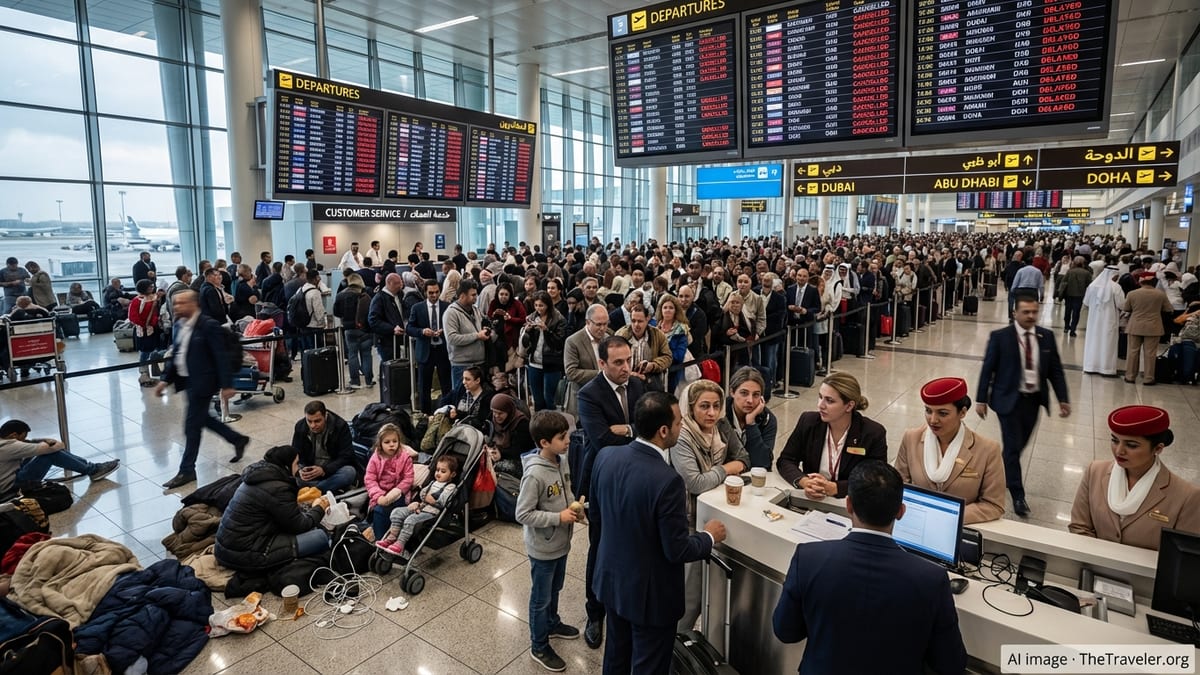
The sudden shutdown has left terminals crowded not only in the Gulf but also at major connecting airports worldwide, from Europe and Africa to South and Southeast Asia. At Dubai International and Abu Dhabi’s Zayed International, long lines have formed at airline service desks as travellers seek hotel vouchers, meal coupons and rebooking options after seeing departure boards turn red with cancellations.
In Doha, Qatar Airways transfer passengers have found themselves stuck in transit zones as onward flights vanish from schedules, with some unable to enter Qatar due to visa restrictions. Similar scenes are unfolding in Riyadh, where King Khalid International remains technically open but is suffering knock-on disruption as foreign carriers suspend or reroute services to avoid the region’s congested and restricted skies.
Travellers report spending nights on terminal floors or in hastily arranged airport hotels while awaiting news, as airlines juggle aircraft positioning, crew duty limits and shifting airspace notices. Governments including the United Kingdom, India and several European Union states are assessing potential evacuation or repatriation options for citizens unable to depart the region, although officials caution that any large-scale operation would depend on the gradual reopening of at least limited corridors.
For the moment, passengers are being advised by carriers and travel agents not to cancel itineraries themselves, which could weaken claims to compensation or free rebooking, but instead to wait for official cancellation notices and follow airline instructions. Travel insurance providers have begun warning that many policies exclude disruptions caused by war or similar hostilities, leaving some travellers reliant on airline goodwill and government assistance.
Economic Shock for Global Aviation and Gulf Economies
The grounding of hundreds of flights across the United Arab Emirates, Qatar, Saudi Arabia and neighbouring states is reverberating through the broader aviation sector. Airline stocks in Europe, the Gulf and Asia have come under pressure as investors price in higher fuel costs, longer routings and the prospect of prolonged schedule reductions if the conflict continues to affect regional skies.
Cargo flows are also being hit. The Gulf functions as a vital bridge for Asia–Europe and Asia–Africa freight, with Emirates, Qatar Airways and other carriers operating extensive dedicated freighter fleets as well as carrying bellyhold cargo on passenger aircraft. With many of these aircraft now idle, logistics providers are scrambling to secure alternative capacity or reroute shipments via longer, more expensive northern or southern corridors.
Tourism and hospitality operators in hub cities such as Dubai, Abu Dhabi and Doha face a dual shock. On one hand, the loss of transit traffic threatens hotel occupancy, retail spending and airport concession revenue. On the other, authorities in the UAE and Qatar have announced emergency measures to house and feed stranded passengers, with some governments pledging to cover accommodation and meal costs for those unable to leave until airspace is deemed safe.
Economists note that if the closures extend beyond a few days, the disruption could ripple into business travel, trade delegations and major events scheduled in the Gulf, further complicating recovery plans for a region that has invested heavily in positioning itself as an indispensable global aviation crossroads.
Uncertain Timelines and Cautious Hopes for Gradual Reopening
Aviation regulators across the Gulf and wider Middle East are expected to review airspace safety in rolling 24 to 48 hour cycles, but none have yet provided a firm timeline for full restoration of normal traffic. Notices to air missions remain active over multiple countries, and airlines are preparing contingency schedules built around partial, phased reopenings rather than a sudden return to business as usual.
Industry experts say that even if some corridors reopen this week, untangling the backlog of cancelled and delayed flights will take days, if not longer. Aircraft and crews are out of position, maintenance windows have been disrupted and many airports will need to impose temporary caps on movements to manage congestion as services resume.
For Emirates, Etihad Airways, Qatar Airways and flydubai, the disruption represents a critical operational and reputational test in markets where passengers have come to expect seamless long-haul connectivity through Gulf hubs. How quickly they can restore trust will depend not only on the pace of political de-escalation, but also on the clarity of communication and the practical support they provide to the hundreds of thousands of travellers still waiting for a way home.