

More news on this day
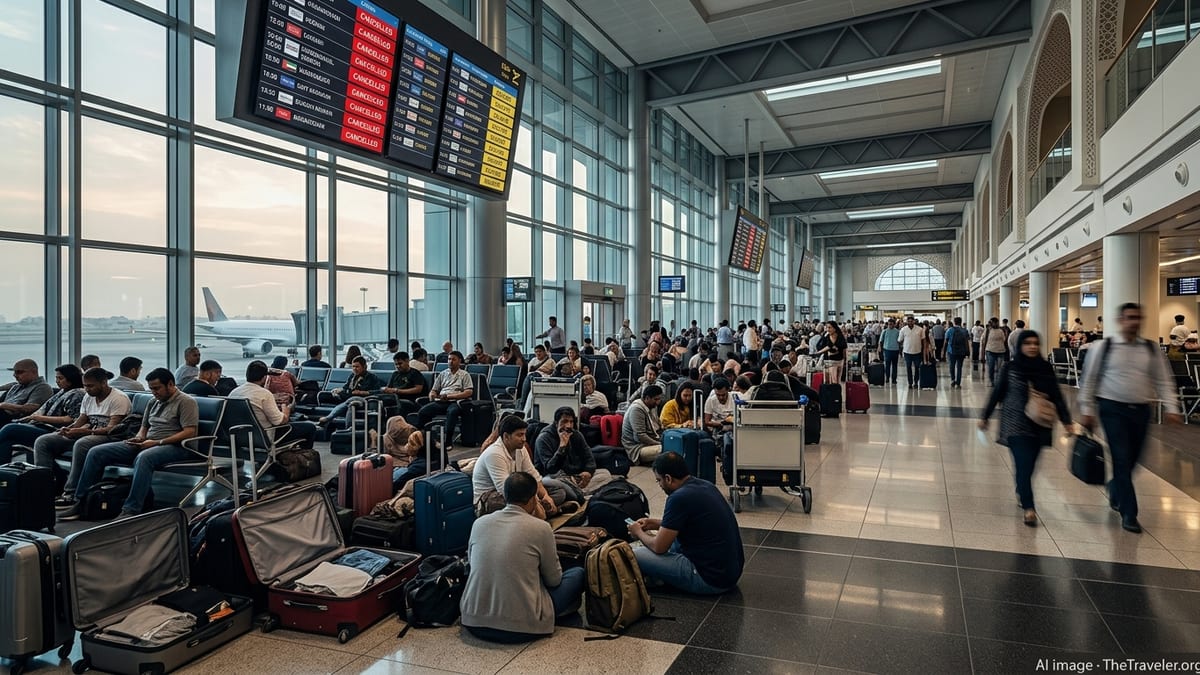
Hundreds of passengers were left stranded across the Gulf as a fresh wave of disruption hit Bahrain International, Hamad International, Dubai International, and King Khalid International airports, with at least 166 flights reportedly cancelled and 103 delayed, snarling connections across Bahrain, Qatar, the United Arab Emirates, and Saudi Arabia.
Get the latest news straight to your inbox!
Gulf Transit Hubs Grapple With New Wave of Disruption
Published coverage and live flight-tracking data from the weekend indicate that the latest disruptions have concentrated on four of the region’s most important transit hubs: Bahrain International Airport, Hamad International Airport in Doha, Dubai International Airport, and King Khalid International Airport in Riyadh. Together, these airports form a critical bridge between Europe, Asia, and Africa, meaning any operational shock quickly ripples through global networks.
Reports from regional newspapers and aviation analytics platforms describe a sharp spike in cancellations and delays as airlines adjusted schedules in response to continuing airspace constraints and heightened security conditions. The tally of at least 166 cancelled flights and 103 delayed services across the four hubs reflects only the movements directly affected at these airports and does not capture the knock-on impacts on feeder and onward connections worldwide.
Travelers transiting through the Gulf reported missed long-haul connections, extended waits in crowded terminals, and rebookings stretching several days ahead as carriers restructured their operations. Publicly available information from airline and airport status pages suggests that many routes were either consolidated onto fewer frequencies or rerouted along longer paths to avoid sensitive airspace, further complicating scheduling.
While some flights continued to operate on modified routings and extended flight times, the disruption level was sufficient to leave large numbers of passengers stuck between stages of their journeys, particularly those relying on tightly timed transfers.
Airspace Restrictions And Security Concerns Behind Cancellations
The current wave of disruption follows weeks of instability in regional airspace, with published reporting pointing to periodic closures or restrictions over parts of the Gulf and surrounding states in response to heightened geopolitical tensions. These measures have forced airlines to abandon standard high-traffic corridors and in some cases to halt operations entirely for limited periods.
According to publicly accessible aviation data, large volumes of traffic that would ordinarily overfly Bahrain, Qatar, or the United Arab Emirates have been rerouted to skirt closed or restricted zones, placing extra pressure on alternative corridors over Saudi Arabia and Oman. This reconfiguration reduces available capacity and complicates crew and aircraft rotations, increasing the risk of delays and short-notice cancellations at hub airports.
In addition, recent localised security incidents near major airports have added to the operational strain. Coverage of events around Dubai International, for example, has described temporary suspensions and sharply reduced schedules on certain days, with some carriers cancelling services in advance while others attempted limited operations as conditions allowed.
These overlapping factors have combined to produce a fragile operating environment in which even a single further alert, temporary closure, or missed crew rotation can cascade into widespread timetable changes across multiple airports in the region.
Stranded Passengers Face Long Queues, Rebookings, And Visa Concerns
Accounts shared in public forums and social platforms over recent days portray a difficult situation for travelers caught in the middle of the latest disruptions. Passengers connecting through Bahrain International and Hamad International reported multiple successive cancellations on the same itinerary, with some eventually abandoning Gulf routings altogether in favor of overland links to alternative airports in neighboring countries.
In Dubai, one of the world’s busiest international hubs, travelers described lengthy queues at transfer desks, overnight stays in transit areas, and uncertainty over when replacement flights would become available. Some passengers noted being rebooked several days later than their original travel date, while others said they had received short-notice notifications that newly assigned flights were also cancelled or subject to significant delay.
Visa rules emerged as an additional concern for stranded travelers, particularly visitors on short-term entry permits in Bahrain and the United Arab Emirates. Public posts advise affected passengers to verify options for visit-visa extensions or grace periods and, where necessary, to seek guidance from consular services to avoid overstays triggered by flight cancellations beyond their control.
Despite the difficulties, publicly available information from airlines indicates that most carriers are offering fee-free rebooking in the case of cancellations, and in some cases refunds or alternative routings where space permits. However, constrained capacity across the Gulf hub network means that immediate solutions are not always available, especially on high-demand long-haul sectors.
Operational Recovery Likely To Be Gradual, Not Immediate
Industry experience and recent Gulf disruptions suggest that even once airspace conditions improve and formal restrictions are eased, it can take several days for operations at major hubs to normalize. Aviation data shared in recent regional reports highlights how previous shutdowns at Gulf gateways produced multi-day backlogs as airlines repositioned aircraft and crew and worked through waves of stranded passengers.
For the current episode, publicly accessible airline advisories indicate a cautious approach to ramping services back up. Some carriers have signaled reduced or adjusted schedules over the coming days, while airport information dashboards still show elevated levels of disruption compared with typical operations for this time of year.
Analysts note that the highly interconnected nature of Gulf hub networks adds complexity to any recovery. A delayed or cancelled departure from Dubai or Doha can destabilize onward schedules for aircraft and crew that would otherwise feed Bahrain, Riyadh, or other regional airports later in the day. Recovery therefore tends to be progressive, with airlines prioritizing long-haul trunk routes and gradually restoring secondary frequencies as resources allow.
Travelers with upcoming itineraries through Bahrain International, Hamad International, Dubai International, or King Khalid International are being advised, through airline and airport communication channels, to monitor flight status closely, avoid heading to the airport without a confirmed departure, and expect longer-than-usual queues at check-in and transfer counters while operations remain constrained.
What Travelers Should Watch In The Coming Days
With conditions still evolving, publicly available guidance places particular emphasis on real-time information. Travelers are encouraged to rely on official airline flight-status tools and airport information pages for the latest departure and arrival data, since third-party trackers and static timetables may not reflect rapid last-minute changes.
Experts quoted in regional coverage recommend that passengers holding non-essential or flexible travel plans consider postponing or rerouting journeys that depend on tight Gulf connections, at least until cancellation and delay rates trend back toward normal levels. Those who must travel are urged to build in long layovers, keep accommodation options flexible, and ensure that travel insurance covers disruption arising from airspace closures and security-related suspensions.
As airlines and airports across Bahrain, Qatar, the United Arab Emirates, and Saudi Arabia work to stabilize operations, the impact of the 166 cancelled and 103 delayed flights underlines how quickly events in a single region can reverberate across global aviation. For now, passengers and industry observers alike will be watching closely to see how swiftly the Gulf’s critical hub network can absorb the shock and restore its usual high-intensity flow of international traffic.